Category: [WEBINAR]

  • [WEBINAR] How to Optimize Online Engagement for Government Agencies

    [WEBINAR] How to Optimize Online Engagement for Government Agencies

    Watch Webinar Recording

    About the Webinar

    Government agencies frequently ask how they can get the best results from online community engagement. This webinar presents a visual tour of the strategies that agencies of all sizes can use to achieve unprecedented levels of participation, informed public input and actionable results. Whether you are interested in trying online engagement for the first time or are already a power user, this session is the fastest way to get up-to-date and learn about how you can optimize your online public engagement.

    Learn the best practices to help you create the most effective online engagement experience, promote your site for maximum participation and analyze and showcase your results to give decision makers the confidence they need. You’ll learn from award-winning case studies and see simple techniques that you can use to optimize your online engagement to achieve the best results for your agency.

    Additional Resources for Attendees

    As described in my presentation, you can download your complimentary Beginner’s Guide to Effective Online Engagement. I hope you find it useful.

    Presentation Slides

    My slides from the presentation are available here.

    Questions and Responses

    There were so many questions that came in that this post would scroll on and on if I responded to each one separately. It would also get repetitive since there were common themes among them. What I’ve done below is pull out one question from each of the common themes and wrote a response. I hope this covers most of what’s on your mind. Naturally I would encourage you to reach out to me or one of our engagement specialists if there are still unanswered questions on your mind.

    How does MetroQuest account for those who might not have computer access or speak another language?

    MetroQuest offers multilanguage support. Once a site is created in English, since there are not a great deal of words on each screen, it’s easy to have these translated into any language of your choice. We do not recommend using automatic translators as these often get the meaning wrong and compromise the integrity of the input. Once created, participants can simply toggle to the language of their choice on the opening screen. We find that it’s important to engage the leaders of the community groups to help to promote participation among these other non-English speaking people as they are often better connected and a more trusted source.

    For people without computer access, using kiosks for iPads at community centers or local events can be very helpful to gather the input of difficult to reach populations. If you can set up a table with a staff person on hand during popular events this will allow people to get assistance if they need.

    With this said, there will always be people who will not want to use a device of any kind so sometimes a paper-based option can be useful as well. It’s really all about providing many easy options for people to participate in the way they feel is most convenient or comfortable.

    Do people need to log-in/register to use MetroQuest?

    This question was addressed at the end of the webinar at 41:35. In short, no, the MetroQuest software is optimized to engage as many people as possible – going well beyond the “usual suspects.” For that reason, it’s designed to avoid any possible barriers to participation like requiring people to sign-up before they participate. Such a barrier typically reduces participation by approximately 90%. MetroQuest still allows you to collect demographic information on participants as well as email address and other information as a part of your survey if you wish.

    Can the look of the platform be changed or adjusted to our needs?

    Yes there are many ways that the look of your MetroQuest sites can be modified to suit your project. First there are many screen types which act as templates. You are free to use whichever ones best meet your needs for the project in question. Next the look and functionality of each screen can be adjusted in a variety of ways to match the branding of your agency or project and the specific public input needs of your project. There are naturally limitations in place that are mostly to ensure that everything works well on all platforms and smartphones and to adhere to the best practices we’ve learned over the years.

    Do you have these surveys available at actual public meetings or do you send people to a website after the meeting to provide feedback?

    Yes, often our clients bring devices like iPads or laptops to public meetings to provide options for people to participate on the spot if they wish. Since these are some of your most engaged participants it’s a good idea to make sure they go home with the link and possibly even a handful of post cards with the project info and url on it to share with their friends or community group.

    MetroQuest seems like a great engagement tool with large participation numbers, and we’ve been thinking about using it for upcoming projects. However, you never discuss HOW citizens learn about the survey in the first place. We have a limited online following, and while a survey like MetroQuest’s would be great, I’m curious what you all do, or what your clients have done, to promote the survey.

    This is a great question and one that I did not have time to cover in the webinar. Thankfully there is an entire section in the Beginner’s Guide on this very topic. I hope you find it useful. In short, there are a wide range of promotional strategies that our clients have found to be useful. Any kind of digital outreach is always useful since recipients can simply click a link to begin. Email and social networking tools are top of the list. Facebook ads provide a cost-effective way to target specific areas and demographic groups. Once the ball gets rolling, a fun and user-friendly tool such as MetroQuest should be shared by participants and away you go.

    How would you avoid one person submitting multiple surveys? Is this managed by IP address

    I addressed this at the end of the webinar but only partially. I mentioned that there are safeguards in place to avoid people being able to abuse the system by “ballot stuffing” but I did not discuss how we do it. Part of the reason is that we do not publicly share all of these details to protect the integrity of the safeguards. I can say that part of the safeguard system involves IP address tracking but it’s more sophisticated than that because there are situations where a single IP address could legitimately be used by many people. For example, a single library computer or kiosk could collect input from hundreds of people so caution must be taken to only filter out real abusers. A multilayer system is needed with IP address being only one of those layers. As I said, this kind of abuse is extremely rare but it’s comforting to know that these safeguards are available.

    Can you talk more about your success with kiosks?

    Success with kiosks is hit and miss and depends largely on the location where they are placed. Our clients have had the most success in busy area where people find themselves with time on their hands such as libraries and community centers. If you are waiting for your child to come out of the locker room, a nice-looking kiosk can be appealing. When you are waiting for your bus or train, you might have time but you will be unlikely to stop because you are preoccupied with getting to your destination. In a great location, we’ve seen participation numbers in the hundreds per day. We’ve also seen much lower numbers so it might be useful to speak with one of our engagement specialists about your situation and needs to see if kiosks are likely to be a good return on investment.

    Hi Dave – I enjoyed the webinar and wanted to thank you for this and the resource. What I find often times is that we continue to see examples where tools are developed or designed mainly for community/municipal engagement. We are seeking examples of engaging broad audiences/perspectives on policy and strategy topics. I’m not seeing how this tool would do that for us. Our engagement does need to delve into exploring what exists, brainstorming opps/challenges and seeking advice on solutions. Any examples?

    I did focus the examples on community and municipal engagement projects since the audience was largely local government representatives. MetroQuest has been used for all kinds of strategy and policy projects (climate action, health care, etc) that I did not show. If you have a particular type of project you have in mind I would encourage you to reach out to one of our engagement team as they will likely have ideas and examples that would resonate better than the local government ones I showed.

  • [WEBINAR] A Recipe for Award-Winning Online Community Engagement Featuring VIA

    [WEBINAR] A Recipe for Award-Winning Online Community Engagement Featuring VIA

    This highly visual webinar presents research findings, proven best practices, practical tips and award-winning case studies to guide agencies towards the successful application of online community engagement for planning projects. Participants walk away with an understanding about how to leverage digital engagement to achieve unprecedented results using cost-effective tools.

    This webinar showcases a wide range of outstanding planning projects throughout Texas, New Mexico and Arizona. Our special guests from VIA Metropolitan Transit join us to talk about the VIA Vision 2040 Long Range Plan, one of the most innovative and successful outreach efforts we’ve ever seen. They discuss the innovative ways they combined online and targeted face to face community engagement to involve over 3,000 community members to help inform the transit plan for the San Antonio region. They also share advice for agencies seeking to improve the diversity and effectiveness of their community engagement efforts and talk about the positive difference that broad community support is making as they move forward.

    Watch Recording

    View Slides

    This webinar featured three presenters: Dave Biggs from MetroQuest followed by Hannah Santiago from VIA Metropolitan Transit and Chester Britt from Arellano Associates.

    Comments from participants

    “Great presentation and very inspiring!”

    Additional Reading

    As described in the webinar, this user guide expands on several of the best practice recommendations. Since it was originally written for MetroQuest users, two of the sections apply specifically to MetroQuest. The remaining five sections can apply to any online community engagement effort. We hope you find it useful.

    Bonus Case Study: NashvilleNext

    Mentioned briefly in the webinar, this case study of the NashvilleNext process shows why they were the 2016 winners of the APA 2016 National Daniel Burnham Award for a Comprehensive Plan.

    Q&A

    Here are the questions raised by participants that came in during the webinar that we didn’t get a chance to respond to during the session as well as some that came in after by email.

    Q: We’d like to learn more about MetroQuest. Who’s the best person to speak with about it?
    A: [From Dave] I apologize for not being able to provide more in-depth information about MetroQuest due to the educational nature of this session. The best place to start would be to connect with Derek Warburton at MetroQuest (by email to derek.warburton@metroquest.com, or toll free phone: 1-855-215-0186. Derek will be pleased to make sure you get the information you need. In the meantime, here is a quick video to give you a better sense of the software.

    Q: The large interactive screens at the public meetings looked great. Are they owned by MetroQuest or VIA? Any idea of the features and costs would be interesting.
    A: [From Hannah] VIA owns an interactive screen, but there are many places that rent the technology. Essentially it is a touch or interactive television that can be connected to a laptop on a stand with casters. [From Dave] We have a preferred pricing plan that we can share with agencies wishing to rent kiosks and ipad panels for outreach. Depending on the size of unit these range from $200 – $600 per month plus shipping costs from Arizona.

    Q: What kind of technical skills training is needed for a local agency to implement a digital process? Also, are there resources to understand the equipment and network capabilities for a small projects?
    A: [From Hannah] Before every outreach push, VIA hosted training sessions to ensure all survey administers had familiarity with the tool and survey questions prior to the outreach event. [From Chester] Most tools are designed to be user friendly and therefore don’t require a lot of training. [From Dave] Agreed. The level of skills is fairly low. MetroQuest, for example, can be configured simply by choosing your preferred screen types and then adding your text and images using a simple interface.

    Q: Is this a good method for community input to not be lost, ignored when projects are presented to City Plan Commission and City Council?
    A: [From Hannah] The Vision 2040 Long Range Planning process benefited from having a large number of people engaged and providing input. That guidance from the community directly informed the recommendations staff made to our Board of Trustees. Reporting the results and findings of each round of public engagement to the VIA Board of Trustees provided that policy making body with information they needed to understand whether or not staff recommendations reflected the community’s vision for transportation. [From Dave] Yes, we have found that by collecting input from a large and diverse range of citizens it goes a long way to encourage elected officials to pay close attention to the plan. In the past it’s been very easy to set aside a plan that is informed by the same ten people.

    Q: What is the best way of capturing all of the input you’re gathering from multiple online tools and making it available to the community?
    A: [From Hannah] Our consultant team at Cambridge Systematics analyzed all the input and formatted the major takeaways into infographics. The team used the infographics in presentations, outreach summary reports and the Long Range Plan documents. Next time we repeat the process, I would work with our Marketing and Communications team to share major findings in graphic form to our social media followers. [From Chester] At Arellano Associates we also use infographics as well as Smart Sheet, an on-line engagement tool that allows attachments to be directly linked to line items on a timeline or spreadsheet making it useful to track comments or input received.

    Q: What is your take on community engagement as a result of the recent election?
    A: [From Dave] I think that it’s fair to say that the tone of the dialog during this past election has been fairly toxic. A few months ago I interviewed James Hoggan on his new book, “I’m Right and You’re an Idiot: The Toxic State of Public Discourse and How to Clean It Up.” You might be interested in what he had to say. It holds more true each day. Read it here.

    Thanks again for your interest and participation in this webinar.

    James Hoggan, "I'm Right and You're an Idiot"
  • [WEBINAR] Online Community Engagement for DOT’s & MPO’s: STIP/TIP Case Studies & Best Practices featuring NCDOT

    [WEBINAR] Online Community Engagement for DOT’s & MPO’s: STIP/TIP Case Studies & Best Practices featuring NCDOT

    This highly visual webinar features the North Carolina Department of Transportation. They discuss the innovative public involvement approach used for the NCDOT State Transportation Improvement Program (STIP) 2018-2027. The process yielded unprecedented results and is being recognized as an example of best practices to help guide DOT’s and MPO’s across the US for their own STIP and TIP updates.

    Agencies across the country know how challenging it can be to collect informed and constructive public input to guide their STIP and TIP updates. Learn firsthand how NCDOT combined online and targeted face to face community engagement to involve more community members than ever before to help inform the 10-year plan. They share advice for agencies seeking to improve the diversity and effectiveness of their community engagement.

    The session also showcases other projects from DOT’s and MPO’s that have used online engagement software to improve public involvement using cost-effective tools. Participants walk away with best practices and practical tips to guide their agency towards the successful application of online community engagement.

    Watch Recording

    View Slides

    This webinar featured three presenters: Dave Biggs from MetroQuest followed by Jamille Robbins and Anamika Laad from the North Carolina Department of Transportation.

    New Illinois DOT Report: 8 Recommendations to Enhance Quality Engagement

    This new report is an excellent guide to help transportation agencies in their efforts to enhance the quality of community engagement. This post provides a summary of the recommendations and a case study from MNDOT that does an excellent job using digital tools to enhance public involvement. You’ll also find a link to the full report. Read the post here.

    Q&A

    There were many great questions that were addressed at the end of the session. Here are the questions that didn’t have time to address or that came in after by email following the session.

    Questions for Dave from MetroQuest

    Q: We are looking for ways to improve our outreach and the software looks interesting. What is the best way to get more information about MetroQuest and pricing?
    A: [From Dave] I apologize for not being able to provide more in-depth information about MetroQuest due to the educational nature of this session. The best person to speak with is Derek Warburton at MetroQuest (by email to derek.warburton@metroquest.com, or toll free phone: 1-855-215-0186. Derek will be pleased to make sure you get the information you need. In the meantime, here is a quick video to give you a better sense of the software.

    Q: Has the tool ever been adapted to gather input about a specific project rather than long range planning?
    A: [From Dave] Yes, MetroQuest is frequently used for site plans, specific projects, corridor studies, park plans etc. To contrast the examples I showed during the webinar here are two other examples that you are free to play around with. These are not collecting data so feel free to click around all you like. If you are curious to see other examples or have a specific project type in mind please let me know and I’ll be happy to help.

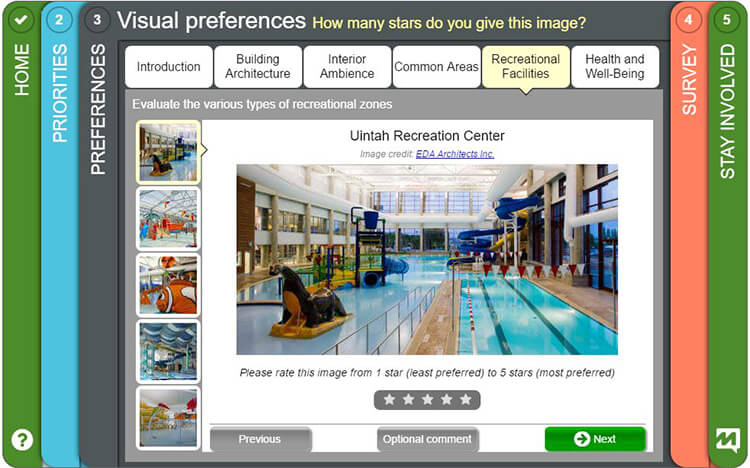
    This first project is an engagement process for the development of a recreation center.

    MetroQuest visual preference screen

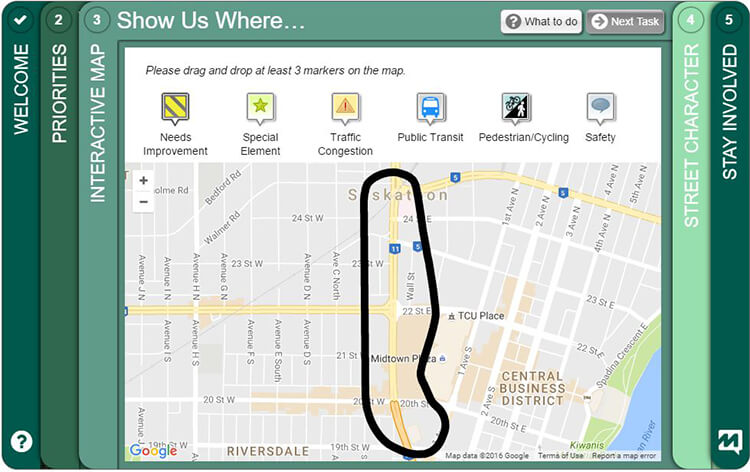
    The second is a corridor study for 5 block section of road.

    MetroQuest map survey screen

    Questions for Jamille and Anamika from NCDOT

    Q: Do MPOs in NC gather public input on the projects sent to NCDOT prior to the STIP public involvement process?
    A: [From Jamille and Anamika] Yes, as a part of the process, they are responsible for conducting their own PI for preliminary point allocations and then finalize them based on the input.

    Q: What were the challenges that this effort encountered? How did you address the challenges if any?
    A: [From Jamille and Anamika] The only challenges we faced were in the inevitable hiccups in the development of the new functionality. Effective and continuous communication with the stakeholders of the process made it easy.

    Q: How did the demographic participation change [with this type of outreach]?
    A: [From Jamille and Anamika] Jamille talked about this in his presentation on the age cohort slide. We saw more of the young parents (25-40) participate (mostly due to the outreach and the online presence), who are otherwise busy in evening routine or kid activities. Even 4% of ‘under 25’ participation was a success.

    Thanks again for your interest and participation in this webinar.

  • [WEBINAR] A Recipe for Award-Winning Online Community Engagement Featuring Anchorage

    [WEBINAR] A Recipe for Award-Winning Online Community Engagement Featuring Anchorage

    This highly visual 45-minute webinar presents research findings, proven best practices, practical tips and award-winning case studies to guide agencies towards the successful application of online community engagement for planning projects. Participants walk away with an understanding about how to leverage digital engagement to achieve unprecedented results using cost-effective tools.

    The webinar showcases a wide range of outstanding planning projects throughout the Pacific Northwest. Our special guests from the Municipality of Anchorage join us to talk about Anchorage Talks Transit, one of the most innovative and successful outreach efforts we’ve seen. They discuss the innovative ways they combined online and targeted face to face community engagement to more community members than ever before to help inform the plan. They also share advice for agencies seeking to improve the diversity and effectiveness of their community engagement efforts and talk about the positive difference that broad community support is making as they move forward.

    Watch Recording

    View Slides

    This webinar featured three presenters: Dave Biggs from MetroQuest, Michelle Poyourow from Jarrett Walker + Associates and Collin Hodges from the Municipality of Anchorage.

    Participant Comments

    Thanks so much for the great comments and kudos. Here’s some of our favorites:

    [Wow, thanks!]

    AICP CM Credits

    Here is the direct link to claim your AICP credits from the APA. Note that the date trips people up. This webinar is part of a series so they instructed us to set it up as an “on-demand” session so you’ll notice that the start and end are a year apart.

    Bonus Case Study: NashvilleNext

    Mentioned briefly in the webinar, this case study of the NashvilleNext process shows why they were the 2016 winners of the APA 2016 National Daniel Burnham Award for a Comprehensive Plan.

    Q&A

    Here are the questions that were raised by participants that we didn’t get a chance to respond to during the session.

    Questions for Dave from MetroQuest

    Q: MetroQuest looks like useful software. What is the best way to get more information about it?
    A: [From Dave] I apologize for not being able to provide more in-depth information about MetroQuest due to the educational nature of this session. The best place to start would be to connect with Derek Warburton at MetroQuest (by email to derek.warburton@metroquest.com, or toll free phone: 1-855-215-0186. Derek will be pleased to make sure you get the information you need. In the meantime, here is a quick video to give you a better sense of the software.

    Q: Once you choose your screens, etc., it works both on web and smartphone?
    A: [From Dave] Yes, all of the MetroQuest screen types are designed to work on computers and smartphones. The layout for each screen type is different on smartphones to make the experience delightful on those smaller screens. The software automatically detects the device type and gives people the layout best-suited for their device. Here’s an image to give you a sense.

    Q: Any advice for engaging EJ populations in the community?
    A: [From Dave] This is a critical topic and there is no short answer that is satisfying other than to say that using well-designed technology can help a great deal but some audiences will always benefit from a more “high touch” or “go to them” approach. It was so frequently mentioned as we interviewed agencies in our review of needs and best practices for community engagement that we organize a special webinar called “Engaging Vulnerable & Disadvantaged People in Planning.” It filled to capacity so quickly that we organized a second session which also filled up. We have therefore made it available to all on-demand via this link: https://metroquest.com/webinar-engaging-vulnerable-disadvantaged-people-in-planning/. You’ll also find some articles we’ve written on the topic here: https://metroquest.com/blog/. I hope this is helpful.

    Q: What is the cost of a yearly all-you-can-use level?
    A: [From Dave] My apologies for not being able to go into more detail about MetroQuest. Due to the educational nature of the webinar I did not feel that it was appropriate. The pricing for an all-you-can-engage annual subscription depends on the size of your organization so that even smaller agencies with tighter budgets can take advantage. If you are curious to learn more feel free to email or call Derek Warburton at derek.warburton@metroquest.com or toll free at +1 855-215-0186. He’ll be happy to help.

    Q: These surveys could be sent to an existing list as well or are they designed to be completed in-person at an interactive station?
    A: [From Derek] Most agencies send out the survey to various lists and otherwise promote them to as many people in the community as they can. They don’t have to be in person. Most complete from home or smartphone.

    Q: In the examples where tablets or kiosks were used for collecting input, was there any person-to-person interaction?
    A: [From Dave] In most projects there are a combination of web-based and face to face interaction. This was the case in the examples where kiosks and tablets were used. Kiosks can be used in a standalone setting such as a community center or library entranceway. In these situations, they are typically used without any person to person interaction. Tablets are most commonly used at events where there is a project team member within close proximity of the table where they are available allowing people to ask questions or chat if they feel inclined.

    Q: Is Anchorage using the transit plan process to identify public involvement best practices for consistent use in other city planning projects?
    A: [From Dave] Yes, in our ongoing pursuit of what’s working best in online community engagement the Anchorage case study is an important source of learning for us. We are very keen to see what happens in the next phase of outreach that is ramping up now. We have already discussed doing an update with Collin once those results are in.

    Questions for Michelle from Jarrett Walker + Associates

    Q: For the Anchorage Transit outreach, how different were the outcomes, compared to what the transit planning experts would recommend? How much did public engagement influence the outcomes?
    A: [From Michelle] You asked how different the results of the public surveys were, compared to what the planners would recommend. That’s a great question. The truth is, we don’t have a recommendation about how these trade-offs should be made for Anchorage. We may have an opinion about our own towns, where we are stakeholders, but we are not Anchorage stakeholders and our values are therefore irrelevant. As technical experts, we can show people the trade-offs, and encourage them to participate in making that difficult choice, but our opinions about how that choice should be made don’t belong in the process. We keep our technical recommendations separate from choices that are really about peoples’ values.

    For example, we can design an excellent high-coverage, low-ridership network, if a city values coverage more than ridership. Or we can design an excellent high-ridership (high-frequency), low-coverage network. Those are technical exercises. But which is BETTER for the community is not a technical question, and we don’t deign to answer it.

    Q: Did you tabulate people’s choices of their priorities? If so, how did you use that info?
    A: [From Michelle] We did indeed tabulate how many people selected each “Priority”, and how highly they ranked it. We then looked at those results, and shared them with decision makers. The results were what you might expect from the results we shared: strong interest in higher ridership and higher frequency service. However, there was also an interest in having high coverage, with some service close to everyone, and as you now understand that goal comes into conflict with a goal of high ridership (or high frequency). Which is why it was so important to ask people’s input, also, in response to those two scenarios, so that they would be forced to wrestle with the trade-off.

    Questions for Collin from the Municipality of Anchorage

    Q: Any pointers for increased turn out at follow up meetings? The Anchorage team described a series of follow up meetings that were not well attended. What purpose were those meetings to serve if no new proposal or scenario was presented.
    A: [From Collin] If we were to do this particular project again, we might not host “traditional” public meetings as follow-up events at all. We may have spent more time at pop-up events instead, for example informational tables at neighborhood events or setting up a table at other organizations’ meetings. We did some of those pop-up events throughout the project, and we got residents to take the MetroQuest survey that way (we had tablets at each event). However, with the clarity of hindsight, we would have allocated more resources to that pop-up strategy instead of investing as much time as we did in the traditional public meetings.

    In terms of getting more turnout for the public meetings, targeted mailings to residents within a certain distance of the venues could have helped.

    The purpose of the follow-up meetings was to provide a variety of locations and times after the kickoff that residents could engage with staff in-person about the project. But within the context of a relatively conceptual conversation about transit priorities, the traditional public meeting format was probably not the best choice for those follow-up efforts.

    Q: Was there any direct mailings done to residents to explain the whole project and direct people to the online engagement tools?
    A: [From Collin] We did not do any direct mailings, primarily because we did not have the budget that would have been required to mail info cards to all of the addresses on our existing routes. As an alternative, we opted to post flyers at community destinations throughout Anchorage in English and our four LEP languages (at coffee shops, grocery stores, municipal buildings, schools / universities, churches, ESL program offices, etc.).

    Q: Can you give us links or examples of “on-line mapping programs?
    A: [From Collin] The programs we considered for presenting our bus network concepts in the Implementation phase were MetroQuest, Wikimapping, and Remix. Our department recently purchased a Remix license to supplement our route planning process, so in the interest of leveraging existing resources we decided to use Remix as the primary web component of our Implementation outreach process. [From Dave] While MetroQuest has several mapping screens (https://metroquest.com/how-it-works/), they are designed to collect community input so they are more commonly used during the planning rather than implementation phases of projects.

    Q: Did you have interpreters available at every meeting? In the past, for example, I have indicated in an ad that if ADA accommodations were needed, participants could contact me directly. Did attendees need to request an interpreter or were they just available regardless?
    A: [From Collin] We provided and advertised interpreters at the big kickoff event as a matter of course, but for all other meetings we provided them on request only.

    Thanks again for your interest and participation in this webinar.

  • [WEBINAR] A Recipe for Award-Winning Online Community Engagement Featuring SCAG

    [WEBINAR] A Recipe for Award-Winning Online Community Engagement Featuring SCAG

    This highly visual 45-minute webinar presents research findings, proven best practices, practical tips and award-winning case studies to guide agencies towards the successful application of online community engagement for planning projects. Participants walk away with an understanding about how to leverage digital engagement to achieve unprecedented results using cost-effective tools.

    The webinar showcases a wide range of outstanding planning projects throughout Southern California. Our special guests from the Southern California Association of Governments join us to talk about the LA/San Bernardino Inter-County Transit & Rail Study, one of the most innovative and successful outreach efforts we’ve seen. They discuss the innovative ways they combined online and targeted face to face community engagement to involve community members to help inform the plan. They also share advice for agencies seeking to improve the diversity and effectiveness of their community engagement efforts and talk about the positive difference that broad community support is making as they move forward.

    Watch Recording

    View Slides

    This webinar features three presenters: Dave Biggs from MetroQuest, Stephen Fox from the Southern California Association of Governments and Yesenia Arias from Arellano Associates.

    Participant Comments

    Thanks so much for the great comments and kudos. Here’s some of our favorites:
    “Very informative webinar exploring how planners can improve the typical community engagement process.”
    “Great webinar for public outreach. Very interesting. The tool looks very effective!”
    “Great presentation–tips provided by Dave Biggs were very useful.”
    “One of the better webinars I’ve heard. Graphics were great.”
    “This was excellent. Planners are better professionals if they understand how their project is presented to stakeholders via multiple communication vehicles, including online. Increased public participation is typically an organization’s goal, and this presentation outlined how the So Cal Association of Governments did that.”
    “The newest concepts in outreach are well worth reviewing, and the variety of tailored outreach options is impressive.”
    “Interesting, upbeat, helpful as we will be writing a comp plan over the next two years.”
    “I really enjoyed this webinar and found it very useful and timely. It was a very visual presentation and I plan to look back at it again.”
    “Public engagement has always been a tough job. This webinar was great – highlights quickly what is working”
    Average rating: 4.6/5 stars

    [Wow, thanks!]

    AICP CM Credits

    Here is the direct link to claim your AICP credits from the APA. Note that the date trips people up. This webinar is part of a series so they instructed us to set it up as an “on-demand” session so you’ll notice that the start and end are a year apart.

    Bonus Case Study: NashvilleNext

    Mentioned briefly in the webinar, this case study of the NashvilleNext process shows why they were the 2016 winners of the APA 2016 National Daniel Burnham Award for a Comprehensive Plan.

    Q&A

    Here are the questions that were raised by participants or that came in after by email that we didn’t get a chance to respond to fully during the session. Note: there were a few questions directed to Steve and Yesenia. Those questions and responses will be posted in a few days.

    Questions for Dave from MetroQuest

    Q: MetroQuest looks useful. How can we get more info about it?
    A: [From Dave] I apologize for not being able to provide more in-depth information about MetroQuest due to the educational nature of this session. The best person is Derek Warburton at MetroQuest (by email to derek.warburton@metroquest.com, or toll free phone: 1 855-215-0186. Derek will be pleased to make sure you get the information you need. In the meantime, here is a quick video to give you a better sense of the software.

    Q: I’m curious to hear if any of your case studies featured the topic of zoning codes.
    A: [From Dave] I showed the following zoning project that used MetroQuest during the Q&A in the webinar and promised to share the link so you could play around with it yourself. Here it is: https://bensenvillezoningdemo1.metroquest.com/. Since MetroQuest is essentially a library of screen types that can be mixed and matched and tailored to meet the needs of a variety of projects it’s not possible to show all the possible combinations. If there are specific project types that you’d like to see Derek (contact info above) would be happy to provide examples that could give you some interesting ideas.

    Q: How have you dealt with organized opposition to projects? (i.e. the City of Claremont against Gold Line expansion)?
    A: [From Dave] While we answered this briefly during the Q&A I thought you might be interested in this blog post I wrote on an experience I call, “What I Learned When an Angry Mob Destroyed My Public Meeting.” It was so popular that I started a series call The Fiasco Files.

    Q: Would you share a copy of your online survey for the project?
    A: [From Dave] The SCAG project used this online survey: https://lasb-demo.metroquest.com/. Feel free to play around since this is a demo version that does not collect data.

    Q: What is the AICP course # for this webinar?
    A: [From Dave] The course number is 9102565. Here is the direct link: https://planning.org/events/course/9102565/

    Many thanks for joining us!

  • [WEBINAR] A Recipe for Award-Winning Online Community Engagement Featuring SNS

    [WEBINAR] A Recipe for Award-Winning Online Community Engagement Featuring SNS

    This highly visual 45-minute webinar presents research findings, proven best practices, practical tips and award-winning case studies to guide agencies towards the successful application of online community engagement for planning projects. Participants walk away with an understanding about how to leverage digital engagement to achieve unprecedented results using cost-effective tools.

    The webinar showcases a wide range of outstanding planning projects from Nevada, Colorado and Idaho. Our special guests from the City of Henderson, NV join us to talk about Southern Nevada Strong project, one of the most innovative and successful outreach efforts we’ve ever seen. As this year’s recipients of the APA National Award for Outstanding Public Outreach, they discuss the innovative ways they combined online and targeted face to face community engagement to involve over 70,000 community members to help plan the region. They also share advice for agencies seeking to improve the diversity and effectiveness of their community engagement efforts and talk about the positive difference that broad community support is making as they move forward.

    Watch Recording

    View Slides

    This webinar featured two presenters: Dave Biggs from MetroQuest and Lisa Corrado from the City of Henderson.

    Participant Comments

    Thanks so much for the great comments and kudos. Here’s some of our favorites:
    “Exemplary project presentation and “How-To” regarding the Public Participation/Open Process.” “The presentation was well crafted and interesting.”
    “Great webinar for public outreach. Very interesting. The tool looks very effective!”
    “One of the better webinars I’ve heard. Graphics were great.”
    “Great webinar. Really good info, efficient, relevant to my work.”
    “Interesting, upbeat, helpful as we will be writing a comp plan over the next two years.”
    “I really enjoyed this webinar and found it very useful and timely. It was a very visual presentation and I plan to look back at it again.”
    “Public engagement has always been a tough job. This webinar was great – highlights quickly what is working”

    Average rating: 4.75/5 stars

    [Wow, thanks!]

    AICP CM Credits

    Here is the direct link to claim your AICP credits from the APA. Note that the date trips people up. This webinar is part of a series so they instructed us to set it up as an “on-demand” session so you’ll notice that the start and end are a year apart.

    APA Award Video for Public Outreach

    Here is a great video that the APA produced to showcase Southern Nevada Strong – Breaking Barriers Through Public Outreach.

    Bonus Case Study: NashvilleNext

    Mentioned briefly in the webinar, this case study of the NashvilleNext process shows why they were the 2016 winners of the APA 2016 National Daniel Burnham Award for a Comprehensive Plan.

    Q&A

    We answered all of the questions during the webinar but this one came in by email.
     
    Q: MetroQuest looks interesting. How can we get more information?
    A: [From Dave] I apologize for not being able to provide more in-depth information about MetroQuest due to the educational nature of this session. The best place to start would be to connect with Derek Warburton at MetroQuest (by email to derek.warburton@metroquest.com, or toll free phone: 1 855-215-0186. Derek will be pleased to make sure you get the information you need. In the meantime, here is a quick video to give you a better sense of the software.

    Many thanks for joining us!