Category: [WEBINAR]

  • How Planning Consultants Win Clients with Exceptional Public Engagement

    How Planning Consultants Win Clients with Exceptional Public Engagement

    Consultants competing for urban and transportation planning projects with government agencies are always looking for ways to differentiate themselves with a competitive edge. As firms and government agencies alike struggle with engaging constituents at public meetings, increasingly, leading firms are using online public engagement prowess to win projects and increase client loyalty.

    To learn more about this trend and what leading consulting teams are doing to enhance their public engagement offerings, we interviewed a range of firms, from the largest planning and engineering firms to smaller boutique public engagement firms. They agreed on three things:

    1. Planning projects present unique public engagement goals,
    2. The benefits for creating leading edge public engagement capabilities have never been greater, and
    3. When used skillfully, today’s public engagement toolbox can deliver game-changing results.

    The detailed results of this research are presented in a recent webinar recording: How to Optimize Public Engagement to Wow Clients on Every Project. Here’s a summary for quick reference.

    We found 4 unique goals for public engagement to support urban and transportation planning projects.

    #1. Increase public participation

    Agencies cite increasing participation as their top challenge, nationwide. With dwindling attendance at public meetings, now averaging nine people per meeting, increasing the number of people engaged to inform and support planning efforts is top of mind for government agencies. Planning projects represent major investments of public funds and require major public participation. Firms with case studies that can demonstrate large scale public engagement stand out.

    #2. Broaden demographics

    Environmental justice and other directives require agencies to demonstrate diversity in their public outreach. Several key demographics continue to be difficult to reach with traditional methods increasing the urgency to hire a team with a track record and a plan to broaden the diversity of participation well beyond the usual suspects.

    #3. Inform and educate

    Planning projects deal with complex topics and any meaningful engagement must demonstrate to decision makers that the public input was informed. Planning decisions involve constraints, trade-offs, visual-preferences, and other complexities that need to be embedded skillfully into the engagement process to gather trustworthy community preferences. Teams with a plan for weaving education into their outreach process instill confidence with agency representatives.

    #4. Quantify public input

    Anyone who’s had the ‘pleasure’ of summarizing hundreds or thousands of community comments can appreciate the benefit of collecting quantifiable public input. Agency planning professionals must summarize public input in a clear and easily digestible format for decision makers. Consulting proposals that demonstrate a concrete plan for collecting data on public preferences in well-structured ways will generate confidence. Today, public input must support data-driving planning.

    We’re always impressed with our friends at the national planning and design consulting firm, Kimley-Horn, who have consistently delivered great public engagement. To date, they’ve engaged over 68,000 people with online surveys and collected over 1.5 million data points to support both urban and transportation planning projects. That’s exceptional value for their clients! Stephen Stansbury, Vice President at Kimley-Horn, described the advantage of great online public engagement,

    “Thousands of data points have just become a customary result … that increased volume of participation increases confidence in the results and makes our planning process go that much more smoothly. It’s adding value to the communities that we’re working with.”

    We uncovered 8 benefits of leading-edge public engagement specific to planning consultants.

    Another leading firm that needs no introduction is Michael Baker International. Our friend Kenneth Mobley, Associate Vice President and Planning Manager, described the struggles facing so many consulting firms during our interview,

    “A lot of our meetings were having low attendance, and so, we were looking for something that was creative, that was online, and that we could use as an alternative to traditional meetings. We really needed to have something to distinguish ourselves from engagement firms that are small and very specialized. We needed a platform to get to a large number of people in a cost-effective way.”

    Kenneth turned to online public engagement surveys years ago to solve these challenges. Michael Baker International was among many firms that were interviewed, which cited the following eight benefits of going beyond the traditional methods and delivering best in class public engagement services for their planning projects:

    1. Impress clients with increased participation,
    2. Champion data-driven plans,
    3. Build public support and foster trust,
    4. Reduce risk of public backlash,
    5. Foster confidence with elected officials,
    6. Get innovative plans approved,
    7. Cultivate customer loyalty, and
    8. Gain a lasting competitive edge!

    Kenneth’s colleague, Lorna Parkins, Vice President of Transportation Planning at Michael Baker International described the impact of great online pubic engagement in serving her clients,

    “We’re able to go to decision makers and show them ‘we got this much input, and these were the findings.’ This gives them more confidence to tell us that they’re ready to move forward. They feel that what they’ve heard from the public is reliable.”

    In the webinar, we shared 12 keys success factors used by leading firms to optimize public engagement in planning projects.

    The webinar outlines 12 key success factors in detail that leading consulting teams are using to meet the unique challenges of public engagement for planning clients. To pique your curiosity, each team is doing these three things incredibly well.

    #1. Firms are dramatically lowering the barriers to engagement by using online tools.

    These consulting teams are focussed on using fast and visually appealing online surveys as a primary source of public input. These tools help to engage larger numbers of people on every project and reach a broader demographic than more traditional techniques.

    #2. They are weaving education into interactive online surveys to ensure that the public input they collect is informed.

    In order to ensure that the public input is informed, rather than providing documentation that is seldom read or detailed presentations that are poorly attended, leading teams rely on gamified and interactive tools that embed education into the survey process. The most successful teams have experience translating planning complexities into compelling questions and images that highlight trade-offs, limitations, visual-preferences, and other planning issues.

    #3. Leveraging social media and other cost-effective techniques to promote participation.

    A wide range of tools and strategies are available to agencies for promoting participation and targeting difficult to reach populations. To say that most agencies are overwhelmed by the options and unclear about which ones to use for which purposes would be an understatement. Consultants with experience and a track record for promoting participation have a significant advantage. Using boosted Facebook posts to promote their online surveys is one way that firms are repeatably able to engage thousands and impress clients.

    The most effective strategies for these areas and each of the 12 key success factors are described in the webinar video using case studies and feedback from our consultant interviews. We’d like to congratulate all the firms nationwide on their outstanding public engagement success! Thank you for the opportunity to share your stories.


  • Millennials to Boomers: How MDOT Involved 6,300 for Its LRTP

    Millennials to Boomers: How MDOT Involved 6,300 for Its LRTP

    The Michigan Department of Transportation (MDOT) has reinvented how it approaches public involvement and the payoff has exceeded even their wildest expectations.

    Watch this webinar to hear them tell their story

    While transportation matters to residents of all ages, few attend public meetings. Transportation agencies across the country are plagued by declining participation across all planning projects. They’re also struggling with involving a broad demographic.

    Public involvement for long range transportation plans (LRTPs) can be particularly challenging. Most people are concerned more about immediate and localized issues. They generally don’t think in terms of long-range policy directions, constraints, and trade-offs that are the subject of the LRTP process.

    In fact, last time around MDOT conducted an extensive public involvement effort including over 20 public meetings throughout the state to support its long range plan. A total of 125 people attended, with higher representation from older demographics. MDOT project manager Brad Sharlow described the public input as “very sparse.”

    This time around, Michigan DOT went online with the hopes of broadening its outreach to support its new state long range transportation plan (SLRTP). In their webinar, they explain how they joined forces with WSP to engage 6,300 people, from millennials to boomers, to uncover their evolving transportation priorities for the Michigan Mobility 2045 SLRTP. Shane Peck, Anita Richardson, Brad Sharlow, and Kyle Haller share their engagement techniques and what they learned about public preferences for modal tradeoffs, infrastructure investments, intelligent technologies, and transit.

    This webinar recording is like a best practices playbook to help other agencies develop and implement public involvement programs for broad and inclusive outreach for LRTPs.

    Watch this complimentary on-demand webinar for modern ways to:

    • Uncover the transportation priorities of your citizens
    • Engage across all age-groups, going beyond the usual suspects
    • Gamify transportation education to capture informed public input
    • Integrate tech to capture public input at public meetings
    • Build resident support and buy-in for meaningful change
  • Cleaning Up Toxic Public Discourse for Meaningful Engagement

    Cleaning Up Toxic Public Discourse for Meaningful Engagement

    With over 1500 registrants, it’s clear that our recent record-breaking webinar – Cleaning Up Toxic Public Discourse for Meaningful Engagement – hit on an important and timely topic for planning and engagement professionals. 

    We were honored to host James Hoggan, bestselling author of ‘I’m Right and You’re an Idiot: The Toxic State of Public Discourse and How to Clean It Up’ and ‘Do the Right Thing: PR Tips for a Skeptical Public.’ James is a leading voice in how to understand the nature of today’s toxic public engagement environment.  

    James carried the first half of the session, focusing on the causes of the current state of public discourse. He offered some inspiring advice to practitioners based on his extensive research, including interviews with thought leaders from the Dalai Lama to sociologist Bruno Latour.  

    When facing a public square polluted with polarized discourse, James suggested that we need to improve in three areas.

    1. Deep listening. James emphasized that ‘compassion’ and ‘deep listening’ are very essential tools to address angry people and toxic behaviours. If we want people to hear our point of view, we first have to be able to hear theirs. James recalled his interview with scientist Peter Senge who noted, “the quality of any intervention is based on the inner qualities of the intervener.” The best way to calm an angry person is to remain calm, hear them, and show empathy by repeating back their feelings and values.
    2. Emotional dialogue. James warned that data and statistics are not persuasive. We know from cognitive psychology that the human mind processes information using stories that stir up feelings and values. In a fight, facts always lose to emotions. And so James advised that leaders and public figures need to effectively participate in ‘emotional dialogue.’
    3. Stories of us. James also encouraged us to become ‘story tellers.’ For example, an emotional story about how a specific likable person or family is struggling today and how a proposed plan could change their future can help paint a compelling story, bringing an important statistic to life. Public meeting participants will forget the statistic but remember and be moved by the story.

    Following his talk, I outlined a set of very practical strategies and tactics to help planners and public engagement professionals design and implement public involvement programs that are less vulnerable to disruptions and go beyond the vocal minority to engage the more moderate and positive voices in the community.  

    We rounded off the webinar with a live Q&A session. Participants were clearly highly engaged. There were common recurring themes with their many questions, which clearly points to a need for more information and training on how to deal with angry or disruptive participants specifically at public meetings. We’re happy to oblige.  

    As discussed in the webinar, public meetings for projects will always tend to attract the most motivated – this generally means the most opposed. Public meetings are also highly vulnerable to cooptation by vocal individuals. There are several techniques described in chapter 9 our “100 Community Engagement Ideas” guidebook to help create public meetings that are less vulnerable along with some methods for dealing with disruptive participants.

    Below are some of the methods we’ve found to be most effective when faced with a vocal opposition! 

    1. Be honest and clear about what’s on the table for discussion and where you are in the process.
    2. Consider conducting a broad and inclusive online survey about priorities prior to the public meeting process. This can allow you to summarize what was learned about top priorities from a broader demographic than is likely to be represented at the meeting. It will help set the tone that there are many points of view to consider beyond the ones represented in the room.
    3. Drop the mic! Instead of the traditional room with a line of people at the microphone, try dividing people into discussion tables where they are encouraged to share ideas and hear from neighbors.
    4. Start the meeting with a clear set of rules and request self regulation and respect for all participants.
    5. Speak directly to the challenging decisions to be made and demonstrate that you understand that there are multiple perspectives and that it’s not easy.
    6. Ensure that people feel heard. Repeat back what you heard to make sure you got it right even if you don’t agree. You can even take notes on a flip chart.
    7. For people who dominate the dialog despite requests to share the time with others, invite them to a one on one side bar discussion either at the meeting or after.

    In addition to creating better structured public meetings and using best practice facilitation skills the following strategies can help as well.

    1. Use a fast and fun online engagement platform to allow people to weigh in quickly on their own schedules. These surveys can dramatically lower the barrier to participation to open the process to more moderate or positive voices. It’s critical that these surveys offer private experiences with no open forum or commenting to allow people to participate without fear of reprisal or intimidation.
    2. Embed education into your engagement experience, as made possible with interactive and visual surveys. By educating people about the planning options, pros and cons of alternatives, trade-offs, and constraints, you can widen the perspective of people who may not feel knowledgeable on the issues or who are too focused on a single issue to appreciate that there are multiple priorities simultaneously. A recent case in point was revealed in this webinar with Truckee Meadows RPC where they describe how they went from vocal resistance to infill to widespread support by cleverly educating people about the pros and cons of alternatives in an interactive survey.
    3. Monitor demographics of the participants carefully and seek out missing voices to broaden the engagement. Too often the vocal minority represents only a narrow cross section of the community.
    4. Use “go to them” strategies to engage with people who are attending another community event or even passers by in public places, thereby increasing the chances of engaging average people and a broader demographic. This can be as simple as setting up a table at a community gathering of any kind. This strategy can be highly cost effective compared with organizing your own sessions. In addition, by picking and choosing your events carefully, it’s possible to target difficult to reach or underrepresented populations. 

    We hope this webinar recording and these additional tips will help you clean up toxic public discourse and create more meaningful engagement in your outreach projects. Checkout additional success stories from our case studies for more inspiration. 

  • Public Engagement Jackpot | How Your Agency Can Win Big

    Public Engagement Jackpot | How Your Agency Can Win Big

    I was recently joined by the enthusiastic and bubbly Truckee Meadow Regional Planning Agency team, and I’m thrilled to share their amazing success story!! We truly had a great time putting this webinar together.

    Learn how TMRPA in Nevada is making its own luck by going online to engage 1000s. This on-demand webinar offers a detailed look inside the strategies that have made them so successful.

    The stakes are high in planning for regional growth in Reno, Sparks, and Washoe County. Truckee Meadows RPA reveals the winning strategy for online public engagement! They show the use of resident survey data in action, providing a clear path to game-changing regional plans.

    Jeremy Smith shares how TMRPA used public engagement to build broad public support for infill development in core areas to stop the sprawl. Lauren Knox tells us how they used 53,290+ survey data points to inform their 20-year Truckee Meadows Regional Plan.


    Watch this complimentary on-demand webinar to explore effective ways to:

    • Foster inter-agency collaboration with unified engagement
    • Gamify public engagement to create a great online experience
    • Use a multi-phase engagement approach to guide citizens in planning
    • Build resident support and buy-in for transformative scenarios
  • [WEBINAR] Inside CMAP’s Award-Winning Public Engagement Process

    [WEBINAR] Inside CMAP’s Award-Winning Public Engagement Process

    I’d say most of our clients are dealing with challenges around mobility, the environment, and driven by a desire to make their own communities more livable and resilient. These ambitions speak directly to my passions that I try to advocate for in my own community. I see MetroQuest as being one way to help empower better conversations around community and how we move around the globe. I am lucky to be able to work with like-mind clients who value the voice of the public.

    CMAP has built a national reputation as a leader in public engagement. This on-demand webinar offers a detailed look inside the strategies that have made them so successful.

    For the Chicago Metropolitan Agency for Planning, award-winning comprehensive plans involve public engagement at all scales, collaboration with 284 communities, and a Local Technical Assistance program that’s admired nationally.

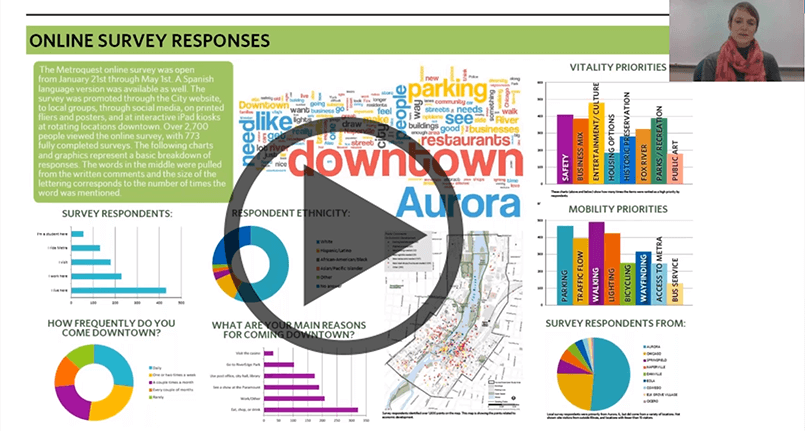
    Join CMAP Deputy Executive Director of Planning, Stephane Phifer, Associate Outreach Planner, Katanya Raby, and Senior Planner, Lindsay Bayley as they take you inside their local approach to online engagement for OnTo2050 – their comprehensive regional plan to improve quality of life and economic prosperity for 8.5 million people. Learn how CMAP used a multi-phased approach to online engagement for a variety of local plans, including the downtown Aurora Master Plan.

    Webinar recording.

    Watch this complimentary on-demand webinar to explore effective ways to:

    • Engage inclusively to build inclusive plans
    • Uncover the ideas, hopes, and concerns of residents
    • Take a multi-phase approach to online engagement
    • Think both locally and regionally for collaborative planning

    Here what participants are saying about the webinar:

    “One of the best webinars I’ve seen. Very applicable to my work in municipal planning.”

    “Very useful information that others can use as well for their efforts. tackles a common issue with planning projects.”

    “Great presentation on challenges of comprehensive public engagement, as well as several examples on strategies to do it successfully.”

    Watch this on-demand webinar to get inspired!

  • [WEBINAR] Transforming Public Apathy to Revitalize Engagement with Dave Meslin

    [WEBINAR] Transforming Public Apathy to Revitalize Engagement with Dave Meslin

    There are very few rock stars in the field of public engagement … so that makes Dave Meslin something of an anomaly.

    Once you hear Dave Meslin speak in this on-demand webinar you’ll understand why his TED Talk on apathy and public engagement has over 1.7 million views!

    Apathy is all around us. Most people have become disengaged not only from politics, but also from the government agencies that make decisions that directly affect their quality of life. Increasingly, leaders are asking themselves “How do we boost public participation?”

    Join me with TED Talk celebrity, Dave Meslin as we explore proven techniques for building a culture of engagement. We try to encourage everyone to recognize apathy as a web of barriers that reinforce disengagement – and show how together we can work to dismantle the obstacles to revitalize public participation.

    This in-depth journey combines humor with many examples of best-practices. The strongest cities have learned how to tap into the collective creativity, passion, and knowledge of their constituents. This webinar charts the course.

    This presentation appeals to all public engagement and planning professionals as well as staff and leaders with planning agencies. For professional planners, APA AICP CM credits are available for watching the on-demand recording.

    Here are some comments from participants:

    “Exceptional analysis of the challenges of public engagement. Great ideas!”

    “Quite possibly the most beneficial webinar I’ve ever attended. The speakers were both very knowledgeable on the topic.”

    “Great presentation, very engaging, and it helped me step back from the day-to-day to re-think about planning topics from the citizen’s viewpoint.”

    “Outstanding examples of how to improve public participation.”

    “This was an excellent session! It might be the best session I’ve ever attended, including in-person sessions! Great content!”