Category: Urban Planning

  • [SURVEY OF THE MONTH] A MetroQuest Survey Identifies Community Priorities for WalkEC, a Comprehensive Pedestrian Plan

    [SURVEY OF THE MONTH] A MetroQuest Survey Identifies Community Priorities for WalkEC, a Comprehensive Pedestrian Plan

    We’re excited to introduce the Survey of the Month: an exceptionally well-done example of a MetroQuest survey created by one of our users. We’re consistently impressed with the amazing public engagement surveys that MetroQuest subscribers launch to gain valuable public input for their plans. We want to share their inspiring work!

    Going forward, every month we’ll show you how one agency or firm put together an outstanding survey and highlight a few takeaways to inspire YOU to create equally engaging surveys!

    This month, we’re thrilled to introduce a Comprehensive Pedestrian Plan for Elizabeth City, in collaboration with MetroQuest subscriber Kimley-Horn and Associates and the North Carolina Department of Transportation (NCDOT). Jonathan Whitehurst and his team at Kimley-Horn created an amazing MetroQuest survey to identify obstacles and solutions to building a more walkable city as part of a strategic plan to stimulate community growth.

    What’s the story behind WalkEC? It’s Elizabeth City’s First Comprehensive Pedestrian Plan

    Elizabeth City’s “Vision 2020” was a community planning initiative that aimed to create economic and community development. Initially, a dedicated committee worked together to create a strategic plan that could guide Elizabeth City’s upcoming developments using data from research and focus groups, reaching all segments of the community. With these, the committee previously recommended that increased sidewalk connections would provide better access to health and social services, trails in nature, parks, and other destinations, elevating Elizabeth City’s ability to serve and support the community.

    As a continuation of this larger community strategy, “WalkEC” is a Comprehensive Pedestrian Plan that will set priorities for new sidewalks, multi-use paths, and street crossings. It will also review policies and programs to ensure that the community can make the best use out of the new infrastructure. Jonathan Whitehurt worked together with Elizabeth City and NCDOT to create the WalkEC MetroQuest survey for this plan, looking for actionable community input that would allow them to identify obstacles and create community-backed solutions!

    Anatomy of a Survey: How WalkEC’s MetroQuest Survey Gathers Actionable Public Input

    WalkEC’s survey has great flow from screen to screen, first identifying how the community prioritizes five themes, then identifying potential obstacles to achieving those goals, and finally creating a space for citizens to safely suggest solutions.
    WalkEC_Rating-Screen

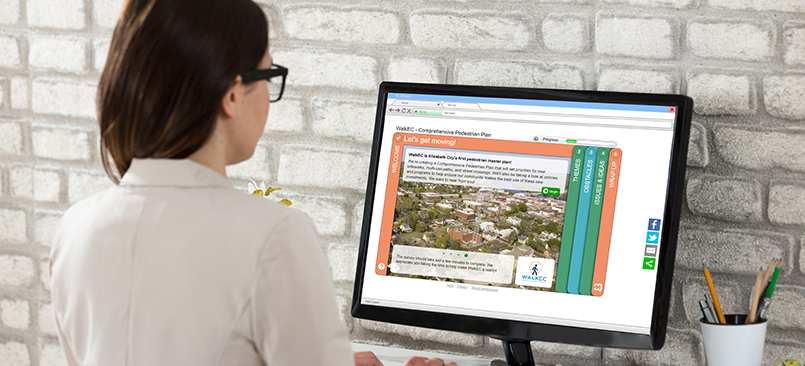
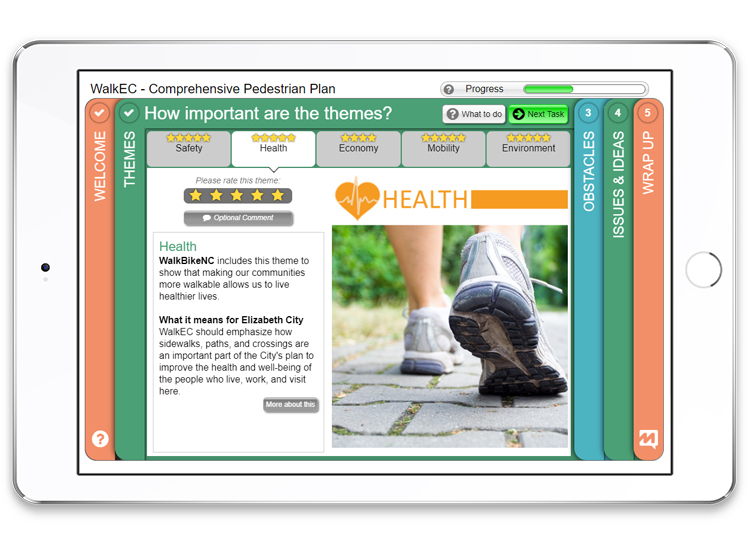
    In more detail, the survey starts by presenting some background information to help provide context and let citizens know how their input will be used: namely, to help ensure that the community will be able to make “the best use of these new investments.” It then dives into the first interactive data collection activity, presenting five themes from the statewide North Carolina bicycle and pedestrian plan, called WalkBikeNC.

    Participants are asked to rate each theme on a 5-point scale and can submit optional comments on each. The five themes are: Safety, Health, Economy, Mobility, and Environment. Understanding how important each of these state-identified themes are to Elizabeth City residents will help shape the pedestrian plan around the topics that are most valuable to them.
    WalkEC_PriorityRanking-Screen

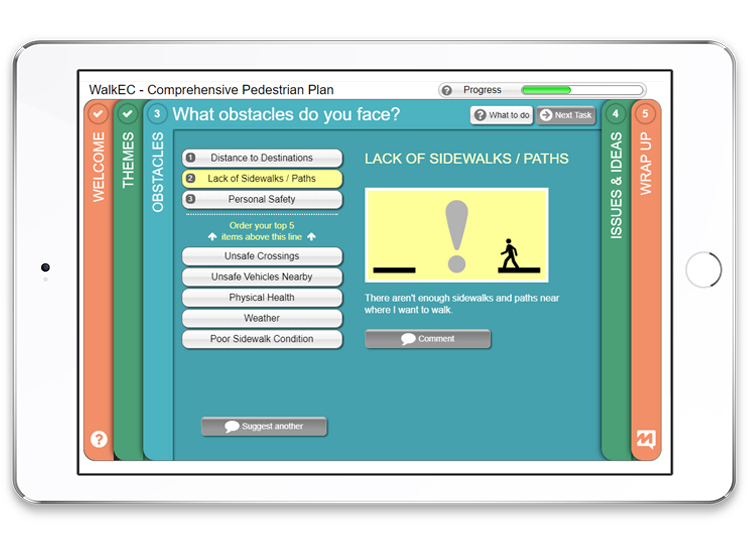
    In the second activity, participants are asked to rank the 5 biggest obstacles that prevent them from walking or from walking more frequently. Because one goal of the comprehensive plan is to help the community utilize pedestrian infrastructure, it is important to the Elizabeth City team to make sure that they identify concerns and attempt to solve them where possible.

    The list of obstacles includes: Personal Safety, Poor Sidewalk Conditions, Lack of Sidewalks/Paths, Physical Health, Unsafe Crossings, Weather, Distance to Destinations, and Unsafe Vehicles Nearby. Understanding obstacles to walking will help Elizabeth City to become safer, more enjoyable, and more accessible.
    WalkEC_Map-Screen

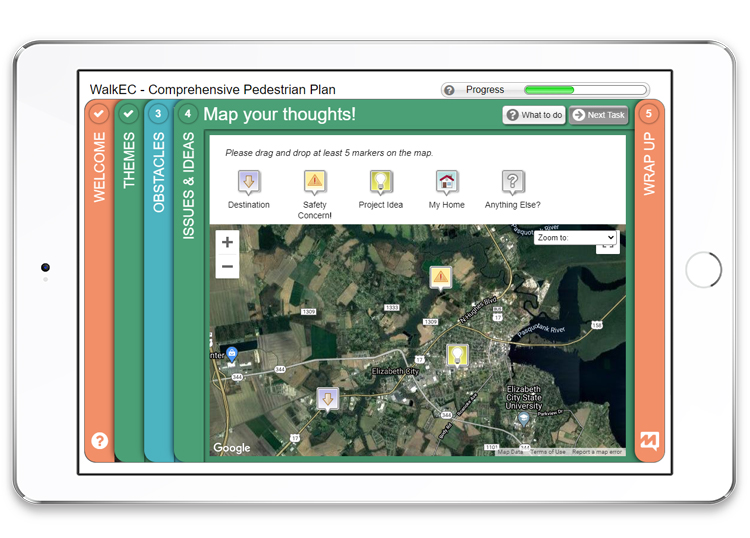
    Finally, before asking a few demographic questions, participants are asked to map their thoughts and show issues and ideas spatially by dropping markers onto a virtual map. Jonathan and his team configured markers that people can use to show the location of their Safety Concerns, Project Ideas, and Destinations, as well as showing where they live (My Home) and providing additional ideas (Anything Else). This survey screen gives participants the option to show exactly where they want more pedestrian infrastructure, where they feel unsafe, and where sidewalks, trails, or crosswalks are needed. By giving participants the option to share these in a clean map (without existing markers that cause bias), Elizabeth City is giving each citizen an equal opportunity to have their voice be heard.

    If you’d like to try a demo of the survey, click the button below. This will not affect Elizabeth City’s survey results, so feel free to click around.

    The accompanying project website can be found here. This survey is currently live, and we are looking forward to seeing great public engagement results!

    5 Tips from Elizabeth City: How to Make an Effective Online Survey for Public Involvement with MetroQuest

    The survey the team created is fantastic in many ways. They made the most out of MetroQuest by translating the goals of their comprehensive plan into an accessible survey that could collect actionable information from the broader community.

    How did they make their survey so engaging? Below are 5 aspects to keep in mind as you build your next MetroQuest survey to ensure that yours is just as successful.

    1. In a brief introduction, convey the goals of your plan and show participants how their input will have impact. There’s no need to go into great detail—that’s what the project website is for—but knowing that their input is valued and will be acted upon will motivate participants.
    2. Use a simple call-to-action so that participants have an immediate and obvious next step. The example WalkEC uses in the introduction screen is simple yet effective: “We want to hear from you!”
    3. Enhance your text with icons and relevant images – it draws the participant in, makes the survey more fun and visual, and encourages the participant to connect to the questions and identify their priorities. For example, the second screen of the survey uses a picture of two children at a crosswalk to illustrate the theme of Safety. Help participants link the concepts in the survey to their everyday lives!
    4. Keep all text short and precise and use simple language instead of jargon. WalkEC is a Comprehensive Pedestrian Plan. While citizens might not know what that type of plan is, they’ll certainly understand that the city is looking to “help ensure our community makes the best use of these new investments.” Follow this rule of thumb in the survey itself, too. For example, when discussing barriers to walking, this survey explains “distance to destination” plainly as “it would take too long to walk from point A to point B.” Simple, everyday language like this helps participants think about their everyday concerns more easily, all the while subtly educating the public and helping you to collect informed input!
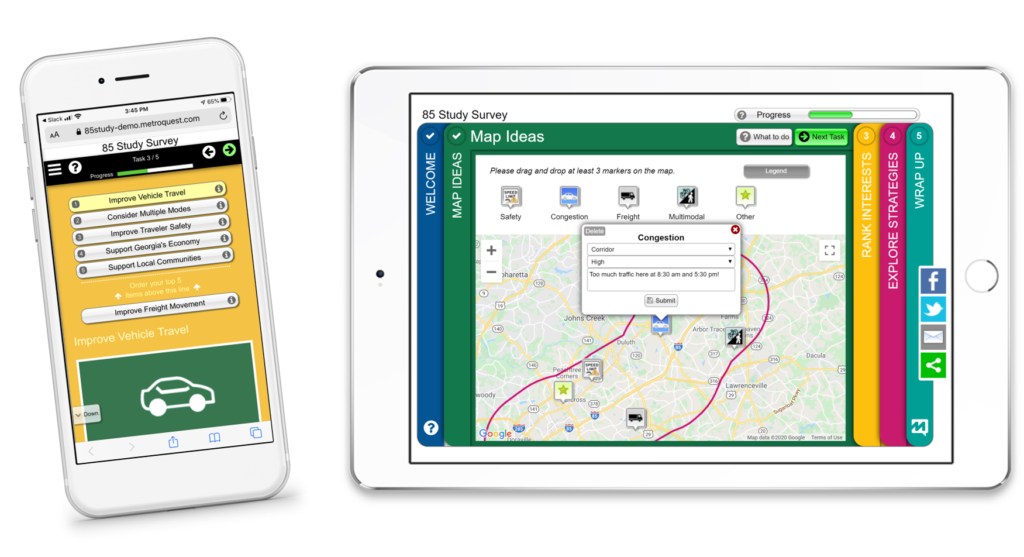
    5. Allow for specific and quick answers. Notice that the questions in WalkEC are drag-and-drop or can otherwise be answered in one click! For example, the map uses icons that can be dropped onto different areas, with drop downs that pop up to capture additional information. This makes answering the survey fast and easy, instead of forcing participants to verbalize and type out all their answers. This also makes it easier to aggregate the data afterwards. Win-win!

    Congrats to Jonathan and the entire team at Kimley-Horn & Associates, the North Carolina Department of Transportation, and Elizabeth City for creating a fun interactive experience for WalkEC!

    For more great tips on how to make the most out of MetroQuest, contact your Customer Experience manager or reach out for more information!

    Want to learn more about MetroQuest? Check out our recent webinar:

    Webinar_Optimizing-Planning

    Optimizing Online Engagement for Planning with MetroQuest

    Online tools are a critical part of the planner’s public engagement toolbox, especially as we look for safe, effective methods to engage during the COVID-19 pandemic. Find out which options result in positive, actionable community input for your urban and transportation plans.

  • How Planning Consultants Win Clients with Exceptional Public Engagement

    How Planning Consultants Win Clients with Exceptional Public Engagement

    Consultants competing for urban and transportation planning projects with government agencies are always looking for ways to differentiate themselves with a competitive edge. As firms and government agencies alike struggle with engaging constituents at public meetings, increasingly, leading firms are using online public engagement prowess to win projects and increase client loyalty.

    To learn more about this trend and what leading consulting teams are doing to enhance their public engagement offerings, we interviewed a range of firms, from the largest planning and engineering firms to smaller boutique public engagement firms. They agreed on three things:

    1. Planning projects present unique public engagement goals,
    2. The benefits for creating leading edge public engagement capabilities have never been greater, and
    3. When used skillfully, today’s public engagement toolbox can deliver game-changing results.

    The detailed results of this research are presented in a recent webinar recording: How to Optimize Public Engagement to Wow Clients on Every Project. Here’s a summary for quick reference.

    We found 4 unique goals for public engagement to support urban and transportation planning projects.

    #1. Increase public participation

    Agencies cite increasing participation as their top challenge, nationwide. With dwindling attendance at public meetings, now averaging nine people per meeting, increasing the number of people engaged to inform and support planning efforts is top of mind for government agencies. Planning projects represent major investments of public funds and require major public participation. Firms with case studies that can demonstrate large scale public engagement stand out.

    #2. Broaden demographics

    Environmental justice and other directives require agencies to demonstrate diversity in their public outreach. Several key demographics continue to be difficult to reach with traditional methods increasing the urgency to hire a team with a track record and a plan to broaden the diversity of participation well beyond the usual suspects.

    #3. Inform and educate

    Planning projects deal with complex topics and any meaningful engagement must demonstrate to decision makers that the public input was informed. Planning decisions involve constraints, trade-offs, visual-preferences, and other complexities that need to be embedded skillfully into the engagement process to gather trustworthy community preferences. Teams with a plan for weaving education into their outreach process instill confidence with agency representatives.

    #4. Quantify public input

    Anyone who’s had the ‘pleasure’ of summarizing hundreds or thousands of community comments can appreciate the benefit of collecting quantifiable public input. Agency planning professionals must summarize public input in a clear and easily digestible format for decision makers. Consulting proposals that demonstrate a concrete plan for collecting data on public preferences in well-structured ways will generate confidence. Today, public input must support data-driving planning.

    We’re always impressed with our friends at the national planning and design consulting firm, Kimley-Horn, who have consistently delivered great public engagement. To date, they’ve engaged over 68,000 people with online surveys and collected over 1.5 million data points to support both urban and transportation planning projects. That’s exceptional value for their clients! Stephen Stansbury, Vice President at Kimley-Horn, described the advantage of great online public engagement,

    “Thousands of data points have just become a customary result … that increased volume of participation increases confidence in the results and makes our planning process go that much more smoothly. It’s adding value to the communities that we’re working with.”

    We uncovered 8 benefits of leading-edge public engagement specific to planning consultants.

    Another leading firm that needs no introduction is Michael Baker International. Our friend Kenneth Mobley, Associate Vice President and Planning Manager, described the struggles facing so many consulting firms during our interview,

    “A lot of our meetings were having low attendance, and so, we were looking for something that was creative, that was online, and that we could use as an alternative to traditional meetings. We really needed to have something to distinguish ourselves from engagement firms that are small and very specialized. We needed a platform to get to a large number of people in a cost-effective way.”

    Kenneth turned to online public engagement surveys years ago to solve these challenges. Michael Baker International was among many firms that were interviewed, which cited the following eight benefits of going beyond the traditional methods and delivering best in class public engagement services for their planning projects:

    1. Impress clients with increased participation,
    2. Champion data-driven plans,
    3. Build public support and foster trust,
    4. Reduce risk of public backlash,
    5. Foster confidence with elected officials,
    6. Get innovative plans approved,
    7. Cultivate customer loyalty, and
    8. Gain a lasting competitive edge!

    Kenneth’s colleague, Lorna Parkins, Vice President of Transportation Planning at Michael Baker International described the impact of great online pubic engagement in serving her clients,

    “We’re able to go to decision makers and show them ‘we got this much input, and these were the findings.’ This gives them more confidence to tell us that they’re ready to move forward. They feel that what they’ve heard from the public is reliable.”

    In the webinar, we shared 12 keys success factors used by leading firms to optimize public engagement in planning projects.

    The webinar outlines 12 key success factors in detail that leading consulting teams are using to meet the unique challenges of public engagement for planning clients. To pique your curiosity, each team is doing these three things incredibly well.

    #1. Firms are dramatically lowering the barriers to engagement by using online tools.

    These consulting teams are focussed on using fast and visually appealing online surveys as a primary source of public input. These tools help to engage larger numbers of people on every project and reach a broader demographic than more traditional techniques.

    #2. They are weaving education into interactive online surveys to ensure that the public input they collect is informed.

    In order to ensure that the public input is informed, rather than providing documentation that is seldom read or detailed presentations that are poorly attended, leading teams rely on gamified and interactive tools that embed education into the survey process. The most successful teams have experience translating planning complexities into compelling questions and images that highlight trade-offs, limitations, visual-preferences, and other planning issues.

    #3. Leveraging social media and other cost-effective techniques to promote participation.

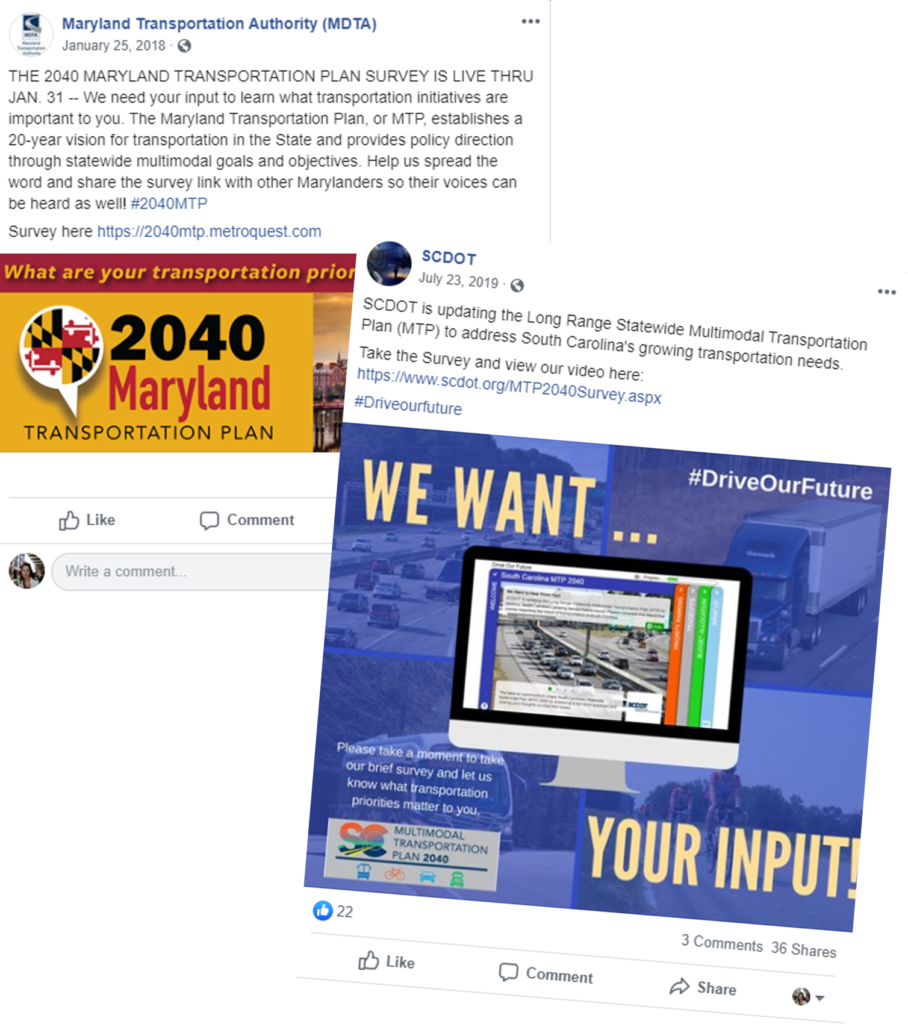
    A wide range of tools and strategies are available to agencies for promoting participation and targeting difficult to reach populations. To say that most agencies are overwhelmed by the options and unclear about which ones to use for which purposes would be an understatement. Consultants with experience and a track record for promoting participation have a significant advantage. Using boosted Facebook posts to promote their online surveys is one way that firms are repeatably able to engage thousands and impress clients.

    The most effective strategies for these areas and each of the 12 key success factors are described in the webinar video using case studies and feedback from our consultant interviews. We’d like to congratulate all the firms nationwide on their outstanding public engagement success! Thank you for the opportunity to share your stories.

  • The Evolution of Public Engagement at APA NPC19

    The Evolution of Public Engagement at APA NPC19

    Each year at the American Planning Association’s National Planning Conference, when I’m not presenting a session, I can be found in the crowd at any public engagement related session. And each year, I share my thoughts and lessons learned following the conference. 

    Compared with past years, on the surface, public engagement seemed less prominent at NPC19. A deeper dive reveals that the dialog about public engagement was woven into a sophisticated treatment of equity and inclusion. This trend was first noticeable at NPC18 in New Orleans. This year’s NPC took it to the next level. 

    There are too many sessions to cover comprehensively, so I will focus on the sessions that inspired me the most. The first session that got me scribbling notes featured Kim Lundgren of Kim Lundgren Associates, Inc. (KLA) in her talk, “Beyond the Usual Suspects: How to Deliver Ongoing, Equitable Engagement.” She described KLA’s approach to reaching beyond the usual suspects using a toolbox approach in recognition that each audience group may require a different tool or engagement technique. This session was a refreshing move away from the one size fits all solutions we’ve seen in past years.  

    My second inspiration came from the description of the role that the City of Loveland, Colorado’s Youth Advisory Commission (YAC) was playing in the city’s transit planning. The most exciting takeaway for me was the part of the process where YAC conducted peer-to-peer engagement to influence the city’s transportation master plan. I’ll be following the YAC carefully as this demographic is so critical and has been the most challenging to reach for many communities.

    I darted out mid-session to catch Darlene Flynn, from the City of Oakland, California, talk about “Strategies Toward Racial Equity in Planning.” I’m glad I did. Her powerful presentation about her work in Seattle and later in Oakland on racial equity in planning and city policy made it clear that it plays a central role in some of the most challenging issues facing cities and regions. She, and her co-presenters, encouraged the audience to look at the legacy of historical policies and planning decisions whose affects still linger across the country. The session dove deep into displacement, gentrification, economic inequality, criminal justice, and health disparities and connected these issues to historical planning policy so clearly that it changed the way I see cities. She made quite a few new fans that day, myself included.  

    I rushed from there to my own presentation on “Community Engagement Therapy” based on Pecha Kucha talk I gave at the Rail~Volution conference in Denver. 

    I offered a lighthearted and self-deprecating look at how vulnerable public engagement processes can be to vocal minorities and how new technologies can play a role in creating more balanced and safe ways for meaningful community dialog. 

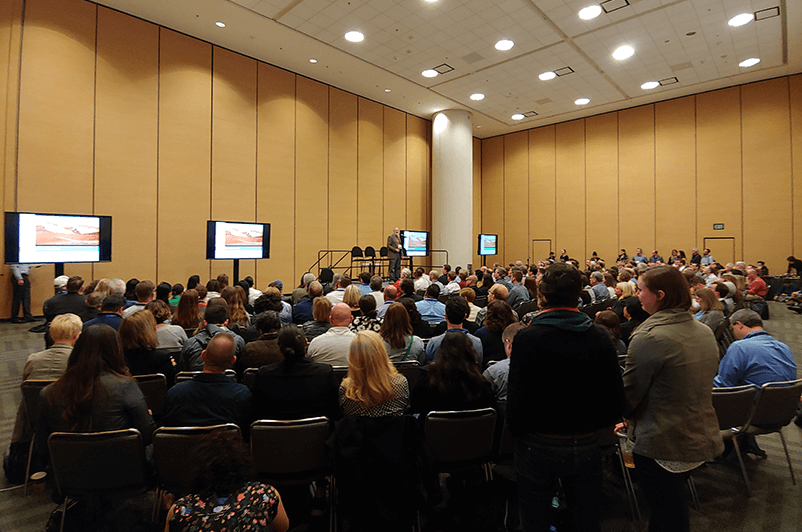
    APA NPC19 Session

    This “Fast, Funny, and Passionate” session was part of a series that the APA has been offering for a few years at the NPC and it is clear that they need larger rooms for these popular sessions. Our room seated 250 and organizers had to close the doors after well over 300 people crowded in!  

    Next up was an inspiring story about Akron, Ohio who is collaborating with community members to co-create public spaces to develop trust and inspire healing in this mid-size Rust Belt city. Citing increased polarization, segregation, social isolation, and economic inequality, this partnership with the national Reimagining the Civic Commons initiative is reinvigorating a civic pride and engagement in a way that can serve as a model for cities across the country.  

    Gabrielle Lyon of Lyon Strategies talked about the Chicago Architectural Foundation’s (CAF) Meet Your City initiative to engage with youth. As part of this initiative, CAF hosted a design competition and published a 144-page color graphic novel to help youth understand their role as city stewards and to encourage active participation in the planning process.  

    The passion and creativity of these planners to deeply understand and address the needs of all demographic groups in the communities where they work is inspiring. 

    I’ll use this inspiration to look more deeply into online engagement case studies to reveal best practices for reaching traditionally underrepresented populations. I’ve already found three excellent examples, so stay tuned for upcoming articles, case studies, and webinars.  

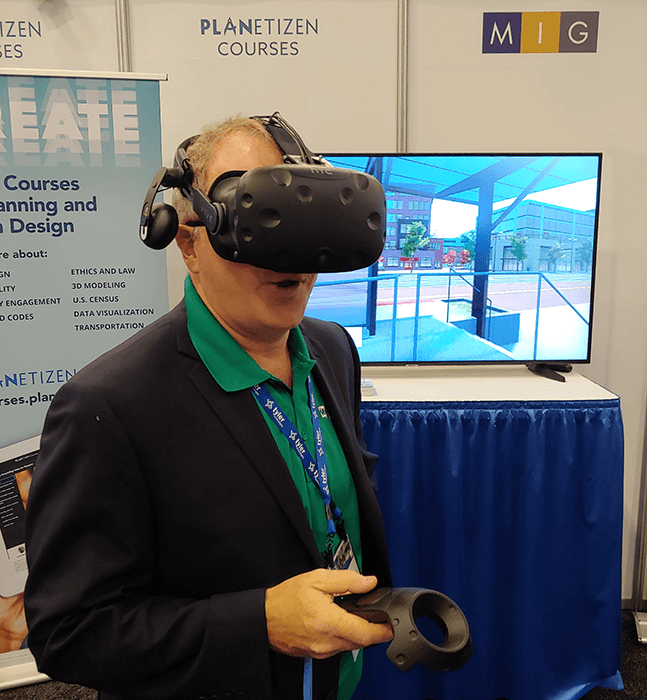
    I did manage to sneak in some fun time in the mist of all these amazing sessions. I had a great time playing with the Planetizen/MIG virtual reality setup.

     VR glasses

    Many thanks to the APA conference team for curating another thoughtful array of presentations and sending me home inspired to continue raising the bar for public engagement. I can’t wait till APA NPC20!