Category: Urban Planning

  • FAQ on The Ultimate Virtual Public Involvement Checklist Webinar

    FAQ on The Ultimate Virtual Public Involvement Checklist Webinar

    Our first webinar of 2023 was a success!  

    Dave Biggs hosted The Ultimate Virtual Public Involvement Checklist webinar to share details on our latest eBook release alongside Emily Margitan, one of the Customer Success Managers here at MetroQuest.  

    MetroQuest partnered with AASHTO, AMPO, TXDOT and COMPASS to compile a list of 101 questions to consider throughout the planning, engagement and reporting phases of every project.  

    In this webinar, we unveil key aspects of our new Checklist for Success and explore how asking the right questions can help your team deliver great virtual public involvement results on every project!  

    Here are a few clips from our live Q&A…  


    https://vimeo.com/796721338

    [scroll-box]Dave: Emily, Our team is new to VPI. What training or support does MetroQuest provide for customers to help them get started?

    Emily: Yeah, that’s a really good question. It’s something I’m quite involved in, in my role. And so, when new companies are onboarded at MetroQuest, we offer virtual training sessions essentially, and we can go through in detail with the software live with the team. Depending on how large the team is, sometimes it’s broken up into a couple of sessions and then we work really closely with those teams.

    So often we might even have typically a kickoff call with senior leadership to really talk about what are their goals, what are they hoping to get out of MetroQuest. And then we do the actual training of the software, a demo, and we go through and often it’s very customized depending on the organization in terms of what they’re looking to get out of MetroQuest.

    And then essentially I’m kind of their primary contact as they get started. I used to work in public engagement and design surveys, and so I love getting to work with teams closely on their surveys they’re working on. And so, you can kind of expect when you’re getting started that we will hold your hand along the way and help you get a sense of the software.

    And then to our support team is fantastic. They are really good at answering questions and a bit of a sneak peek: We have a live chat feature that’s going to be coming up soon! I think our new customers are really going to love that because when you, you know, there’s little things, it’s sometimes writing a whole email out seems really formal, so you can easily quickly pop up the chat and kind of talk to your team in real time.[/scroll-box]


    https://vimeo.com/796806092

    [scroll-box]Dave: What do you think are the biggest barriers to participation? So, maybe I’ll weigh in on this because I’ve got an acronym for this because I’ve been asked this question so many times. My acronym is TACK: Time, Awareness, Connection, and Knowledge. People lack often the time. People are working two or three jobs, you know, their time is of the essence. Public meetings are completely out of the question for a lot of people. So, keeping it short.

    Awareness: they might not even know that this project exists. They might not be connected to the agencies or follow them on Facebook and all that sort of thing. So just awareness raising is so important. Connection means: do they feel like the outcomes of this are going to impact their lives?

    Do they feel connected to it like it’s they’ve got some skin in the game in terms of the outcomes, and then knowledge is do they feel comfortable weighing in? Some people feel like, well, I don’t have any experience with transportation, so I don’t know if my opinions are valid. A lot of people kind of discount their own ability to have a priority about something. And so, giving people the confidence to participate is so important. [/scroll-box]


    https://vimeo.com/796806143

    [scroll-box]Dave: What suggestions do you have regarding hybrid engagement? Hybrid engagement has been the topic of the post-pandemic, if we can call it post-pandemic, period. So very quickly from me… if you’re going to have face-to-face engagement with virtual public engagement, the things to keep in mind are if you’re going to ask questions face-to-face, make sure that they’re the similar or the same questions that you’re asking online so you can actually combine the answers together.

    Oftentimes, with face-to-face engagement, you can go into more detail with people. You can really get the kind of a face-to-face experience and really get more information about the underlying concerns that people have about different options going forward. And so it’s an opportunity to really expand on what you might be hearing in volume online with some more nuance.

    So really take advantage of that discussion time with people to be open to what is it about this that makes you afraid or concerned? What is it about this other option that attracts you and gets the nuance around it? Emily, anything to add about hybrid engagement?

    Emily: I think you said that perfectly, Dave, and in my experience, often projects benefit in most cases from both because you’re going to have those stakeholders that are really, really invested in the project. Maybe there’s someone that lives right next door to where it’s happening and they’re going to want that forum to really get their opinions out and whether that’s, you know, around a table where you’re talking that can be really effective.

    But then you’re going to have people that don’t want to spend their evening coming to a meeting and they want to just quickly do a survey online. So I think, yeah, in most cases, it’s really going to be beneficial in many different ways.[/scroll-box]


    https://vimeo.com/796806165

    [scroll-box]Dave: Dave, if a project is controversial, does VPI open the agency to even more resistance? I’ve got a short amount of time here. I’ve got more to say on this. But essentially, the short answer is virtual public engagement actually does the opposite. By making engagement more difficult, you’re essentially filtering out all the people who aren’t angry at you, who aren’t willing to give up 2 hours to shake their fist at you.

    So, by making it really easy for people to participate, you’re actually expanding the range of people that participate to the people that are less motivated and typically less angry. Especially if you have a controversial project, you want to make it as easy as possible for people to participate so you can hear the full range of opinions and not just the people that are so fired up that they’ll go to any lengths to give you a piece of their mind, as it were.[/scroll-box]


    Access The Ultimate Virtual Public Involvement
    Checklist webinar now!

  • The Future of Electric Vehicles in Transportation Planning: An Interview with Andrea Noel

    The Future of Electric Vehicles in Transportation Planning: An Interview with Andrea Noel

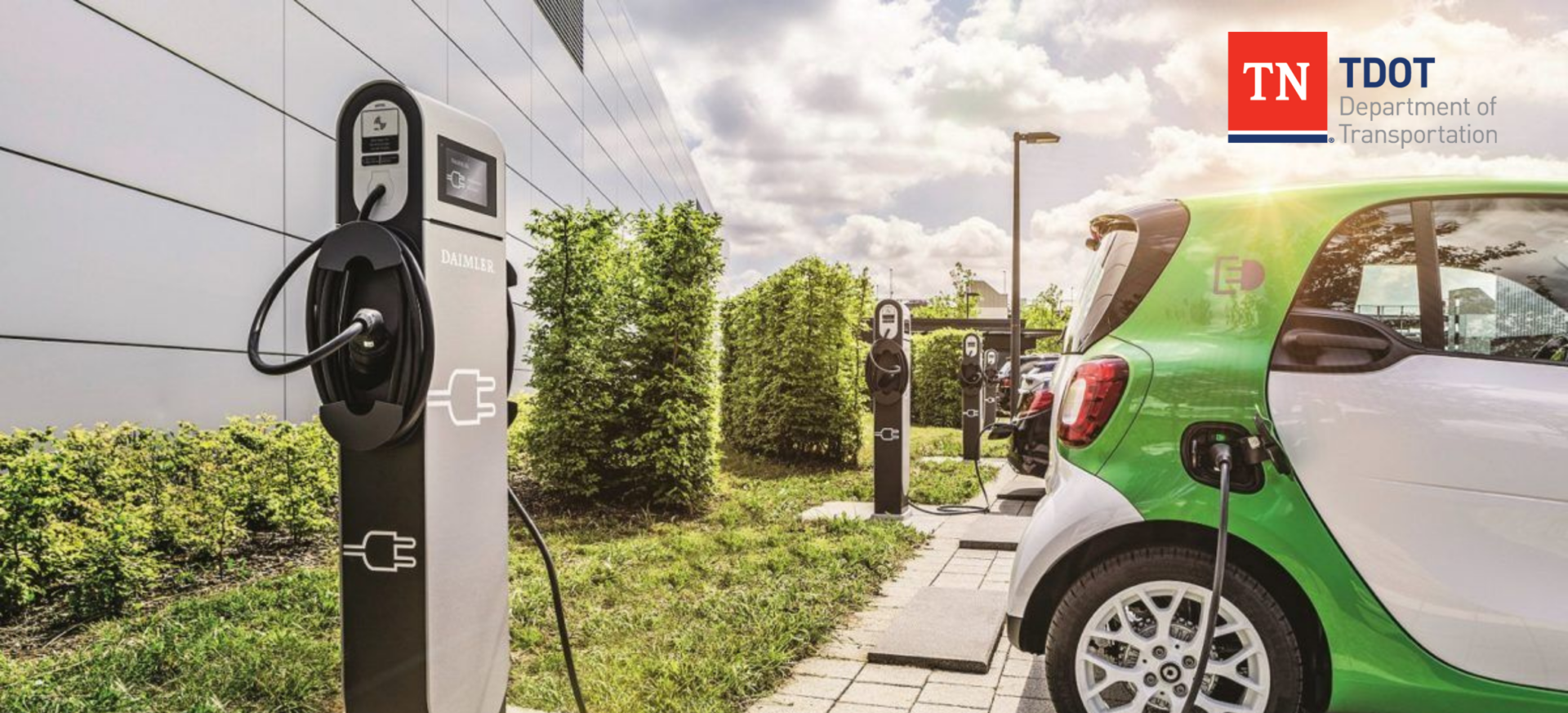
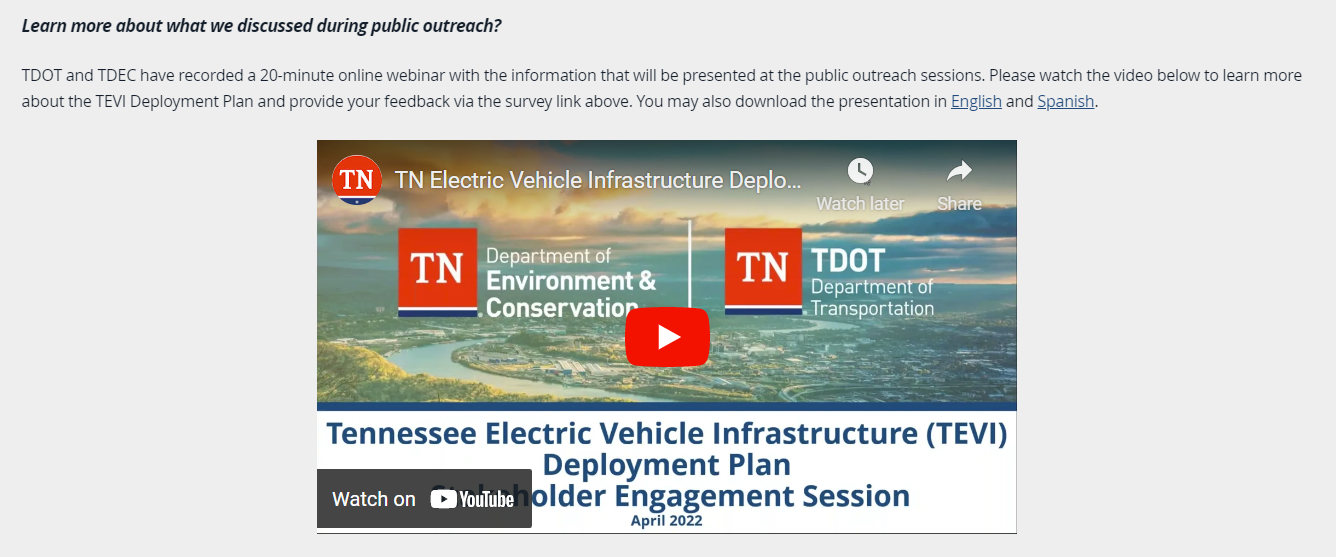
    The planning industry always needs to consider evolving modes of travel, and electric vehicles are climbing up the list. I recently had the opportunity to connect virtually with Andrea Noel, the Planning Supervisor for the Tennessee Department of Transportation (TDOT). The agency most recently developed a plan as part of their commitment to support electric vehicle technologies. Andrea gave us a complete breakdown of the Electric Vehicle Infrastructure Deployment Plan, which will support Tennessee’s mission to create a network of electric vehicle charging stations along key routes in the state.  

    Here at MetroQuest, we were intrigued to learn how the team at TDOT utilized our software for understanding the future of electric vehicles in transportation planning, and excited by the successful engagement efforts made by Tennessee DOT to gather public input on the plan! In our conversation, Andrea shared why MetroQuest was so useful for this project and discussed the strategies they implemented for their public outreach, how the results affected the plan, and what, in her opinion, the future holds for electric vehicles in transportation planning. 

    Continue reading to get all the details…  


    Why did you choose MetroQuest for your Tennessee Electric Vehicle Infrastructure survey?  

    Well, that was easy. We want to use MetroQuest for all our planning surveys because it provides such a good visual for people. With other software, sometimes people can’t answer the question exactly how you had it, or sometimes they don’t even understand the content. 

    It’s kind of like when you go to the voting station, right? And you’re like, oh, I didn’t read up on that guy. I don’t even know if I should vote for him or not. When you’re taking a survey, it’s similar. MetroQuest really gives you the ability to see it on a map and see where it is.

    I love that section where you can put a list of things and add a description and picture. I think that helps people answer questions with knowledge. I think that it is important to be able to give participants the information within the survey. That’s the part I love about it the most. I feel like it’s more than just a survey. It’s a way for us to give them information and educate them. 

    What strategies did you use to gather public participation?  

    Our whole public engagement plan was to use several methods for participation. We wanted to be able to go to people in person and also have a survey for those that didn’t show up. We traveled around the state, and we did nine locations in person. Our first step was doing a webinar and putting it on the website. And then we did the survey, which was open and collecting public input from May 1st until May 30th. 

    We just wanted to have a lot of different things so that everybody that wanted to participate could. We got 1,014 responses in that 30-day period.”


    We did have a social media campaign. We used Facebook, Twitter, and sent out reminders. We also had an email blast. We sent out over 7,000 emails to our stakeholder group. We sent the link to the survey and the dates and locations of where we were going to be.  

    During the in-person session, we had little cards printed with a QR code so they could click on them and be taken to the survey directly. At in-person events, they wanted to ask questions, but we didn’t feel like we were getting the answers we needed. The survey is what really gave us their prioritized choices. 

    What were you hoping to achieve by using MetroQuest? 

    We had two goals. Our first goal was to find out what people wanted when they drove up to a charging station. We gave them a list of ten things and said, which four things are the most important for you when you go to a charging station? The top concern turned out to be safety. But then we even broke safety down into, what do you want out of safety? People wanted to know that there would be lights 24 hours a day and cameras in case something happened.  

    When we start writing the guidance this week, safety is our number one priority. That’s going to be a requirement now because that’s what we got out of the survey. We’ll be putting their priorities into action.

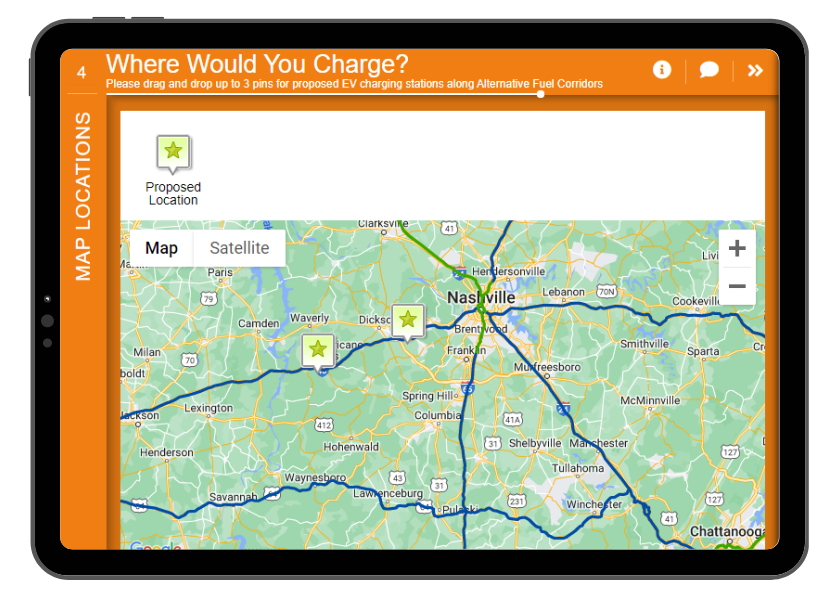
    The second goal was to identify specific locations stakeholders thought would be good for charging stations. On our last screen of the Survey, we had an interactive map activity. We built-in a location buffer because the charging stations must be within a mile of the exit. We buffered the map so that they could only click in a within a mile of that buffer. We wanted to know, where do you want to see the stop? Where would you stop if you were driving from one side of the state to the other? 


    How did the public participation results impact your plan priorities?  

    We didn’t even think about the plan. We didn’t think about the guidance. All we did was think about how to engage the public first. As the month went along, we looked at in-person and online comments and saw a lot of safety concerns. At the next meetings, we would say if safety were your first priority, what exactly does that mean to you? We were able to delve deeper into it. No one had any preconceived decisions or notions; we let the public decide for us what those priorities would be. 

    What results did you achieve on launching the survey, and what were the outcomes that came from the data?  

    The survey closed on May 30th, and during the first two weeks of June, we analyzed the data, which was easy because MetroQuest had already given us the map showing where people took the survey to see if it was relevant to where we had our in-person meetings. 

    We did find that the highest participation levels were also where we had our in-person meetings. We think going in person and promoting the survey helped boost those numbers.  

    Looking at the data, we discovered only 2% of participants identified themselves as being from the freight industry. I’m attending a statewide freight advisory group meeting to present again about the plan. We will meet them in person and ask for their opinions to put into the guiding document. 

    Having the Survey data helped us focus on who we think we missed.  

    What do you think the future holds for Electric Vehicles in transportation planning?  

    I don’t think it’s going away. We have to think about how it’s going to change how we plan because people can move differently now. We’re going to have to start thinking about where people are going to charge their electric vehicles. What are they going to be near when they charge? Are they going to stop and have dinner?  

    In five years, things are going to look so much different. As planners, we have to keep our minds open to the next thing because in likelihood, these chargers are not going to be here in 20 years. They’re going to be outdated in five, and then we’re going to have to be thinking about the next thing. We need to really start looking at our plans as being like five-year increments, more so than we used to do. 


    Congratulations to Andrea and the entire team at TNDOT! We’re so inspired by your public engagement efforts and looking forward to seeing how your impressive survey results shape Tennessee’s electric vehicle infrastructure planning!  

    For more ideas on successful public outreach, read our past interview with Adrienne Heim, the Public Information Officer for San Francisco Municipal Transportation Agency: An Interview with Adrienne Heim: Engagement Strategies, Tips and Techniques to Help enhance Your Public Outreach. Need help reaching diverse crowds? Read our latest blog 5 Equitable Community Engagement Tactics: What to Expect from #VPET22.  

  • 4 Survey Examples to Inspire your Next Transportation Plan Study

    4 Survey Examples to Inspire your Next Transportation Plan Study

    Community surveys can be a mixed bag in terms of effectiveness. Practitioners in planning, and transportation planning in particular, can have a difficult time catching the attention of their community when there are so many other things competing for their attention. But when done well, online community engagement can have a profound and meaningful impact on your project. With an eye toward the best examples of online surveys that achieved great results, let’s take a look at 4 different survey examples that will inspire your next transportation plan study. If you know what you’re looking for, feel free to jump ahead to the type of survey you need: 

    Planning Ahead: Survey Examples for Long Range Transportation Plans

    Long range transportation plans are all about learning the growth patterns and opinions of the community now, and gathering insight into how projects can meet growing demands of the future. 3 elements to consider when developing an online survey for LRTPS: 

    1. Gathering input early in the process. This will help generate interest and knowledge in the project, as well as help your planners identify community priorities. 
    2. Maintaining communication with the surveyed population over time. This could be done through post-survey reports, announcements… or even a follow up survey. 
    3. Giving context! Particularly because the results of the survey won’t be enacted for years to come, give context around existing plans, the latest update, and what you’ll do with the information afterward.

    In Treasure Valley, located in Southwest Idaho, the Community Planning Association (COMPASS) foresaw rapid population growth in their area over the next 30 years, and thus needed a way to understand how their citizens were currently using the transit system, as well as fine-tune a transit option that would suit the population now, as well as while it grew.  This survey example is actually a 3-in-1 example. COMPASS used a series of three surveys to first identify the public’s opinions on the future; get opinions on 4 scenarios derived from the results of the first survey; and finally do a deep dive into the scenario that proved most popular in the second survey.

    If you’re curious about how these surveys worked out (spoiler alert: very, very well) visit COMPASS’ case study for the full story!

    Mobility Options: Survey Example for Route Scenario Planning 

    How do you show different scenarios to the community, while conveying all the pros, cons, and tradeoffs that need to be made for each one? Scenario planning can be complicated, especially when it comes to gathering public input and identifying the option with the most public support! 

    3 elements to consider when developing an online survey for scenario planning 

    1. Showing the benefits and drawbacks of each option clearly. Your participants need to clearly understand the stakes.  
    2. Cutting out irrelevant details for clarity. What details do participants need to know to make an informed decision?  
    3. Anticipating additional options. Sometimes the community has different ideas for the region! Give participants a chance to provide input on their priorities in general. 

    Texas Department of Transportation (TxDOT) needed to ease the congestion around the city of Seminole, a major hub and important transportation corridor. The roadway provides access for the region’s agricultural industry as well as the energy sector, and faced mounting pressure and increased use. TxDOT wanted to gauge community properties and identify the best option out of the several that the agency had identified. 

    This survey example is a great one because it approaches the problem of conveying scenarios by giving participants two different activities to consider the same three scenarios. Take a look at the example survey below to see how that helps illustrate the options clearly and effectively.  

    Updating the Future Vision: Survey Example for Metropolitan Transportation Plan

    Federal mandates around updating Metropolitan Transportation Plans (MTP) mean that this form of transportation planning can take up a lot of resources. Particularly with a public engagement element, a welldesigned online survey can make the process easier. 

    3 elements to consider when developing an online survey for metropolitan transportation plans

    1. Setting expectations for participants. With regular plan updates necessary, creating routine or consistent engagement opportunities can improve participation rates over time! 
    2. Efficiently utilizing resources. With the regularity of MTP updates, consider dedicating some resources into developing the skills and tools you’ll need time after time. 
    3. Developing branding. If you’ll be regularly engaging the same community, it’s a good idea to establish a consistent and memorable brand—even if it’s just colors and a logo. 

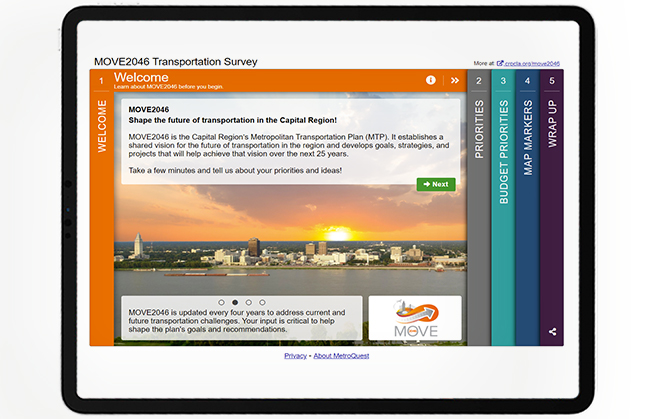
    In Louisiana, the Capital Region Planning Commission (CRPC) in Baton Rouge focuses a large part of its resources on updating the Metropolitan Transportation Plan every four years. By regularly updating a vision of future transportation, they’re able to coordinate with local governments and key stakeholders to ensure that projects support existing priorities in the region. 

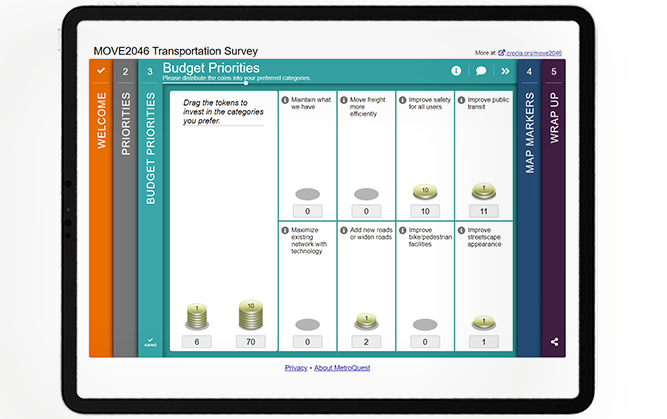
    This survey is beautifully designed, with well thought out placement of key information and interactive methods of gathering input. The team was familiar with the survey platform and used their expertise to build a very engaging survey, including a budget game to demonstrate resource tradeoffs, and a map to collect geospatial data around the region’s biggest transportation needs.


    Environmental Factors: Survey Example for Planning and Environmental Linkages
     

    With a focus on environmental aspects, Planning and Environmental Linkages (PEL) studies are a crucial part of transportation planning, particularly because of its impact on the National Environmental Policy Act (NEPA) environmental review process.  

    3 elements to consider when developing an online survey for PEL studies 

    1. Establishing data requirements. As an inter-agency study, it’s important to keep on top of each agency’s particular data needs.   
    2. Designing surveys with the outcome in mind. PEL studies have direct impact on how agencies plan transportation projects!  
    3. Developing realistic timelines. Although PELs minimize duplication of efforts between planning and NEPA processes, the additional stakeholders involved can complicate deadlines.  

    The Michigan Department of Transportation, working with AECOM, created this survey for a PEL study around Grand Rapids and Wyoming. The purpose was to evaluate improvements for a section of the US-131 around the conditions and safety of the corridor, as well as local needs, community development and economic growth.  

    The survey was developed in response to comments received during the initial study process. The team used clever methods to maintain data integrity throughout the survey, including limiting certain answers to drop-downs or multiple-choice, and designing the complex questions to feel short and not-overwhelming. 


    For more information, the Federal Highway Administration has some excellent resources on the 
    Planning and Environment Linkages page.


    What types of surveys would you like to see examples of next? Let us know in the comments! 


    To learn more about using online surveys to support your next transportation project, contact us for more survey examples or watch our recent webinar on-demand: 

    The Art & Science of Effective Online Surveys for Planning

    The Art & Science of Effective Online Surveys for Planning 

    The road to success with online surveys is part art and part science. This webinar explores both by unbundling the most successful MetroQuest surveys and what made them so effective!