Category: [WEBINAR]

  • [WEBINAR] Best Practices for Online Public Engagement for DOTs

    [WEBINAR] Best Practices for Online Public Engagement for DOTs

    This 41-minute video presents a series of case studies, best practices and tips to guide DOT’s towards the successful application of online public engagement for a variety of projects. Award-winning LRTP, STIP, TIP, NEPA, EIS, corridor, highway, transit, TOD and participatory budgeting projects that successfully leveraged innovative digital engagement are presented. From crowdsourcing platforms to interactive surveys to social media, the latest fleet of online engagement tools are making it so easy and fun to participate that they are drawing in thousands of participants and collecting constructive public input to inform and support DOT projects across the country. This session outlines best practices gathered based on hundreds of project case studies.

    Watch Recording

    View Slides

    Q&A

    Below are some of the questions that were asked during the Q&A session at the end of the live webinar.

    Q: Without a registration process, how do we avoid people participating 100 times and skewing the results?
    A: [Responded to in the webinar] Planning processes can be controversial and abuse is always a possibility. With MetroQuest we have tools and techniques to identify and help mitigate ballot stuffing in order to protect the integrity of the results. Any attempts at abuse are easily recognized and nullified.

    Q: Do you think your findings are equally applicable to projects other than ground transportation. e.g., water use planning, watershed management, etc…?
    A: Yes. In our review we also looked at water use plans, storm water management, environmental plans, etc. The lessons equally applied to those projects however they often had the additional challenge of dealing with a subject matter that was not top of mind for the public. I spoke at the American Public Works Association conference last year about Online Engagement for this sector and referenced a MetroQuest project that engaged over 10,000 participants in stormwater management for a public utility. They said they had never seen such high participation in a project like that. I think in that case the entire project team did a great job making the topic accessible and interesting.
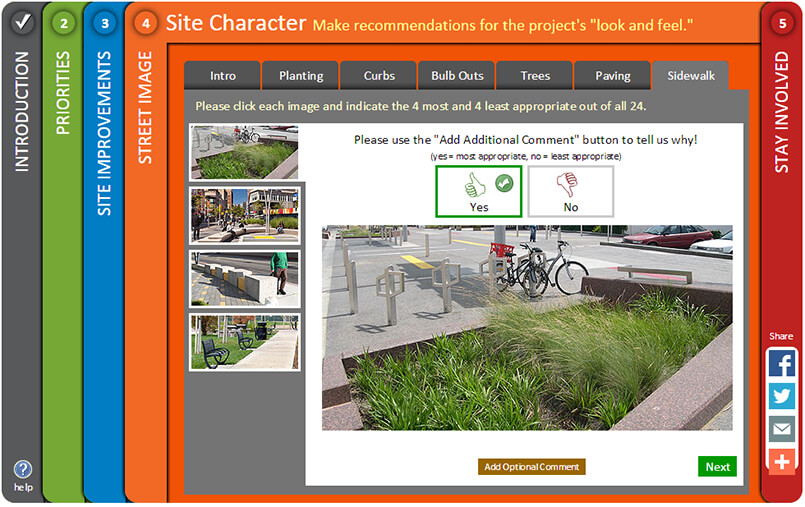
    Q: What is the process for setting up MetroQuest for a project?
    A: [Responded to in the webinar] Here is an excerpt from our “Public Involvement Software User Guide”. The MetroQuest team provides much more than software. Think of us as your trusted project partner with over 18 years of experience with digital engagement. We take care of setting up the software to meet the specific needs and goals of your project. We also guide you along the way to ensure the best results. The MetroQuest team works collaboratively with you and your team to determine the 4 or 5 screens that will best meet the needs of your project. We then use your content (pictures, phrases, branding, color schemes, maps, etc) to set up the MetroQuest screens. MetroQuest comes configured for mobile, tablet and desktop platforms so no matter how your participants wish to engage, we’ll make sure that their experience is delightful. Once MetroQuest is launched it’s time for your team to actively promote and monitor participation. We’ll back you up with great advice about how to maximize participation and even target particular demographic groups to ensure broad representation of your community. Download the guide here.

    Q: What tactic works best with communities of color? how do you engage EJ when they are less likely to have internet at home?
    A: [Responded to in the webinar] This is a big topic and I suggest you read our 8 tips to reach targeted communities here.

    Q: How does MQ get beyond the “vote” concept? Setting the expectation that the alternative or concept with the most points “wins”? Decisions are made on a variety of factors, so having an expectation that something will be selected based only on public opinion may backfire on the client.
    A: I totally agree and I realize in my presentation I used the word “vote.” We would not suggest using that word in the public interface for the reasons you cite. I think it’s critical to set expectations for how the public input will be used and not over promise. Great point. Thank you.

    Q: How are sites made ADA accessible?
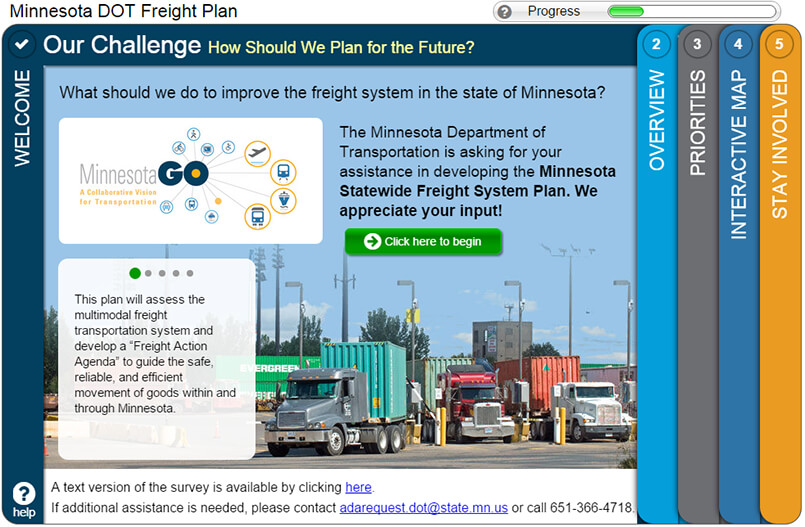
    A: Thanks for reminding me. I meant to point this out when I was showing the Minnesota Freight Plan example. Because of the visual and interactive nature of the tool, some people (such as those with vision impairment) will need an alternative way to participate. This can be easily handled in a variety of ways. In the case of the Minnesota Freight Plan, you’ll see an option to participate in a text only survey as well as contact information for additional assistance.
    Q: Do citizens also have a way to rate the planning process or event itself? Clarity is in the mind of the citizen, not the presenter.
    A: [Responded to in the webinar] Yes we often have often have evaluation questions at the end of the online engagement experience and have used those responses to monitor how we are doing and improve the tool. This kind of honest feedback is extremely useful. Most of the responses are very positive. It’s clear that there is a pent up desire to have an easy and fast way to participate and that online tools are fulfilling that need. The critical responses are helpful as they give us clues as to what we can do to continually improve.

  • [WEBINAR] Getting the Most Out of Online Engagement

    [WEBINAR] Getting the Most Out of Online Engagement

    This webinar presents an overview of the MetroQuest Public Involvement Software to help both new and existing users get the best results from their online community engagement. The video covers the latest features, screen types, best practices and tips on everything from planning and promoting your site to analyzing and reporting the results. You’ll learn about award-winning case studies that successfully leveraged MetroQuest in innovative ways to engage thousands, collect informed input and build community support for their projects.

    Watch Recording

    View Slides

  • [WEBINAR] Best Practices for Online Public Engagement for Transit Agencies

    [WEBINAR] Best Practices for Online Public Engagement for Transit Agencies

    This highly visual webinar presents a series of best practices, tips and case studies to guide transit agencies towards the successful application of online public engagement for a variety of projects. You’ll learn about award-winning LRTP, Mobility Plans, Station Plans, NEPA/EIS, Corridor Studies, Transit Master Plans, TOD and participatory budgeting projects that successfully leveraged innovative digital engagement.

    Watch Recording

    View Slides

    Q&A

    Below are the comments and questions from participants that were received during the Q&A session.

    Q: What if the comments from the community are not financially feasible?
    A: We often include financial constraints into MetroQuest for this very reason. People can come in with very unrealistic expectations and it is very useful to present real constraints into the engagement process to ensure that the participants are learning about these limitations and providing informed input. Take a look at some of the projects here. As one example, this project in Vancouver, Washington is clever. They ask people to choose a level of investment on screen 2 and then require them to raise enough funds to balance the budget on screen 4.

    Q: How can we get maximum involvement with the minimum budget?
    A: In general using some sort of online community engagement is more cost effective on a per participant basis compared with any of the face to face options. For online tools, I’d suggest looking at survey tools over crowdsourcing tools since they attract more participants. As far as online survey tools go, if you are focused on maximizing public involvement, MetroQuest currently has no peer, especially for transportation agencies. Since your goal is maximum involvement I would not suggest using a simple multiple choice survey tool. They simply don’t draw in participants in large numbers and likely won’t meet your goals. If you don’t have a great deal of budget and wish to conduct several projects per year you might be best off looking at an annual subscription which will allow you to keep your per project costs low while still taking advantage of results that you get with MetroQuest.

    Q: Will the slides be available?
    A: Yes indeed. They are posted here. I’m glad you found the material interesting.

    Q: How much should one budget for the kinds of projects that were demonstrated?
    A: We have recently started offering “all you can engage” annual subscriptions so many agencies are now using MetroQuest on multiple projects with no additional cost per project. That makes it a little more difficult to cite a specific per project fee. For agencies that use MetroQuest on a single project typically $12,000 is a reasonable budget number to have in mind. The precise fee depends on the scope of your project so it’s best to have a contact us for a quick chat about what you’d like to accomplish.

    Q: What other software options are out there that are similar to MetroQuest
    A: There are lots of tools but they are all very different than MetroQuest. We have found that it’s best to define the goals and needs of the project and then seek out a software solution to meet those needs. There are no other tools that we are aware of that are as well-suited to transit planning as MetroQuest (e.g. that have the visual and interactive features that planners look for, educate participants about choices and tradeoffs, are designed to be fast and fun to use, etc). There are however several other online survey software options available such as SurveyMonkey. These tools offer basic survey functionality such as multiple choice questions so it’s unfair to compare them with MetroQuest that is specifically designed with the needs and goals of transportation agencies in mind. We have found that on average MetroQuest engages 7.5 times more participants compared with a simple multiple choice survey due primarily to its popularity among participants. I hope it is helpful.

    Q: How can the needs of visually-disabled be accommodated?
    A: There are several great ways to accommodate people with visual-impairment without compromising the appeal of the tool for other participants. This is a very important topic and MetroQuest is leading the charge to expand the accessibility of online tools. I have recently written a blog post on this topic for Planetizen magazine. Check back on our blog for a link to it. It should be released shortly.

    Q: What role does door to door play?
    A: Door to door is generally a last resort of most engagement plans primarily because it is so labor intensive. It can be a useful strategy for very localized projects such as station area plans but even for these plans, broader community involvement is often useful since people interested in station design could live and work in a much broader area.

    Q: Do we work with rural clients?
    A: Yes, indeed. Many rural areas have difficulties with face to face engagement due to the spread out nature of the population. With the increase in online shopping and social media, online participation among rural residents has been rising rapidly.

    Thanks again for your interest and participation in this webinar.

  • [WEBINAR] Engaging Disadvantaged People in Planning

    [WEBINAR] Engaging Disadvantaged People in Planning

    The best public involvement is inclusive and increasingly it is being enforced as a requirement of planning efforts. At the same time, technology is changing the way we communicate. In response, the use of online public engagement is rapidly expanding, whether it’s on your laptop at home, kiosks in the community center or the smartphone in your pocket. However, when it comes to engaging vulnerable and disadvantaged people the question is – does technology help or hinder? This session presented a series of case studies, best practices and tips to guide project leaders that are attempting to engage some of the most difficult to reach citizens.

    Watch Recording

    View Slides

    Q&A

    Below are the comments and questions from participants that were received during the Q&A session.

    Q: What software did you use for the online survey example?
    A: The examples shown were from our own project portfolio using the MetroQuest Public Involvement Software. If you are interested, feel free to learn more here.

    Q: How much does a kiosk cost?
    A: MetroQuest has a preferred pricing arrangement with a firm that rents kiosk at discounted rates. Full sized branded kiosks rent for under $1000 for the first month and about $600 after that including return shipping. Smaller ones are about $200 per month. Software support for kiosks is included with MetroQuest. Please give us a call if you would like more information about kiosks.

    Q: What if you have limited resources, which method is cheaper and effective?
    A: When done well online engagement can yield the best results for the least cost per participant so that is typically the best place to start for projects with a limited budget.

    Q: Has anyone done this with the TIP after a MTP?
    A: MetroQuest has been used many times to facilitate the public engagement for TIP projects. Here’s an example you can play with. These projects typically use our “Project Selection” screen among others. We are currently working with NCDOT on 14 TIP projects throughout the state for their STIP process. Stay tuned for that. Feel free to use the comment section below if people are aware of other projects.

    Q: Government entities tend to be less receptive to techniques like this because of time, resources, etc. How can we convince agencies to adopt such strategies?
    A: The majority of our projects at MetroQuest are for government agencies so I think many of them are seeing the benefits of broader and more inclusive public engagement. It may be helpful to highlight the benefits to agencies that are less receptive. Here three short articles on the benefits for agencies.

    The ROI of Better Engagement
    Beyond the Opposition – How to Engage the Moderates
    6 Benefits of Digital Community Engagement

    Q: What are a few more examples of successful pop up events? Has anyone held a successful pop up event around public health/community health initiatives?
    A: One you might want to look at was the Juice Up 412 Community Engagement Project. I’m sure some of the attendees have examples to share in the comments below.

    Q: How could youth be engaged with more?
    A: I know from our own work that people under 25 can be difficult to reach. They often have no problem with the technology, but their minds are simply not on planning. If engaging youth is critical to your project it may be necessary to go to events where young people will be and encourage them to engage using tablets, their own smartphones or other tactics that don’t require technology at all (dots posters, idea walls, etc). We can help you set up tablets with MetroQuest for use in this capacity. It’s pretty easy but does require someone to take the time to find events and set up a table or engagement station. Technology like Textizen allows people to simply text responses to survey questions which may appeal to text-crazed youth.

    Q: Can you safely assume that many people have smart phones? What about digital divide in how the phones are used?
    A: The penetration of smartphones has been growing steadily over the past 5 years. A study done in 2014 showed that 61.3% of mobile subscribers from households with income less than $25k/year now own a smartphone. These number indicate to us that smartphones are an increasingly important option for community engagement. I would also caution that several other convenient options need to be provided to ensure that people without smartphones are able to participate.

    Q: Some of our communities have many New Americans, many of whom don’t speak English. Does anyone have examples of success with reaching individuals who don’t speak English, and for whom a digital option may not be possible?
    A: One of the participants noted an interesting example from Toronto below. I would suggest that peer to peer engagement techniques might be most effective in this situation. If you could find a bilingual community leader that you could train and support, they could conduct short community engagement exercises in a peer to peer manner. This could be as simple as a dot poster exercise or an idea wall at an existing event where these people are gathered.

    Q: BTW Metroquest, are you hiring?
    A: We are always interested in connecting with smart and talented people to add to our growing team. Please feel free to check out our careers page.

    Participant Feedback

    “What’s worked well for you? How have you broken down barriers?”

    • We have been most successful with pop-up events. Fairly easily we reached 800 people in St. Louis where community engagement is difficult.
    • Something we take as a best practice: when possible, provide food.
    • By providing child care and pizza we were able to attract people who might not have otherwise attended.
    • Some communities have youth groups, based at the rec centers or even congregat SB.
    • We have set up booths at church festivals, feed stores, and other community events.
    • I’ve heard and witnessed, many people with low wealth (low income term can be demeaning) even have smartphones. Goes back to your point about most ppl having access to internet only on their smartphone. (Dave: My apologies. I was not aware of the sensitivity around the term low income. Duly noted.)
    • We have reached ESL groups by going to citizenship classes, church groups, and house meetings.
    • Re: working with newcomer communities. In Toronto, we’ve done sessions with settlement agency workers – they can then pass on info/knowledge to their clients. Also, settlement agencies work in libraries and schools, and their workers often need to provide content for workshops they hold.
  • [WEBINAR] Best Practices for Online Public Engagement for Transportation Agencies

    [WEBINAR] Best Practices for Online Public Engagement for Transportation Agencies

    This 42-minute video presents a series of case studies, best practices and tips to guide MPO’s and DOT’s towards the successful application of online public engagement for a variety of projects. Award-winning LRTP, STIP, TIP, NEPA, EIS, corridor, highway, transit, TOD and participatory budgeting projects that successfully leveraged innovative digital engagement are presented. From crowdsourcing platforms to interactive surveys to social media, the latest fleet of online engagement tools are making it so easy and fun to participate that they are drawing in thousands of participants and collecting constructive public input to inform and support MPO and DOT projects across the country. This session outlines best practices gathered based on hundreds of project case studies.

    Watch Recording

    View Slides

    Q&A

    Below are some of the questions that were asked during the Q&A session at the end of the presentation.

    Q: What are the best methods you have heard of for getting the survey in front of people so that they will share it?
    A: From my perspective there are two aspects of this question. First, how do you make people aware of the survey and second, what can we do to encourage them to then share it with their contacts? Both of these questions are addressed in our Public Involvement User Guide. Inside you will find a section on effective methods for promoting participation and many insights into how to develop surveys that people want to share. This is the key! That, and making it easy to share with one click which is incorporated into all MetroQuest sites.

    Q: What is the typical participation rate through kiosks vs. other screen types?
    A: The participation rate for kiosks depends in small part on the branding and call to action stickers on the front (which we can advise you on) and to a much greater extent on where they are placed. We have found that places are where people are not in a great hurry are best: libraries, recreation centers, etc. We’ve seen participation rates as high as 200-500 participants per day in the best cases though 50-100 per day is more common. Here are the platforms we support and a rough estimate about what percent of participation you can expect from each: computer 50%, smartphones 30%, kiosks 15%, face to face 5%. Our Public Involvement User Guide provides advice on developing a multi-pronged engagement strategy that fits your project goals.

    Q: Has this been used in Washington State?
    A: Yes, MetroQuest is the most widely used online engagement platform in North America so there are case studies in most regions. In Washington State most recently we worked on the Street Funding initiative for Vancouver, WA. It’s an interesting site that combines the scenario, priority ranking and funding balance screens in an interesting way. Feel free to check it out here.

    Q: Is there a particular age demographic that this appeals to?
    A: MetroQuest is designed to appeal to the broadest demographic possible. Several of our clients have done detailed analysis on the participation by age group and compared it with the mix in the general population and each time the share of participation has been within 10% of the region’s population with one exception: youth. It used to be that seniors were the most difficult to engage online, but that has changed dramatically in the last 3 years. Here is a blog post about engaging seniors if you are curious. People under 25 that can be difficult to reach. They have no problem with the technology, but their minds are simply not on planning. If engaging youth in large numbers is critical to your project it may be necessary to go to events where young people will be and encourage them to engage using tablets or their own smartphones. We can help you set up tablets with MetroQuest for use in this capacity. It’s pretty easy but does require someone to take the time to find events and set up a table.

    Q: What are the cost for using MetroQuest? What is the cost for each additional language?
    A: MetroQuest is provided either as a subscription or for use on a project as a package. To support a project here’s the process and what’s included:

    1. The MetroQuest team collaborates with you (via a web meeting) to determine which of the MetroQuest Screen Types will be the most effective to use on the project.
    2. MetroQuest then provides a template for you to place content (text, images, etc) to populate the screens.
    3. MetroQuest does all the technical heavy lifting and sets up and refines the MetroQuest experience with your feedback.
    4. Once the software meets your approval, MetroQuest performs a suite of technical and user experience testing to ensure the software runs properly on all browsers and smartphones, and is accurately collecting and organizing participant data.
    5. Once MetroQuest is launched it is available for public use for up to 3 months. We’ll offer tips on how your team can promote participation and train you in the use of our MetroQuest Insights dashboard where you can monitor activity and analyze the data.

    The fee for this standard package of software use and related services is $12,000. If you need to support additional languages they can be added for $4,000 per additional language. If you plan to use MetroQuest on multiple projects we would be pleased to discuss subscription pricing options to reduce your costs. Contact us to discuss your needs.

    Q: Will a recording of this presentation be available to rewatch?
    A: Yes, the recording is provided above and you may feel free to rewatch it or share it with others. Thanks in advance for helping to spread the word about online engagement. It’s very gratifying to help so many agencies improve their outreach.

  • [WEBINAR] Best Practices for Online Engagement for MPOs

    [WEBINAR] Best Practices for Online Engagement for MPOs

    This 45-minute video presents a series of case studies, best practices and tips to guide MPO’s towards the successful application of online public engagement for a variety of projects. Award-winning LRTP, TIP, NEPA, EIS, corridor, highway, transit, TOD and participatory budgeting projects that successfully leveraged innovative digital engagement were presented. From crowdsourcing platforms to interactive surveys to social media, the latest fleet of online engagement tools are making it so easy and fun to participate that they are drawing in thousands of participants and collecting constructive public input to inform and support MPO projects across the country. This session outlines best practices gathered based on hundreds of project case studies.

    Watch Recording

    View Slides

    Q&A

    Below are some of the questions that were asked during the Q&A session at the end of the presentation.

    Q: How do you reach out to the target public?
    A: We’ve written two blog posts with best practices on promoting participation and reaching targeted populations (e.g. Environmental Justice). I hope they are useful. If there are specific groups you’d like to reach, please let us know and we’ll be happy to advise you on what we’ve seen work best.

    Q: We like the project “voting” in the Lee County example – how do you monitor multiple votes from one stakeholder group?
    A: Yes, I love the Project Selection screen. It’s a great way to collect public input on transportation projects. In each of our surveys we include questions at the end which allow you to determine how many people from each stakeholder group are participating. Using this data you can ensure that no one group is over or under represented. In addition, as I mentioned during the webinar, MetroQuest also has ways of ensuring that individuals are not able to vote numerous times in an attempt to skew the results. Check out some of our most popular screen types.

    Q: For the Lee County MPO, how much staff time was required to set up the interactive website?
    A: The staff time required varies a bit depending on which screen types are selected. In general, we’ll work with you to determine how to make the best use of material that you already have or are planning to develop for other purposes so that generating the content for MetroQuest is not a great deal of additional effort. We’ve found the range to effort to be 1-3 days of staff time spread out over a few weeks. See below for more about the development process.

    Q: Will the slides be available after the presentation?
    A: Yes, see the link above.

    Q: What is the approximate cost to create and maintain an online survey?
    A: MetroQuest is provided for use on a project as a package. Here’s the process and what’s included:

    1. The MetroQuest team collaborates with you (via a web meeting) to determine which of the MetroQuest Screen Types will be the most effective to use on the project.
    2. MetroQuest then provides a template for you to place content (text, images, etc) to populate the screens.
    3. MetroQuest does all the technical heavy lifting and sets up and refines the MetroQuest experience with your feedback.
    4. Once the software meets your approval, MetroQuest performs a suite of technical and user experience testing to ensure the software runs properly on all browsers and smartphones, and is accurately collecting and organizing participant data.
    5. Once MetroQuest is launched it is available for public use for up to 3 months. We’ll offer tips on how your team can promote participation and train you in the use of our MetroQuest Insights dashboard where you can monitor activity and analyze the data.

    The fee for this standard package of software use and related services is $12,000. If you need anything else (additional languages, extended periods of use, etc) we’ll be pleased to discuss your needs if you have a project on your radar.

    Q: Does MetroQuest integrate with electronic keypad voting systems for stakeholder group participation?
    A: Yes, MetroQuest has been used frequently with keypad polling systems in a workshop setting. It’s a great way for everyone to contribute equally (even the shy ones).

    Q: Is Spanish translation automatically included in the MetroQuest survey?
    A: Spanish or any other language support is available as an option. We do not use or recommend tools that rely on automatic translation since they often get things wrong, especially with planning options and concepts. Because there is not a great deal of text on the screens in MetroQuest, the translation task is not too time consuming to do manually and we have found that it pays off to get it right.

    Q: How does MetroQuest integrate with Facebook and Twitter?
    A: MetroQuest is integrated with Facebook, Twitter and other social networks via our sharing widget. People seem to like encouraging their network to participate on social networks so we have incorporated a one click system that allows them to spread the word quickly on the network of their choice. As a client, you’ll have an opportunity to write the default content that goes out so even if people don’t write their own post, what they share will convey your call to action in your own words. This has proven to be a very powerful mechanism to generate participation since people are much more likely to pay attention to someone they know and trust.

    Q: Who do you consider to be your competitors and what do you do better than your competitors?
    A: This is a big question but I’ll do my best to answer it. There are three “competitor” categories.

    1. Business as usual

    Our biggest competition is “business as usual” or not using online engagement at all. While the use of online engagement has been growing quickly, there are still many agencies that are slow to start. I spend some of my time demystifying this new world and allaying fears that it will bring in more opposition. We’ve found repeatedly that the easier we make it to participate, the more support agencies hear from people.

    1. Multiple choice survey tools

    In the online engagement world, there are tools like survey monkey that allow for multiple choice surveys to be presented online. While we don’t think anyone who sees what we do would compare us to a multiple choice survey, they both are technically online survey tools. What do we offer that is superior to online survey tools: a fun and visual interface that people are excited use and share with friends (quantity) and educational exercises that teach people about complex choices before they are asked to weigh in (quality).

    1. Crowdsourcing tools

    On the other end of the spectrum is crowdsourcing tools like Mindmixer that ask people for their ideas and other members of the community weigh in on those ideas. These tools, by their nature, require people to register and encourage people to come back repeatedly to see how their ideas are doing. This activity is appealing to a smaller group of highly motivated citizens (10x lower quantity) and generates input that can be difficult to quantify or ideas that are not practical (lower quality)

    [Mindmixer is no longer available and the organization that created it has focused on another direction. I believe there are other software options still available but their use by agencies is declining.]

    I know you asked me talk about what we do better but I don’t like to sound critical. I believe that there is a role for a variety of tools. I believe that MetroQuest is the best platform for engaging a large audience from a broad demographic and collecting informed and actionable input. This is not by accident – we asked agencies what they wanted to achieve and have focused all our energy towards those objectives.

    Q: What do you recommend for very small MPOs–staffs of one or two–who can barely eke out the time to do the basics? Small MPOs can’t always hire consultants…
    A: I recently gave a presentation at the TRB conference for Small and Medium Sized Communities on this topic and I understand the limitations smaller agencies are facing. Most of our clients in smaller agencies use MetroQuest directly and seldom hire consultants. A number of smaller agencies have turned to online engagement as a way to reach more people with less staff resources compared with public meetings. Of course this only works if you are able to reduce the number of public meetings. We’ve found that the cost of online engagement is often equal to or less than the total cost for planning and hosting a single public workshop. As I said in the webinar, many of the smaller MPO’s are in rural areas that are very spread out and it can be difficult to get people to travel long distances to attend public meetings so online options can be helpful.