Category: Urban Planning

  • [WEBINAR] Q&A: Facing Contention ~ How to Detox Public Engagement

    [WEBINAR] Q&A: Facing Contention ~ How to Detox Public Engagement

    Belmont

    Engagement

    They said they had 3,500+ touch points and 30,500+ data points. How did they count these and did it include the website unique views?

    The touch points included participation in public meetings, committee meetings (which were open to the public), the MetroQuest survey, and the website unique views. The data points were calculated as part of the analysis and summary of the engagement activities.

    Would have liked to understand whether the municipality participated in social media forums or was just an observer

    The City was an active participant in developing and executing the engagement strategy.  The City prefers to utilize surveys, comment forms, email, phone, website (www.belmontbridge.org), public meetings  and traditional press to solicit public comment and provide information.  Social media forums pose challenges – amount of staff time to monitor/answer questions, can perpetrate spreading misinformation provided by commentators, possibility to be dominated by opponents or grandstanders, etc.

    Budget

    Just curious about the budget to accomplish the project.

    First design effort began with $14.5 million and focus on utility (improving/adding multi-modal features, improved landscaping).  Due to public response and Council decision to pursue Enhanced Bridge Concept, budget was increased by $9 million with local funding & state grant to expand scope to include more design & enhanced aesthetics in addition to utility.

    What was budget for public engagement?

    The public engagement budget was approximately $400,000, which included the review of past design effort materials, development of the engagement strategy, project branding, website creation/upkeep, 6 technical committee meetings, 6 steering committee meetings, 3 sets of meetings with 5 focus groups, 3 community events (including a multi-day charrette), the MetroQuest survey, and presentation and hearings associated with the formal approval of the recommended design.

    Contention

    For the Belmont Bridge team, I assume that hostile groups still appeared. Would you tell me how you countered those groups with the information gained through your engagement plan? Or did you counter them?

    We definitely encountered groups and individuals focused on a narrow part of the overall design. To meaningfully engage these groups, we followed many of the best practices discussed during the call, including:

    • Worked in partnership with the City to identify known opposition and their viewpoint/objective
    • Listened to their concerns without allowing them to be disruptive. (These groups need to feel their input is genuinely valued but also measured against the project constraints, design program, and their other facts and opinions.)
    • Developed memos/material to directly and clearly respond to concerns and state project team’s position documenting data collected/regulations/standards/practices considered.  Materials used at later meetings and posted online.
    • If the process is sound, it will either win them over, or make it clear their views are not supported by the community at large, in which case they tend to fade out of the process
    • The City regularly engages with a local facilitator with credibility in the community to help manage disruptive voices at meetings.

    Process

    In the Charlottesville example, what was the City’s level of involvement in the public participation process? Was it largely handed off to the consultant, or did staff have a significant role?

    Staff played a significant role in establishing the engagement process and provided an important local voice and perspective during preparation. The City requested the consultant team facilitate meetings so technical experts could directly interact with the public/committees, which is appreciated in this community.  Staff, of course, participated in each event and would “step in” to answer the tough questions/provide direction when necessary.

    Can you discuss community values were captured and translated?

    Community values were captured during early engagement activities, including the initial steering committee meeting, the Mobility Summit, and the MetroQuest survey. It was important to state why community values were being documented and explain these values in clear and concise language.

    Did you use tools to translate technical drawings such as BIM?

    No

    Were the images used for weighing aesthetic preferences realistic renderings for what the project would look like or stock photos? If stock photos, did the public expect the project to look like those pictures?

    Stock photos were used for some design elements or themes for early engagement prior to development of conceptual designs. We made it clear that the intent of the images was to gauge where the community aligned relative to specific themes and values, and did not represent design intent.Once a preference for “look” was established, for this project the preference is for contemporary with limited “funky” details, examples are being refined through the design process to reflect City Standards (light fixtures) or for proposed treatments that can be accomplished with the project (bridge abutment cladding, railing, etc.)

    Results

    If you had to do it all over, what would you do differently?

    Knowing the difficult project history, we view this effort as very successful in terms of process and outcomes. Ordering better weather for our outdoor event would have been nice but did not hinder participation.

    What was the outcome for the bridge?  Show us the final design.

    Portions of the preferred design alternative was shown in the presentation and is attached.  A Design Public Hearing is being scheduled for May 2018 with construction in 2019.

    Questions and Responses

    There were so many questions that came in during our live webinar that we were unfortunately unable to answer them all. We have since had the opportunity, along with the help of our guest speakers: Jeanette Janiczek from the City of Charlottesville with Jonathan Whitehurst and Sal Musarra from Kimley-Horn, to answer these questions. Thank you everyone who participated for such compelling questions!

    General Questions

    I would like to share this with a client. Will there be a recording available later?

    Yes, the recoding is now available on-demand. Please feel free to share the link with anyone that you feel would benefit from the information. Here it is: https://metroquest.com/webinars/belmont-bridge-kimley-horn/

    MetroQuest Questions

    How do you prevent duplication of comments/feedback? Can you monitor if people from outside the region are participating?

    MetroQuest has tools and techniques to identify and help mitigate ballot stuffing in order to protect the integrity of the results. It’s very rare but, if it happens, these tools allow potential abuse to be easily recognized and nullified. The system also tracks the location of participants automatically so clients can be confident that participants are local.

    MetroQuest looks like effective public participation software. How can I learn more about costs?

    I apologize for not providing more in-depth information about MetroQuest. Due to the educational nature of this session I didn’t feel that it was appropriate. Pricing for an annual subscription for MetroQuest depends on the size and nature of your organization. I would suggest you connect with Derek Warburton at MetroQuest (by email to derek.warburton@metroquest.com, or toll free phone: 1-855-215-0186.

    Can you tell me more about the smart phone survey tools you showed?

    The images of the smart phone survey tools were from the Belmont Bridge project.
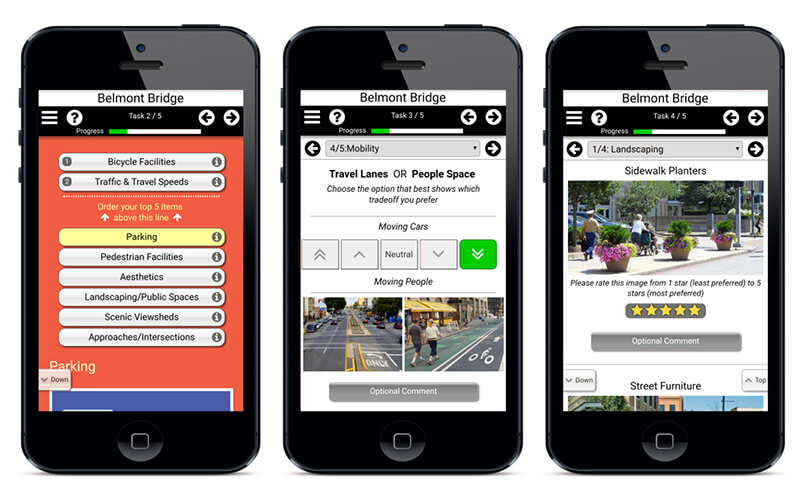
    This is how MetroQuest looks for participants using smart phones. MetroQuest automatically senses the screen size of participants and adjusts to ensure that the experience is attractive and useful on their device.

    How can we create safe online spaces?  We’ve gotten sadly familiar with trolls from around the world barging into our virtual civic space.  People are much more nervous about online privacy and protection from personal repercussions than they used to be, with good reason.

    MetroQuest has been specifically designed for privacy and to ensure that people feel safe and not subjected to trolls or other biasing or intimidating forces online. People are free to participate anonymously and there are no open forum comment areas which can attract trolls.

    Excellent tools! Is there a template available?

    MetroQuest comes with a suite of templates for various kind of engagement (priority ranking, visual preferences, budgeting, map input, scenarios, etc). You simply select the templates that you wish to use, add in your text and images and launch it to the public.

    I represent a consulting firm and am wondering if it is better for us to subscribe to a service to assist with public engagement, or have our communities sign up?

    That’s a good question. I can speak only to our experience with MetroQuest. There are many consulting firms and government agencies that make good use of an annual subscription. The advantage to consulting firms is that having a subscription gives them a competitive advantage in the services they offer and allows them to provide better results for their clients. Spread across many projects, the cost per project will be small. For agencies the advantage they talk about is to be able to use online engagement on even the small projects that often have very small budgets and little or no consultants. These smaller and less glamorous projects are as in need of public input as many larger projects and benefit greatly from the efficient way online tools can extend the breadth and reach of outreach. I’d say that if you have an opportunity to conduct outreach 3 or more times per year it makes sense to consider a subscription.

    Best Practice Questions

    Great session. Can you talk more about how to specifically engage vulnerable or under-represented populations?

    Yes, indeed, engaging environmental justice communities, non-English speakers, people with limited literacy or access to technology, people who are vulnerable or have mobility challenges and many other groups who are traditionally under-represented is an important challenge. As you might guess, it’s about much more than ensuring that you offer your engagement in different languages. While there are several design guidelines to ensure that online tools are more likely to be effective for engaging these vulnerable people a big part of the solution is to ensure that your engagement has an effective “go to them” strategy using pop-up engagement. Whether you set up a table with iPads, paper-based surveys or voting dots on boards, by picking events carefully, you can effectively target underrepresented audiences. The staff who attend can assist people as needed to accommodate wide diversity of participants.

    Much of the dialog on the Environmental Justice topic is focussed on language. I think this is much too narrow. Yes, engagement should be offered in multiple languages but that does not mean that people from different cultural backgrounds will participate. I think the most effective way to really engage these groups is by first engaging the leaders in their community. These community leaders are already trusted and sometimes are the only effective way to mobilize participation.

    How key is the educational aspect where you inform the public of things that they typically don’t include in their view on a project or specific project elements.

    Public input tainted by misinformation or lack of awareness of trade-offs and constraints can be worse than useless. It can lead to increasing community frustration. For this reason, the educational aspects of engagement are an integral part of the success for the project, particularly on contentious projects. The education can help broaden the perspective of participants to consider elements that they might not have considered, gain an appreciation of opposing views (empathy), and ensure that the input gathered is a true reflection of public preferences.

    As staff, how do you balance using good policy to override community consensus?

    This is a tough question. The policy should serve the public. If there is consensus against the policy presumably either: the public does not understand the implications of the policy and how it benefits them, the “consensus” is not truly representative of the broader community, or it’s not a policy that is in the best interests of the community. In my experience it’s typically the first two possibilities and the most effective response is to mount an educational engagement campaign and seek to reach a wider cross-section of the community. If it’s the latter then the policy itself might need to be re-examined.

    How does one handle an influential city official who wants to advance his or her individual preference?

    This is best countered by widespread and convincing public input. If the official continues to advance his or her position in the face of public preferences to the contrary, the official should be asked to defend their position in a transparent process.

    I would like tips for how to correct public misinformation campaigns.

    Misinformation campaigns can be difficult. It’s easy to get drawn into an unwinnable fight that makes the agency look defensive. My best advise is to make sure that people know about participation opportunities that you are organizing and that you welcome an open discussion about the topic. I have often seen that erroneous information get corrected by members of the public. It can seem too self-serving if agency staff are the only ones doing the correcting.

    One primary challenge we face is the lack of trust in the data or the need for change because they don’t trust local government based on poor public processes conducted in the past. How might that legacy of mistrust be addressed?

    To answer this properly could take a whole webinar. In a nutshell, trust takes time to build and a minute to lose. My top advice: admit that it’s a challenging situation with conflicting interests upfront, tell them about your constraints, do everything you can to demonstrate that you are hearing them and report back frequently about how public input is affecting the outcome. Do this consistently and trust will build. If you can’t comply, don’t worry. You don’t have to give in to build trust. Transparency is the key.

    What are some strategies to prevent a very vocal minority from dominating a process and intimidating other participation?

    The best defence against a vocal minority is to add the voice of the silent majority. Public engagement can be designed to eliminate or minimize opportunities for anyone to dominate the process. Try using table discussions instead of not plenary sessions with a mic in the middle. Try online engagement without open forum that invite trolls to grandstand, bias or intimidate others.

    How do you engage an uniformed and apathetic public?

    We touched briefly on this in the webinar and it is covered in more detail in this session focused on best practice. The main advice is to make it dramatically easier to participate by making it fast, fun and easy. Online tools are the most effective way to accomplish this but also setting up pop-up engagement tables at community events is another way to engage people who would otherwise not participate. As mentioned, it’s important to weave education into the engagement because, as you suggest, most people are not well informed  on government policies or planning matters.

    What is the most effective way to engage the “general public” to get meaningful input when you have limited monetary resources and time? (i.e. the low to moderately motivated groups)

    Because face to face engagement is labour intensive, online engagement can be effective in both saving costs as well as engaging the moderately motivated groups. Be careful to keep your online engagement short and as easy as possible. Keep in mind that people who are less motivated are also not as aware of the issues so some education should be built into the experience to gather, as you say, meaningful input. This on-demand webinar on-demand webinar covers this topic in more detail.

    What is the best and most efficient way to counter residents who say: “I don’t believe that data. I’ve done my own research and it completely contradicts what you’re saying.” Sometimes it appears that no amount of data will please people.

    As discussed in the guidebook, it’s important to avoid using data to address emotionally charged arguments. This is mistake often seen in case studies. If people are angry or frustrated no data will help them calm down. Practitioners recommend starting with the emotions. Probe for information about how they are feeling, what scares them about a project, how they feel they will be impacted, and make sure they know that you have heard. It was suggested in the webinar to talk about priorities. This begins to focus the dialog on what outcomes people want and what consequences people wish to avoid.

    This kind of discussion about priorities and values can be a powerful tonic for emotional participants. Once people feel heard and see that their priorities are represented (among others) the transition to talk about solutions can begin. It is at this stage where data can play a role. If people have other contradictory data it’s best to be open to considering it letting them know that your research says something different but that you are open to looking at their findings as well.

    Are there metrics out there based upon a municipality’s population to the ratio of the ideal range of public participation to achieve displayed as a percentage?

    There isn’t a consensus about the ideal percentage but everyone seems to agree that more is better, especially politicians and decision makers but also community members. According to statisticians who deal with community population polling, it’s typically less about a percentage of the population than it is about a number of people. Most information suggests that the number is about 30 people per cohort. What this means is that if you engage 30 people in a particular cohort and they for example rank ordered 8 items in order of preference, the order of the items would not change if you go on to engage 3,000 more in that same cohort. In our experience with MetroQuest this seems to be the case and it does not seem to matter if it’s an engagement in a town of 5,000 or a Metropolitan region. The trick is then, how many different cohorts or demographic groups do you have in your community with potentially differing views or needs related to the project. When add it up, needing 30 people from each different age groups, neighborhoods, economic groups, etc it becomes evident quickly that engaging large numbers is rather important if you would like to truly represent the diversity of the community.

    I would like more info on public engagement/public comment on routine planning items. Development plans and rezonings that do not engage the public beyond the legal requirements of public notice and the public hearings. Those hearings also often get toxic, people are very emotional, and planners tend to get blamed for projects that they are required to process. I would love more info from this type of perspective.

    I feel your pain. I lament the fact that big projects seem to get all the attention and that routine projects get little time on the podium. I think the best practices equally apply to routine projects. Bare minimum engagement that does not go beyond the legal requirements typically engages a very narrow cross-section of the community. Since it’s only the most highly motivated people who attend these required public hearings I’m not surprized that you find that they often get toxic. The moderate voices are comfy on their couches doing other things. It’s a big mistake to be too swayed by these minority voices as they seldom represent the opinions of the broader community.

    The problem is often that these more routine projects do not have a big engagement budget so running an extensive outreach process is often impossible. Online community engagement tools like MetroQuest are typically used on an annual subscription that allows for unlimited use. These be an effective way to dramatically broaden the engagement for even routine projects cost effectively since there are no incremental fees for using it more frequently.

    Most other community engagement tactics involve more labour but pop-up engagement can be done with little cost. This can be a great way to fill in some of the gaps for underrepresented demographics by piggy-backing on existing community events.

    I’m keen to know more about that diagram showing the extremes show up while people unsure or in the middle do not. Fits my intuition. How can this be useful for outreach, engagement planning, and cross-citizen civility efforts?

    I think the primary lesson in that diagram is that the high barrier to participation activities (e.g. public meetings) ensure that you hear mainly from the most polarized people. For that reason it’s best to plan those events to allow people to speak their minds and hear the perspectives of others who may hold a different view. In order for the loud voices to not be allowed to disrupt the entire meeting, most facilitators recommend table conversations with 6-8 people maximum with an agreed upon set of ground rules.

    The other main lesson is the need to include very low barrier options for participation such as the fun and interactive web tools used by the Belmont Bridge team. These are better suited to engage the more moderate voices and, if they are designed carefully, can be immune to tampering or being dominated by trolls.

    Do you have ideas for getting planning out to people even when’s there’s not a specific project or vote going on.  For example, I notice that the census bureau shows up at street fairs etc.

    I really like pop-up engagement as a way to reach people. By going to an event that is planned already and popping up some kind of simple display (table or boards on easels) it’s possible to reach people who would otherwise never find you.

    Can you share a case study where a meeting went off the rails and was salvaged?

    Sadly, people tend to shy aware from talking about meetings that go off the rails even if, in the end, they were salvaged. I think there is a great deal to learn from these situations. I wrote an article about one of my “fiascos” here https://metroquest.com/what-i-learned-when-an-angry-mob-destroyed-my-public-meeting/.

    I wasn’t able to salvage that particular meeting but I was able to apply some techniques in subsequent meetings on the same project that worked well. Based on the interest in the topic, it seems like a session on managing public meeting anger would be very useful. Stay tuned!

    There was not much stated about whether a municipality should just observe the social media forums or should they participate with information?

    In the guidebook it is recommended that you perform a social media scan as a passive “ear to the ground” manner. Too often agencies make the mistake in assuming that factual information is all that is needed to calm emotional people. It seldom works so I would advise caution with intervening in the dialog. It can be effective to ask for clarifying information, let them know that you are listening and share any information about how people can constructively participate in the process.

    Is it patronizing to lay out the rules of respectful public discourse at the beginning of meetings?

    Not at all. This is a best practice that is outlined in the guidebook. This can be done very diplomatically. For example: “Thank you everyone for taking time out of your schedule to be here. We’re here to listen and we’d like to hear from everyone. To that end, we’d like to get agreement on a set of ground rules that will allow everyone an equal opportunity to participate, even the quietest among us.” Do this as early as possible and refer back to it throughout the session. The motivation is not to silence any loud voices but rather to be fair to quiet ones.

    At a meeting, how to you diffuse a speaker who is angry and move the discussion to the purpose/focus of the meeting by not getting totally off-track?

    This topic is worthy of an entire session so stay tuned for upcoming sessions. In short, when participants get angry it’s best to acknowledge the emotion and invite them to talk more about their priorities and objectives. Draw it out with questions like, can you share with people why that is so important to you? Make sure they know you’ve heard them and understand their concern and then ask if others share that concern. When you are seen as approaching the subject as opposed to recoiling from it or defending a position the mood should shift for the better. When it is more settled it’s then time for a gentle pivot to opposing views. Ask if anyone can think of the what people with opposing views might say. Notice how I didn’t ask if anyone disagrees. That’s too intimidating for many. From there often the dialog can often proceed in a much more constructive manner.

    In general, it’s best in emotionally charged situations to avoid plenary discussions with a room full of people. Table discussions with 6-8 people are preferred.

    Psychological and behavioral pointers to keep in mind when facing contention – for instance don’t sit higher than the public (making them feel inferior). 

    There are a few ideas in the guidebook on this topic. The one that I feel is most important is to admit at the beginning of the session that it’s a difficult situation with valid yet opposing views. The biggest mistake I’ve seen repeated too many time is for the project team to begin the meeting essentially promoting or selling a project. This stance is typically irritating to people with opposing views.

  • [WEBINAR] Facing Contention ~ How to Detox Public Engagement

    [WEBINAR] Facing Contention ~ How to Detox Public Engagement

    If you looking are you looking for effective ways to collect meaningful and constructive public input for controversial projects this webinar is for you.

    Jeanette Janiczek from the City of Charlottesville with Jonathan Whitehurst and Sal Musarra from Kimley-Horn and Associates discuss their success with an innovative approach to public involvement on the contentious Belmont Bridge Replacement project.

    Numerous forces have combined recently to create an increasingly toxic and adversarial climate for public engagement. These patterns and their effects are being felt across the country and its planners and community engagement staff who increasingly find themselves on the front lines of this conflict. Finding ways to design and manage public engagement efforts to maintain a respectful and productive dialog and collect meaningful and constructive public input is more important than ever.

    This highly-visual webinar showcases the Belmont Bridge Replacement case study along with proven best practices, research findings, and practical tips to guide agencies towards the successful application of community engagement on hot button and contentious projects.

    Watch  this complimentary on-demand webinar to learn how to …

    • Create a public engagement process to mitigate tensions
    • Engage more people from a broader demographic to hear diverse viewpoints
    • Collect informed and constructive public input on contentious topics
    • Get past entrenched positions to understand community priorities
    • Work with opposing groups to create a more harmonious outcome
  • [WEBINAR] A Recipe for Award-Winning Online Community Engagement Featuring Elevating Erie

    [WEBINAR] A Recipe for Award-Winning Online Community Engagement Featuring Elevating Erie

    This highly visual 45-minute webinar presents research findings, proven best practices, practical tips and award-winning case studies to guide agencies towards the successful application of online community engagement for planning projects. Participants walk away with an understanding about how to leverage digital engagement to achieve unprecedented results using cost-effective tools.

    The webinar showcases a wide range of outstanding planning projects from the Northeastern US. Our special guests from the City of Syracuse and the Town of Dewitt join us to talk about the Elevating Erie project, one of the most innovative and successful outreach efforts we’ve ever seen. They discuss the innovative ways they combined online and targeted face to face community engagement to involve thousands of community members to help inform the process. They also share advice for agencies seeking to improve the diversity and effectiveness of their community engagement efforts and talk about the positive difference that broad community support is making as they move forward.

    Watch Recording

    View Slides

    This webinar featured three presenters: Dave Biggs from MetroQuest, Sam Gordon from the Town of DeWitt and Owen Kerney from the Syracuse – Onondaga County Planning Agency.

    Participant Comments

    Thanks so much for the great comments and kudos. Here’s some of our favorites:
    “The presentation was well crafted and interesting.”
    “Great webinar for public outreach. Very interesting. The tool looks very effective!”
    “Exemplary project presentation and “How-To” regarding the Public Participation/Open Process.”
    “One of the better webinars I’ve heard. Graphics were great.”
    “Great webinar. Really good info, efficient, relevant to my work.”
    “Interesting, upbeat, helpful as we will be writing a comp plan over the next two years.”
    “I really enjoyed this webinar and found it very useful and timely. It was a very visual presentation and I plan to look back at it again.”
    “Public engagement has always been a tough job. This webinar was great – highlights quickly what is working”
    Average rating: 4.75/5 stars

    [Wow, thanks!]

    AICP CM Credits

    Here is the direct link to claim your AICP credits from the APA. Note that the date trips people up. This webinar is part of a series so they instructed us to set it up as an “on-demand” session so you’ll notice that the start and end are a year apart.

    During the webinar Sam and Owen shared a video that they produced to promote participation but it was a little choppy so feel free to check it out here.

    Bonus Case Study: NashvilleNext

    Mentioned briefly in the webinar, this case study of the NashvilleNext process shows why they were the 2016 winners of the APA 2016 National Daniel Burnham Award for a Comprehensive Plan.

    Q&A

    Here are the questions that were raised by participants or that came in after by email that we didn’t get a chance to respond to fully during the session.

    Questions for MetroQuest

    Q: MetroQuest looks useful. Who is the best person to speak to for more information about it?
    A: [From Dave] I apologize for not being able to provide more in-depth information about MetroQuest due to the educational nature of this session. The best person is Derek Warburton at MetroQuest (by email to derek.warburton@metroquest.com, or toll free phone: 1 855-215-0186. Derek will be pleased to make sure you get the information you need. In the meantime, here is a quick video to give you a better sense of the software.

    Questions for Elevating Erie

    Q: How many staff people did you have working on the project?
    A: [From Sam] Between the City and the Town we had 4 different staff people working on different aspects of the project. We also had 3 different consultants who provided assistance.

    Q: What was the overall budget and funding sources for this project?
    A: [From Sam] Between the City and Town we spent approximately $85,000 on the Elevating Erie project inclusive of the design of the ideas competition, running the competition, coordinating the jury, building the exhibition, purchasing and putting together the Metroquest engagement tool. Roughly $35,000 was from the Town of DeWitt Local Waterfront Revitalization Program funding through NYS Department of State, $30,000 was from the City of Syracuse of Syracuse Brownfield Opportunity Area Funding also through NYS Department of State, and we also received a $20,000 grant from a local community foundation.

    Q: Have you done any analysis of the demographic difference of community members engaged via on-line methods vs. in-person? (older/younger? Resident/non-resident?)
    A: [From Sam] According to our survey responses, approximately 28% of our respondents were between 20-35, 30% were between 36-50, and 28% were between 51-65. – also approximately 30% of participants were from the town, 31% were from the City of Syracuse, and 26% from elsewhere in Onondaga County. 10 percent of participants were from other parts of New York State, and just over 4% of participants identified as outside of New York State. It was important to us to hear from a variety of audiences, and to be able to demonstrate that there was interest in this project from outside of the region, we feel that we were successful to date in being able to demonstrate this.

    Q: What’s considered a good length of time to run a campaign of this scope? I noticed on the Erie billboard the project was on display at the museum May through August. How long did you collect input?
    A: [From Sam] We collected input over a three month timeframe, which seemed to be a good window for sustaining both interest from the community and our own effort of scheduling and appearing at the various venues, speaking engagements, and media opportunities during that timeframe. [from Dave] 3 months seems to be a good standard for most of our clients. It’s important to keep the promotional effort going throughout to spur on new spikes in participation. It’s also useful as let people know that there is a limited amount of time and count down as the end get near to increase the sense of urgency.

    Many thanks for joining us!

  • [WEBINAR] A Recipe for Award-Winning Online Community Engagement with Plan Hillsborough

    [WEBINAR] A Recipe for Award-Winning Online Community Engagement with Plan Hillsborough

    This highly visual 45-minute webinar presents research findings and proven best practices, practical tips and award-winning case studies to guide Florida agencies towards the successful application of online community engagement for planning projects. Viewers will gain an understanding about how to leverage digital engagement to achieve unprecedented results using cost-effective tools. This session showcases a wide range of outstanding planning projects throughout Florida including Lee County, Venice, Satellite Beach, Broward, Jacksonville and the award-winning Seven50 project. Our special guests from the Hillsborough Planning Commission in Tampa, FL will be online talking about Imagine 2040, one of the most innovative and successful planning projects we’ve ever seen. They will discuss the innovative ways they combined online and targeted face to face community engagement to involve over 5,000 community members in the creation of a plan for the region. They will also share advice for agencies seeking to improve the breadth and effectiveness of their community engagement efforts and talk about the positive difference that broad community support is making in their implementation process.

    Watch Recording

    View Slides

    Participant Comments

    Thanks so much for the great comments and kudos. Here’s some of our favorites:
    “What a great session. Thank you so much Dave and Lynn.”
    “One of the best presentations on Public engagement I have seen. Well done and congratulations Hillsborough for a great job and setting a great example for us to follow!”
    “Great graphics and concepts. The presentation was insightful and delightful!”
    “Great suggestions for thinking outside the box when it comes to public engagement.”
    “Wonderful online presentation. Got a lot of out the speakers.”

    AICP CM Credits

    Bonus Case Study: NashvilleNext

    Q&A

    Here are the questions that were raised by participants following the presentations with answers provided by the presenters.

    Q: What was the budget?
    A: [from Lynn] $260,000 including all consultant work and public engagement costs. Many public engagement costs were provided or achieved at drastically reduced costs due to strong public-private partnerships.

    Q: Did Tampa have dedicated staff for the effort? How many?
    A: [from Lynn] The Plan Hillsborough staff of about 40 at the time serves various roles as staff and planners for the Hillsborough County City-County Planning Commission, the Hillsborough Metropolitan Planning Organization, and the Hillsborough River Interlocal Planning Board and Technical Advisory Council. Planners on staff participated as planners in preparation of the Imagine 2040 Comprehensive Plans for Tampa, Temple Terrace, Plant City, and Hillsborough County, and the Imagine 2040 Transportation Plan. The planners were joined by various staff to conduct the public engagement for things like community groups and big events.

    Q: Is the consolidated output of these meetings available to your market?
    A: [from Lynn] The Imagine Hillsborough 2040 public outreach process guided the update of the 2040 Long Range Transportation Plan and the jurisdictional Comprehensive Plans. Two phases of public engagement included: an online interactive survey, taken either via computer or using kiosks placed in various public locations; and were available at community meetings where audiences could take a paper version of the survey. Part 1, took place between August and November of 2013, with more than 3,500 people responding to the survey, choosing between three growth strategies: Suburban Dream showing what would happen if growth continued outward; Bustling Metro, focusing growth in our cities and towns and investing in transit; and New Corporate Centers, focusing growth along major highways. For Part 1 results, visit this site. Also view the Executive Summary of Part 1 (used at public meetings for Part 2) as well as the full Survey Results Report.

    Part 2 of the Imagine 2040 outreach started after the 4th of July weekend and ended on Labor Day weekend, resulting in over 2,400 responses. It consisted of an exercise/survey gauging how to fund proposed transit improvements over the approximate 26-year timeframe. For Part 2 results, visit our project site. The majority of the respondents resided in Tampa representing 38% of all responses. Northwest Hillsborough County had the second highest response rate with 24%, followed by South County with 17% and Central County with 13%. Here are the Part 2 Results.

    Q: How much did the engagement feedback shape the plan?
    A: [from Lynn] A lot – see documentation in the reports on the web page.

    Q: Did it lead to different results than if it had it not be undertaken?
    A: [from Lynn] The results of Imagine 2040 parts 1 and 2 and how they helped create a Vision to guide the Imagine 2040 Transportation Plan and the Comprehensive Plans for the Cities of Tampa, Temple Terrace, Plant City and Hillsborough County can be viewed at here and here.

    Q: Has this been used for any FDOT projects?
    A: [from Dave] I don’t recall contracting directly with FDOT in the past but MetroQuest has been used either directly or indirectly (through consultants) by most DOT’s in the US. Given the wide range of planning projects where MetroQuest was used in Florida I’m sure that some of them were FDOT projects. Feel free to contact us so we can help you find appropriate references or case studies.

    Q: What is the AICP CM event number?
    A: [from Dave] The AICP CM number is 9102565. Here is the direct link:
    https://planning.org/events/course/9102565/

    Q: One of the general MetroQuest projects slides included one project in Lee County Florida. What project was that?
    A: [from Dave] That could have been from one of two projects in Lee County. This first one was one involving growth priorities and scenarios and then another for the 2040 Transportation Plan. Please note that the first one is based on a previous version of MetroQuest so some features have been added or changed and since then.

    Q: Federal funding requires engagement in many efforts. Does it need to be for the “big” picture projects only?
    A: [from Dave] While the “big” picture projects seem to get the most attention, online engagement is useful for a wide variety of scales and types of projects beyond these big picture ones. I briefly showed the Parks Plan that Hillsborough is currently working on which is very different from the grand Imagine 2040 effort. In addition, one of the MetroQuest projects that I did not have time to discuss was the University Drive Corridor plan in Miami which focuses on alternative alignments of a small section of the corridor. This morning I reviewed this site that is using MetroQuest to collect input on an Aquatic Center so there are certainly a wide range of planning projects beyond the “big” picture ones where online engagement tools can be helpful.

    Thanks again for your interest and participation in this webinar.

  • [WEBINAR] A Recipe for Award-Winning Online Community Engagement with the City of Abbotsford

    [WEBINAR] A Recipe for Award-Winning Online Community Engagement with the City of Abbotsford

    This highly visual 45-minute webinar presents research findings and proven best practices, practical tips and award-winning case studies to guide agencies towards the successful application of online community engagement for planning projects. Viewers will walk away with an understanding about how to leverage digital engagement to achieve unprecedented results using cost-effective tools. This session also features our special guests from the City of Abbotsford, BC talking about Abbotsforward, one of the most innovative and successful Official Community Planning projects we’ve ever seen. They join us online to talk about the innovative ways they combined online and targeted face to face community engagement to involve over 8,000 community members in the creation of a plan for Abbotsford, BC. They share advice for agencies seeking to improve the breadth and effectiveness of their community engagement efforts and talk about the positive difference that broad community support is making in their implementation process.

    Watch Recording

    View Slides

    Participant Comments

    Thanks so much for the great comments and kudos. Here’s some of our favorites:
    “Really well organized and digestible.”
    “Excellent presentation. Concise discussion of lessons learned with real, transferable information.”
    “The best presentation on outreach I’ve ever attended (and I’ve done outreach since 1993)”
    “Wow! The webinar itself was a great example of effective engagement.”
    “Great webinar. Really good info, efficient, relevant to my work.”
    “The presentation was really well put together. I really enjoy when a presenter is able to get to the key takeaway first then dive into the specifics of that takeaway. Well done.”
    “Great suggestions for thinking outside the box when it comes to public engagement.”
    “Very good online presentation. Got a lot of out the speakers.”
    “This was a very helpful and insightful presentation. It provided good evidence on the effectiveness of online community engagement.”

    AICP CM Credits

    Funny Video Promoting Abbotsfwd

    Bonus Case Study: NashvilleNext

    Q&A

    Here are the questions that were raised by participants following the presentations with answers provided by the presenters.

    Q: Each community seems to create their own design, so does each community buy MetroQuest software and do their own product? How does it work?
    A: [From Dave] I apologize that I was not able to provide more detailed information about MetroQuest due to the nature of the session. We would be happy to provide additional information to those interested in a separate call. The short answer is that MetroQuest is available by annual subscription and clients simply choose from a variety of screen types to suit the needs of each project and then add their own content (words and images). The product is designed with a wide range of standard functionality and has a number of configuration options to meet the needs of a variety of projects at different stages. The community/agency is free to add unique content to create an engagement experience that matches the needs and branding of each initiative.

    Q: How can this information be translated into sustainable RURAL growth?
    A: [From Dave] Online engagement tools such as the ones demonstrated are used on all sorts of projects at all scales including many rural projects. The content is different when applied in a rural area but the functionality is similar. In fact, online community engagement is often a primary engagement channel for rural projects since, due to longer travel distances, getting people to come to meetings can be even more difficult than in urban areas. While internet access has become widespread even in rural areas, one must always be mindful of those without access. In many cases kiosks in general stores or community centres are a useful addition.

    Q: Are the infographics and MetroQuest tool accessible for persons with disabilities?
    A: [From Dave] Accessibility requirements can be met in a variety of ways without going to a 100% text based tool. This blog post outlines how MetroQuest and it’s clients are meeting accessibility standards and working to expand the definition of accessibility. With infographics such as the ones shown for the Atlanta case study, companion text description and image tags can be used to allow the information to be read by screen readers.

    Q: Who was in charge of the graphic design of the campaign?
    A: [From Reuben] The City hired a consultant early in the process to develop a brand package that included logos, colours, and other graphic elements. Once this was completed, City staff were generally responsible for adapting the graphics to fit a wide range of media uses, except in a few specialized cases.

    Q: What was the role of the City compared to the consultant when it came to engagement?
    A: [From Reuben] Early in the process, we recognized our effort would have the most impact if directed to expanding the engagement component, using consultant resources more for technical analysis and new perspectives. Although they attended some key events and workshops, and provided graphic material, City staff were responsible for approximately 75% of the engagement events.

    Q: How many weeks was the engagement?
    A: [From Reuben] Although the project was about 2 years long, engagement periods were focused and intense during that stretch. We started with 5 weeks in the summer of 2014 (Stage 1), followed by 6 weeks in early 2015 (Stage 2) and another 6 weeks in late 2015 (Stage 3), and finally 5 weeks in early 2016 (Stage 4). These periods of intense advertising and presence in the community resulted in high amounts of focused input, rather than minimal input that is drawn out.

    Q: How long did you plan before you launched the engagement portion?
    A: [From Reuben] See the above answer. With each of the 4 periods of engagement, advanced planning and preparation typically took about 2 to 4 weeks, depending on the diversity and complexity of the engagement activities.

    Q: How much time did it take to develop the overall engagement strategy? Did MetroQuest take the lead or was this a shared iterative process?
    A: [From Reuben] During the RFP process for engaging a consultant to help with the project, the City created a general outline of how we wanted to conduct the engagement, and requested this to be a key component of consultant proposals. Once a consultant was selected (DIALOG Design) we worked collaboratively to draft a final community engagement strategy (DIALOG included MetroQuest as their online engagement software) that focused on engagement activities. In addition, we had an internal corporate City engagement document to coordinate social media and advertising, with baseline targets for each activity. The engagement strategy was also iterative, and we adapted it as we learned what worked and online engagement was only one piece of the puzzle. Our involvement in the online survey was preparing the content by working with DIALOG.

    Q: What was the participation with the community conversations (% of total)?
    A: [From Reuben] We had nearly 8,000 interactions across multiple engagement platforms. This is not a measure of individual people, which would be extremely difficult to track since the engagement methods crossed so many different methods, but rather of how many times people interacted with a booth, survey, workshop, etc. Our city population is 140,000, so 8,000 interactions represent almost 6% of the population.

    Q: How did you complete the process once the plan was finished?
    A: [From Reuben] For engagement, we created a popup park where the draft plan was on display for 3 days and staff attended to answer questions. We also presented the draft plan to Council Committees and other groups. The comments received were used to refine the final plan as a bylaw, and then a final open house and public hearing. Going forward, our plan is to have some format of online or annual report on targets and achievements based on the new plan.

    Q: How will you close the loop with participants to report out how their input was used?
    A: [From Reuben] See the previous answer. Throughout the project, each Stage of work included a summary of the engagement input that was included in the Stage report. All of this material was presented to Council, posted on our project website, and taken to future events as background information.

    Q: What was the engagement budget?
    A: [From Reuben] Approximately $70,000 in direct costs, which included about $10,000 for the branding and promotion strategy, about $40,000 for the engagement activities (includes printing, space rental, honorariums, food, advertising, direct mailing, internet for iPads, Facebook, etc.), and about $20,000 for MetroQuest under subcontract. This does not include staff time.

    Q: What was the budget for the tools and logistics in particular?
    A: [From Reuben] Without providing a spreadsheet, this is difficult to answer but here are some general comments. It ranged from a few hundred dollars to advertise a series of events for a couple weeks in the newspaper, to a few thousand to bring in guest speakers for an evening mix and mingle talk, or create a popup park. However, our dollars were stretched through significant in-kind support from companies wanting to be a part of the project.

    Thanks again for your interest and participation in this webinar.

  • [WEBINAR] A Recipe for Award-Winning Online Community Engagement with Metro Nashville Planning Commission

    [WEBINAR] A Recipe for Award-Winning Online Community Engagement with Metro Nashville Planning Commission

    This highly visual webinar video presents research finding and proven best practices, practical tips and award-winning case studies to guide agencies towards the successful application of online community engagement for planning projects. Viewers will walk away with an understanding about how to leverage digital engagement to achieve unprecedented results using cost effective tools (see participant comments below). This session showcases some of the most effective case studies that have found innovative ways to combine online and targeted face to face community engagement to involve thousands of community members in the planning process. Participants will learn strategies to improve the breadth and effectiveness of community engagement efforts increase the level of community support to facilitate smoother plan implementation.

    Watch Recording

    View Slides

    Participant Comments

    Thanks so much for the great comments and kudos. Here’s some of our favorites:
    “The best presentation on outreach I’ve ever attended (and I’ve done outreach since 1993)”
    “Wow! The webinar itself was a great example of effective engagement.”
    “Great webinar. Really good info, efficient, relevant to my work.”
    “Really well organized and digestible.”
    “The presentation was really well put together. I really enjoy when a presenter is able to get to the key takeaway first then dive into the specifics of that takeaway. Well done.”
    “Great suggestions for thinking outside the box when it comes to public engagement.”
    “Excellent presentation. Concise discussion of lessons learned with real, transferable information.”
    “Very good online presentation. Got a lot of out the speakers.”
    “This was a very helpful and insightful presentation. It provided good evidence on the effectiveness of online community engagement.”

    AICP CM Credits

    Q&A

    Q: These campaigns were designed for larger metro areas. How could a small MPO in a smaller community get some success with a lower budget?
    A: [From Dave] From our perspective, MetroQuest is used by agencies of all sizes including many smaller MPO’s with very limited budgets so we have seen a wide range of scales of engagement efforts. While Nashville had hundreds of meetings and used a variety of online tools, smaller agencies would decrease both of these factors significantly. Typically, smaller agencies reduce costs by only hosting a couple of community meetings thereby reducing staff and consultant time dramatically. As far a digital engagement goes these projects often only use one online engagement tool as opposed to many as Nashville did. Typically, if one tool is used it is an online survey tool that has an attractive cost per participant ratio in the hopes of broadening the participation cost effectively. [From Greg] Trying the same tools, but scaling them back. Knowing your regular participants and regular gaps is key, to then select tools (speakers bureau, street teams, or whatever) that match.

    Q: In both presentations, it looks like the engagement was geared around scenario planning, and sometimes very specific scenarios. Is that the most effective way to gain public engagement? What if your plan doesn’t use scenario planning?
    A: [From Dave] The Atlanta case study did not involve scenarios. We find with MetroQuest, that less than one quarter of the projects involve scenarios. The rest use a variety of other screen types depending on the phase and public input needs of the project. With that said, scenarios are compelling as they provide a rich picture of a possible future and can be a tangible way to gain the attention of residents. [From Greg] I don’t think it’s the most productive, but for Nashville it matched our needs. The critical thing is finding engaging ways to structure the decisions your community needs to weigh in on.

    Q: In both Atlanta and Nashville – besides shaping the vision and end product…how impactful were these efforts in bringing elected officials & leaders on board?
    A: [From Dave] If you are successful in drawing in input from a large and diverse population, you can be confident that elected officials will get on board. That certainly happened in both these cases where over 18,000 people were involved. [From Greg] I don’t think it’s the most productive, but for Nashville it matched our needs. The critical thing is finding engaging ways to structure the decisions your community needs to weigh in on.

    Q: Speaker mentioned that “meeting to go?” did not work as well as it hoped. Any thoughts how it could be better?
    A: [From Greg] I’m not totally sure. It may have been that we had too much going on in that phase, and so we couldn’t focus the public’s attention on it.

    Q: For Nashville, how did you best get people to participate at markets, transit stations, etc. Was there a reward like a raffle, candy, or mugs?
    A: [From Greg] In one round, we had some raffle prizes (coordinated with prizes we recruited to give away to active participants on MindMixer). We also had shirts and tote bags in a different round. And we had stickers throughout – another good way to draw families over.

    Q: Did you find that more people would attend after online outreach or were those done simultaneously?
    A: [From Greg] Generally simultaneously. I think each fed the other.

    Q: What was the total budget for Nashville Next?
    A: [From Greg] About $300,000 in outreach consultant costs, plus 10-12 staff working 60-100% FTE. Several other departments and divisions participated in Resource Team meetings, but did not design, develop, or implement public participation.

    Q: What would the cost for Hispanic input have been had the Spanish language site not been used?
    A: [From Greg] I’m not sure. If you want to follow up with me directly, I can try to run the numbers without that.

    Q: What meaningful public input was gained for Nashville Next that Metro Planning wouldn’t have done otherwise?
    A: [From Greg] The prominence of affordability, largely due to traditionally under-represented groups. Affordability hasn’t ever been far from our understanding of community concerns, but it really came to the forefront in NN.

    Q: How long was the public participation process?
    A: [From Greg] All told, three years. Individual phases lasted two to four months.

    Q: How is the comprehensive plan provided online? Interactive? Static pdf document?
    A: Sadly, several static PDF documents right now. We’re working to get the action plan into the open data portal.

    Q: How is implementation affecting your existing zoning and subdivision regulations?
    A: [From Greg] Primarily through a current effort to add inclusionary zoning. Some minor updates. No comprehensive revision is planned right now.

    Q: Is book a planner like a road show or speakers bureau?
    A: [From Greg] Primarily a speakers bureau.

    Q: What is your take on Twitter Live Chats as a method of consultation?
    A: [From Greg] They’re okay. They weren’t a focus; we participated in one handled through the daily newspaper.

    Q: Albuquerque asks: What were the background reports and studies, and how did you pick the topics?
    A: [From Greg] They’re available here: http://www.nashville.gov/Government/NashvilleNext/Background-Reports.aspx. They were developed partly through our own sense of the community and partly in consultant with our Steering Committee. We went wide with the background reports and then narrowed and consolidated them into seven plan elements.

    Q: Was NextDoor utilized for sourcing participation?
    A: [From Greg] We didn’t have very much of a NextDoor presence when NashvilleNext was underway.

    Q: Did you use existing staff to do the staff level (non-consultant) work, or did you deliberately staff up to accomplish the task? What disciplines were the focus?
    A: [From Greg] Existing staff of planners, landscape architects, and architects.

    Q: What is cost for MetroQuest? Is it a subscription?
    A: [From Dave] I apologize that I was not able to provide more detailed information about MetroQuest due to the nature of the session. This session was not meant to be an introduction to MetroQuest and only included examples to highlight the lessons learned via the case studies. We would be happy to provide additional information to those interested in a separate call. I can let you know that MetroQuest is available by annual subscription and the cost varies based on the size of the organization. The Nashville case study compares the cost per participant of various online and face to face approaches at 38:30 in the video.

    Thanks again for your interest and participation in this webinar.