Author: Dave Biggs

  • [TIPS] Good & Bad News: 6 Trends in Online Community Engagement

    [TIPS] Good & Bad News: 6 Trends in Online Community Engagement

    Civic tech, and particularly online community engagement, has grown dramatically over the past few years. For years the field was in it’s infancy with only a few players and early adopters experimenting with new approaches. We’re now in the teenage years, with rapid growth in the number of vendors and agencies taking the leap. As every teenager knows, every growth spurt comes with both positives and negatives, and today’s world of online community engagement has its share of both.

    The Good News

    1. A Maturing Field of Vendors

    In the early days a great deal of online engagement tools were not yet fully developed platforms. Most of them were developed for one particular project and then an attempt was made to commercialize the technology to offer the same functionality to other projects. This product development pathway often resulted in products not designed for the needs of the broader market, making it time-consuming and labor intensive to customize for new projects. Nearly all of these early platforms, if they are still around, have matured into fully templated products that can be configured quickly to meet the needs of new projects. The newest platforms, for the most part, have been designed from the ground up with the latest “software as a service” capabilities.

    2. Costs Coming Down

    Partly as a result of the maturing of the software-as-a-service platforms offered and partly as a result of increasing competition in the market, prices have come down dramatically and are now within reach of even the smallest communities. This shift is opening up the market to a much large number of clients, many of whom have little experience working with these technologies. What is needed now more than ever are educational sessions demystifying and providing best practices and guidance on online engagement. Groups like IAP2, NCDD, and Planetizen Courses are helping and even more is needed.

    3. Technology and Expectations Are Driving Uptake

    According to Internet Live Stats, internet connectivity has risen to 88.5 percent in 2016 in the United States and Canada. This rise over the past five years, along with the penetration of smartphones, has been dramatic. While some critical populations are still left out, there is no denying that online engagement is a critical channel to broaden the reach of community engagement. It’s easy to see how much of people’s attention is now directed towards their devices so the importance of this engagement channel is clear. Given the cost effectiveness of many of the online tools, agencies are now able to engage an increasingly broad audience online and save some of the “boots on the ground” effort to target the underrepresented demographic community members.

    The Bad News

    1. Over Promising and Under Delivering

    The nature of start-ups and the pressure of their investors can create some unhealthy tensions. Tech start-ups often germinate with a great deal of passion around a new idea, a hasty business plan showing dramatic growth projections and high hopes of winning the attention of investors. The start-ups that do attract investment are often under a great deal of pressure to rush a solution to market and grow aggressively. This dynamic can introduce a great deal of confusion into the marketplace for clients. Since these technologies are new, it’s not yet clear how they will perform in the real world or what niche they will fill. Vendors, under pressure from investors, can be overzealous and create unrealistic expectations in order to secure early growth. If expectation are not met, agencies, particularly ones that are new to online engagement, can become disenchanted with online engagement in general, painting the entire industry with the same brush. The wisest and most savvy agencies realize that a suite of tools is needed. Despite marketing messages to the contrary, there is no one tool that will meet all of your community engagement needs. Take the time to look past the brochures, probe deeper and speak to other agencies whenever possible. If you are willing to be an early adopter of a new and somewhat untested technology, do so with a spirit of experimentation.

    2. Large Projects Getting the Press

    Planning conferences are filled with sessions highlighting case studies that have successfully leveraged online engagement. It’s great for people to share success stories and it’s very helpful when they talk about lessons learned and best practices that can be applied elsewhere. The problem lies in the types of projects that win time at the podium. Here’s a recent example: At the APA National Planning Conference in Phoenix, the city of Henderson took home the 2016 National Planning Excellence Award for Public Outreach. They had a great deal of success with online engagement and used a broad mix of other tactics as well. One of the first things you’ll hear in the award video describing the project is “funded by a $3.5 million grant…” I can imagine how disconcerting this must sound for other communities trying to increase the effectiveness of public involvement on meager budgets. If we primarily hear about major projects with big budgets, it’s easy to reach the conclusion that online engagement is reserved for those kinds of efforts. There are plenty of small projects that have had great success using online tools as a cost effective way to broaden the engagement but we seldom see them represented on the podium.

    3. Out With the Old, In With the New

    Online engagement tools are too often presented as solutions to replace outdated face-to-face engagement strategies. This may be due to overzealous marketing or simply a misinterpretation that happens when vendors try to boil their value proposition down to punchy bullet points. The result can be quite detrimental to the field in general. Firstly, as a practitioner in the field of online engagement, I’ll be the first to admit that no online tool has ever come close to replicating the rich interchange that can happen when community members and project leaders meet face to face. It’s foolish to suggest that one replaces the other. Secondly, many of the best potential advocates of online engagement are public engagement professionals who make some or all of their living planning and facilitating face to face events. To suggest that the value that they add is being replaced by a technology will only serve to alienate them. These savvy folks are keenly aware of the fallacy in this notion yet also aware how beneficial online engagement can be when woven smartly into a multi-pronged engagement strategy.

    Still, I’m optimistic. The online engagement field is seeing positive progress on many fronts. The infusion of new creative energy, investment and experiments that are happening all over the continent are great sources of learning. To the many communities who are weighing into this territory with caution, I wish you nothing but success. There’s a great deal of choice available and I know it can be confusing. The best advice I can offer is this: the more clearly you can state your goals and objectives before you go searching, the better prepared you will be to evaluate the capabilities of competing options to meet your needs.

    This article was published in Planetizen. 

  • [CONFERENCE] Community Engagement Highlights from APA 2016

    [CONFERENCE] Community Engagement Highlights from APA 2016

    Whether you attended the American Planning Association 2016 National Conference or not, you likely missed some of the great dialogue on community engagement, because the program was packed. As I do every year, I did my best to catch as many highlights, takeaways, and trends as possible. Here are ones that stood out for me from my four days in Phoenix. Please join the discussion in the comments to share your own takeaways.

    2016 National Planning Excellence Award for Public Outreach

    The big community engagement prize winner this year was Southern Nevada Strong, a HUD funded regional planning effort for Las Vegas and the surrounding region. The project team shown receiving the award above was led by the city of Henderson. This project exemplified best practices in community engagement in numerous ways. Three things struck me about their effort: massive online engagement in English and Spanish, multiple supporting strategies to target typically underrepresented groups, and unique urban ethnographic research partnership with the University of Nevada. The APA describes how their efforts paid off, “SNS received unprecedented community engagement and collaboration among local municipalities. The engagement efforts set a new standard among Sustainable Communities grant recipients. An estimated 6,000 community members participated in the process and nearly 70,000 inputs were received…” Congratulations to the SNS team and all of this year’s Public Outreach award applicants.

    The need to better define social equity

    One workshop on social equity sparked some valuable ideas. Cali Kay Williams from New York City Economic Development Corporation suggested that a more consistent definition of social equity is needed. She felt that given the looseness of the term, groups can cherry pick the elements that are most convenient to them and claim that their process meets the criteria. The dialogue then went further, suggesting that we need to better define metrics for community engagement, especially as they relate to social equity. So often we hear about how many people were engaged and not about the diversity of the participants.

    The importance of educating the community during the engagement process

    Jamie Greene from planning NEXT spoke about the challenge that many community members do not have the information they need to make choices that we are giving them. As an example he suggested, “We need to help people understand the financial implications of the choices during the community engagement on your comprehensive plan.”

    Other sessions built on this idea highlighting techniques like participatory budgeting and scenario planning that use interactive educational tools to highlight benefits, tradeoffs and real world constraints into the community engagement process. Victor Dover spoke about the Seven50 project in Southern Florida that presented scenarios online for the community input using MetroQuest. The scenarios illustrated the costs and benefits of alternatives and after over 2,700 participants had their say, to their surprise they found that over 73 percent of people preferred the scenario that focused on smart growth principles. He credited the educational components of the process with that outcome.

    The rise of targeted community engagement

    The award-winning Southern Nevada Strong team and many panelists this year were talking about the success they had dovetailing traditional and online engagement with targeted engagement to ensure broad representation. To be fair, targeted engagement is not new, but there is a dialogue emerging about the benefits and strategies for evaluating the gaps using a demographic analysis and then using specific strategies to target the missing voices.

    Darlene Walser of Hennepin County in a panel session entitled “Community Engagement in TOD Station Planning” talked about a three-level community engagement strategy. She recommended beginning with a baseline communications strategy followed by a formal public participation process and finally targeted engagement. It was this last phase where they had success leveraging partnerships with community groups to target difficult to reach audiences.

    Multigenerational engagement strategies from Baby Boomers to Gen Z

    One of the most interesting sessions for me was the panel on “Picking the Right Tool: Multigenerational Engagement.” Each of the panelists covered one generation and talked about their characteristics and strategies to engage them. There were many takeaways. The ones that stuck out for me were the lessons about Gen X and younger cohorts that they described as underrepresented in face to face community engagement.

    Linda Vela of the Alamo Area Metropolitan Planning Organization talked about Gen X born between the early 1960s and early 1980s. She described this cohort as fiercely independent, informal by nature, outcomes-focused and many caring for kids at home. Gen X are generally poorly represented in face to face community meetings so online and other alternative engagement strategies are suggested. Online, facebook is their preferred social platform and most will use laptop or desktop computers to surf the net over mobile.

    Tina Geiselbrecht of Texas A&M Transportation Institute talked about millennials or Gen Y born between the early 1980s to the early 2000s. Like Gen X, millennials are interested in engaging online though most access the internet on mobile devices and choose Instagram and Snapchat more than facebook so campaigns to leverage those networks can be effective.

    Trish Wallace of the city of San Antonio talked about Gen Z or boomlets born between the early 2000s and early 2010s. She talked about the benefits of using games and craft activities at community events to engage even the youngest residents. The results were compelling and these activities also gave planners an informal opportunity to talk to parents while the little ones were busy. Many of the tweens in this cohort are glued to their devices and love taking selfies. Trish talked about engagement strategies that invited people to take selfies in places related to the project as a way to engage youth in the dialog about community planning.

    I tip my hat to these planners who took every opportunity to broaden the community engagement to include each cohort.

    Creative ways to combine face to face and online engagement

    In years past online engagement has been presented like a silver bullet touted to solve all of community engagement’s challenges. This naïve notion seems to have dissipated and the dialogue now has turned to a toolkit approach to leverage the strengths of a variety of engagement tactics. Michelle Nance of the Centralina Council of Governments demonstrated this well as she presented their project called Connect Our Future, a regional growth plan for greater Charlotte, NC. Early in the process they engaged over 400 participants in one of the largest Reality Check events ever held. These hands-on workshops allow participants to allocate expected growth using chips or legos on large-scale regional maps. The four scenarios that emerged from this process were then loaded into the MetroQuest online engagement tool to allow the broader community to assess and provide input on the scenario options. Nance reported that over 8,400 people were engaged and closed by saying with satisfaction that, “Everyone said it would be impossible to reach consensus but we beat the odds.” What struck me the most is the value of the co-creative process of coming up with the scenario alternatives with hands on input from residents early in the process before going out to the broader community online.

    Techniques for dealing with contentious groups and individuals

    The heat must be on because several sessions highlighted tools and techniques for dealing with contentious participants at community meetings. Della Rucker of the Wise Economy Workshop ran a session called “Manage the Ax-Grinders: Do Better Public Participation” and led participants through role play exercises and provided tips on dealing with disruptions. In particular she highlighted the value of breaking into smaller group discussion to encourage people to work together constructively while also giving more time for each participant to speak.

    Roberta Rewers of the APA led a session on “Working with Contentious Groups” and provided helpful tips to prepare planners for community meetings. She highlighted the need to establish and reinforce rules of civil discourse and define the purpose and agenda of the meeting early on. When disruptions happen she recommended that leaders do not debate, mind their manners, thank individuals for the comment and do what they can to stay on track and stick to their key messages.

    Participants chimed in with additional suggestions including sitting down and talking with a vocal community member in advance of the project moving forward to allow them to be heard while avoiding public disruptions.

    One participant said that when seeking community input, tables in the round didn’t work in his community as like-minded people would band together and make people with a different opinion feel like outsiders. This may be another reason to heed Della’s advice and break participants up into table discussions.

    The spirit of these discussions was about giving people equal opportunities to be heard and avoiding disruptions that might compromise the right of other participants to have their say by either dominating the dialogue, hijacking the agenda or intimidating others so they are afraid to speak up.

    Building trust and creating an engaged community

    Several panelists highlighted the frustration that many community members feel about not feeling like they have been heard. Begin transparently about what’s on the table and how the community input will be used was a common theme. This year more than ever, panelists were talking about the value of communicating with the community following the engagement to reinforce the value of participation. Darlene Walser of Hennepin County commented that, “When people start seeing what they say reflected in the plans they remain engaged and engage again next time.”

    Overall, APA 2016 did not disappoint. It had community engagement enthusiasts looking for a cloning machine. I look forward to hearing other insights that people took away from their time in Phoenix.

    This article was published in Planetizen

  • [TIPS] What I Learned When an Angry Mob Destroyed My Public Meeting

    [TIPS] What I Learned When an Angry Mob Destroyed My Public Meeting

    One of my pet peeves is how we fill conference programs and websites with the most successful case studies and we don’t talk about our most potent learning experiences – when things went wrong. Maybe we just need a safe place to talk about these important learning opportunities. When things go wrong in public engagement, they can go spectacularly wrong. The result isn’t just frustration for project leaders. It can spell costly delays, failed or overturned planning efforts, or the loss of public support for politicians and government agencies. Introducing the Fiasco Files – a lighthearted opportunity to look back on those times when things went sideways. We’ll have some fun with it and also draw out some valuable lessons that will help us all avoid them in the future. Names will be withheld in order to avoid any embarrassment to any people or organizations involved and keep the focus on the lessons learned. These stories could happen to anyone.

    Fiasco Files #1: A Vocal Minority Dismantles a Community Meeting

    Being vulnerable and talking about personal disasters can be intimidating so I’ll go first. This is the story about one of the last public meetings I ever facilitated. I was on the public engagement team that was charged with conducting a series of community workshops throughout a metropolitan region to discuss a long range regional vision for land use and transportation. The first few workshops were held in urban areas and went smoothly. We weren’t aware what was brewing as we prepared for our 3rd workshop – this one in the suburbs.

    We learned later that the evening before the workshop a local group of people strongly opposed to the direction that the planning process seemed to be going met privately. They studied a manual on how to disrupt a public meeting and developed a strategy. With the project team blissfully unaware, this group of 40 or so arrived the next morning and positioned two of their members at each of the 20 tables set up around the room. A mere 30-seconds into my introduction it started.

    One by one, members of this group started interjecting, some by raising their hands, others by shouting out. When one would say their piece, a cascade of approval spread around the room as other members of the group chimed in. I still recall the looks on the faces of the non-group members which made up the majority of the audience (though it was hard to tell since they were silent). It was a look of “Gee, I’m the odd duck here.” In speaking with participants afterwards I heard statements like, “I disagreed but everyone seemed so fired up that I kept my head down.” These sentiments spoke to the effectiveness of the intimidation and influence that a vocal minority can wield at a public workshop.

    Despite the finger-pointing, personal attacks and criticisms leveled against me as a representative of the agencies involved, I listened to their input and tried in vain to move forward on our agenda. I was under strict direction from the lead agency that participants should be allowed to have their say for as long as they wish. When we were 45-minutes into the session and still barely past the first stage of our workshop plan I took a moment to confer with the team. “Let them talk” was the directive. Needless to say we were unable to follow our workshop plan and we did not collect any structured input that could be compared with input gathered at other workshops. We left feeling frustrated, humiliated and sympathetic for the majority of the participants who were robbed of their opportunity to express their views by the vocal minority.

    Anyone who has a few community workshops under their belt has experienced a disruptive vocal minority though they are not always as well-organized as they were in this case. With the benefit of hindsight there are several things that we could have done to help the situation. Here are some steps that helped at subsequent workshops:

    1. We got into the habit of making the rules of conduct at the workshop clear and got the audience to agree to them at the beginning of the session.
    2. If people disrespected the agreed-upon rules of conduct steps were taken to restore order – gentle at first and if those didn’t work, increasingly direct. On one occasion a little humor alleviated an outburst.
    3. On other occasions we used the wireless voting keypads to ask the audience whether they wished to continue entertaining interruptions or move on with the agenda. Because of the anonymity of the handset voting, the vocal minority was outnumbered by a wide margin.
    4. In some situations we reduced the opportunities for disruptive plenary outbursts by organizing table discussions.

    I’d like to say that these measures fixed everything. They certainly helped a great deal but there still was moments of chaos and disruption at the remaining workshops and I think the agencies involved came away feeling pretty drained and bruised from the face to face process.

    In this particular case one of the things that helped was the concurrent option for people to participate online. In fact this experience caused us to double down on online community engagement. The disruptors not only showed up at community workshops, they also tried to stack the deck online. In this case, we were thankful that MetroQuest had fraud detection capabilities allowing the fraudulent entries to be easily identified and removed from the results. That combined with the sheer number of online participants (over 11,000 participants online) meant that the sentiments of the general population carried the day. The absence of an open forum online meant that grandstanding opportunities did not exist. Thankfully the intimidation and alienation that occurred in the workshop was not part of the online experience.

    It is important to learn about the views of all stakeholders though there are far more productive ways to gain those insights than a chaotic public meeting. We did learn about the nature of the concerns from our very passionate minority group. That knowledge helped to shape not only the plan but also how those divergent views could be mitigated during the implementation process to avoid a political mess down the road.

    We also came away a little wiser about how to structure a public workshop to avoid this kind of disaster and gained a greater appreciation of the relative safety of online engagement. While there are certainly opportunities for chaos online, well-designed software can help to mitigate these potholes to a great extent.

    This post was published in Planetizen.

  • [INSIGHTS] Tip of the Iceberg: Seeking Real Accessibility in Community Engagement

    [INSIGHTS] Tip of the Iceberg: Seeking Real Accessibility in Community Engagement

    Ensuring that community engagement opportunities are open to all residents is not only the law, it’s also good for planning. Incorporating a diversity of viewpoints improves plans, facilitates implementation, and frankly leads to better communities that meet the needs of all residents. Unfortunately too often the accessibility discussion doesn’t get out of first gear.

    When it comes to ensuring open and inclusive public engagement, it’s critical to understand the needs of residents as broadly as possible. When examining a range of possible methods that agencies can employ to gather public input, it quickly becomes evident that it’s far more than the visually-impaired that are at risk of being excluded.

    The importance of this topic became evident when registration for the webinar on “Engaging Vulnerable & Disadvantaged People in Planning” grew to over twice the maximum capacity in a few days. Here is a snapshot of the most important lessons of the research that led up to that session.

    A Toolkit Approach to Web Accessibility

    It’s true that much of the accessibility guidelines focus on people living with disabilities, so naturally that’s a great place to start. The movement toward online engagement tools has meant that the discussion has become focused on web accessibility standards. Online accessibly introduces a critical fork in the road. Best practices in online engagement lead us toward highly visual and interactive elements that can be awkward to deal with using screen readers and other assistive technology. Engaging the public using visual preference surveys, allowing people to place comments on an interactive map, or offering fun and interactive interfaces like drag and drop coin allocation screens are some of the many elements that make online engagement software tools popular and effective. These tools are visually appealing and fast for users. They also allow planners to better inform planning projects by quickly collecting a vast amount of public input.

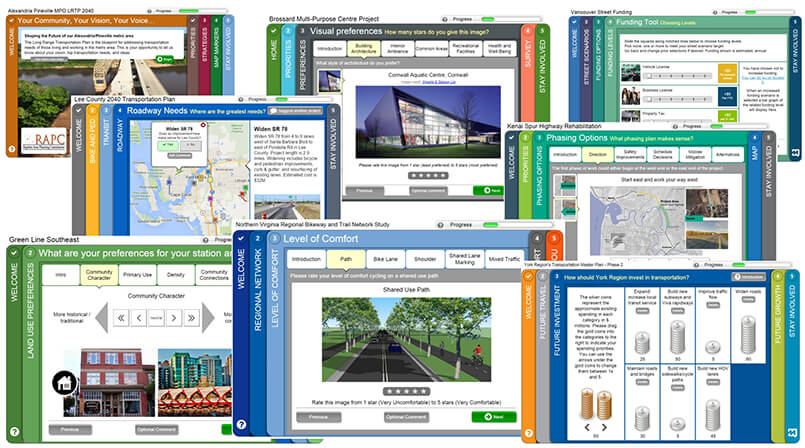
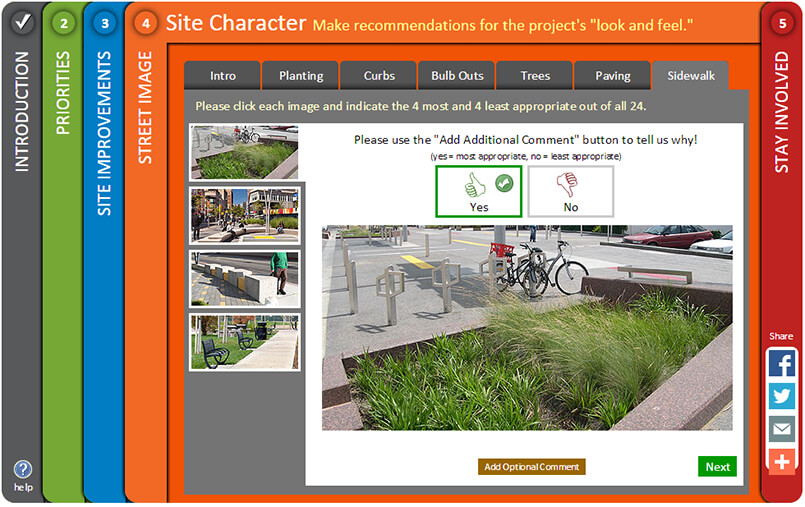
    Collection of MetroQuest screen types.
    Visual and interactive online tools like MetroQuest are a growing part of the community engagement toolkit.

    These same elements present a challenging test when it comes to the web accessibility criteria. While it’s easy to ensure that fonts are large enough for those with less than perfect vision and colors are not used in a way that put people with color blindness at a disadvantage, providing a workaround for people using screen readers to place comments on a map is a bigger challenge. It’s true that even visually rich and interactive online engagement tools can technically meet the requirements by, for example, including text descriptions of images and other screen reader accessible options. It’s also naïve to think that these options are equivalent to the experience provided to those without special needs. Furthermore, depending on the needs of both the project and community members, they may not even be the best alternatives for those with visual disabilities.

    From May to July 2015 we conducted a review of case studies of planning projects using online engagement as a significant source of community input. The review compared the results of the online engagement processes to look for patterns and identify best practices. So what did we learn about these kinds of interactive elements? Should interactive elements be avoided? Based on the case studies we examined, certainly not. In fact, many of the most successful projects attribute much of their success to these visual and interactive features. The leading planning and engagement experts recognize that not every tool in their toolkit will necessarily meet the most stringent online accessibility standards. That said, they know, and have demonstrated, that to optimize overall engagement results, they need a strategy that provides options for all people to participate. And that may include a mix of technologies and approaches, even if some of the visually rich online tools don’t meet certain web standards for accessibility. Here an analogy may help. The entrance to our office building has both a ramp and stairs. To accommodate the needs of people on wheels, the architects didn’t remove the stairs. They added a ramp. No one approach is going to be best for everyone. It’s about a variety of options to meet a diversity of needs.

    Ashley Ver Burg from HDR in Minnesota deals with accessibility issues head on as she seeks to create the most effective digital engagement strategies for her clients. In a telephone interview we conducted in February 2016 she put it this way:

    “When we pull together a digital engagement strategy, we start with accessibility. We strive for design that doesn’t impede accessibility and accessibility that doesn’t impede design. Visual elements are essential to making information easier to understand. This is the foundation of accessibility. The reality is that we often need to use multiple tools to reach different audiences.”

    Naturally, people with visual difficulties have every right to participate, and practical options for them must be part of every engagement plan. Indeed, planning agencies can benefit greatly from the insights provided by people with special needs. In reviewing leading case studies, the best practices that emerge look beyond the minimum requirement spelled out in legislation, toward a goal of providing a range of options that allow people to select the one that best meets their needs. For some people, providing a parallel screen reader accessible site is an attractive option for online access. For those with visual difficulties who choose not to use screen readers or those who would appreciate a more personal experience, providing an opportunity for people to speak to someone by phone or attend a session in their community may be better options. A wide range of choices will serve your community better and will open up the opportunity to participate to a broader audience.

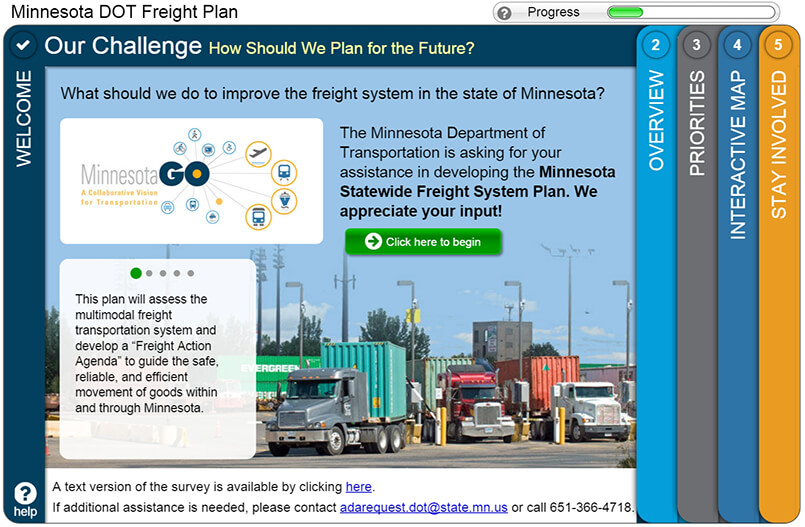
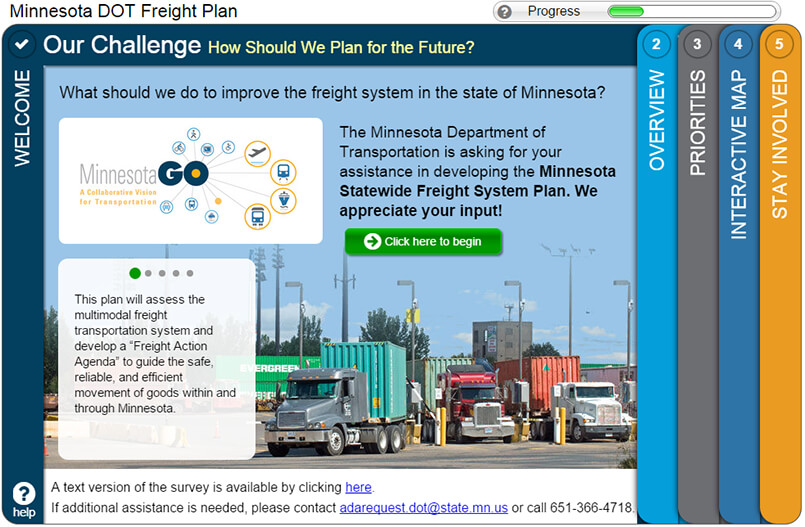
    Minn DOT MetroQuest online public involvement survey
    MinnDOT provides variety of options front and center to accommodate various needs.

    Let’s Broaden the Dialog about Accessibility

    Thinking more broadly about accessibility leads us to consider a wider range of factors that could hamper people’s ability to participate. Looking beyond the ADA guidelines, the environmental justice regulations in the United States call for the “meaningful involvement of all people regardless of race, color, national origin, or income.” While environmental justice applies specifically to environmental laws, regulations, and policies, Title VI applies more broadly to Civil Rights and addresses similar demographic groups.

    Groups that have been traditionally underrepresented in public participation activities for planning projects include youth, people with less formal education, residents who are new to the community and may not have social networks to learn about initiatives, and, perhaps most significantly in terms of numbers, people whose busy schedules or responsibilities limit their ability to get involved.

    Each of these groups present unique but in most cases, manageable challenges. In some cases, online engagement can be an important part of the solution. It can provide an opportunity to engage people with busy schedules quickly and conveniently and when done well, can benefit from the viral nature of social media. Online engagement can be offered in multiple languages and by leveraging visuals and minimizing text it can accommodate people of various national origins and reading comfort levels.

    In other cases, a mix of other community engagement tactics is needed such as:

    • Pop-up engagement events allowing planners to target specific communities,
    • Add-on events allowing planners to engage a specific group as a part another group’s event,
    • Touch-screen kiosks in community centers for participants to “stumble on,”
    • Mobile-friendly engagement options for smartphone and SMS users, and, yes,
    • Public workshops and open houses for people who prefer a face to face opportunity to speak with planners and neighbors about the issues.
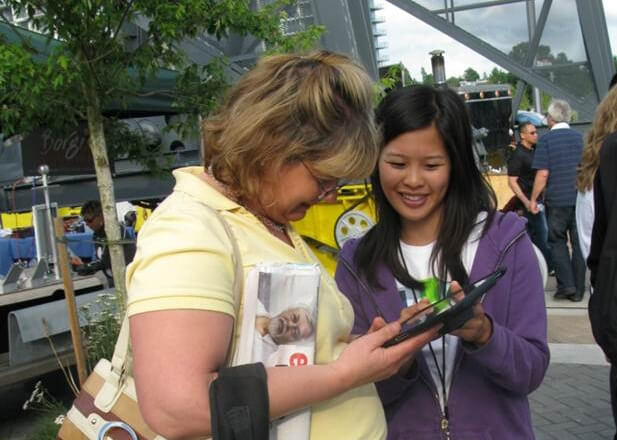
    Women completing public engagement online survey.
    Pop-up engagement with iPads for one-on-one assistance.

    The best projects we examined used a wide variety of engagement and promotional strategies to reach a broad audience. Many planners and engagement experts also commented that while it’s best to plan a multi-pronged engagement strategy at the outset of a project, it’s also very difficult to know precisely who will respond to each option. By collecting demographic information from participants, planners can monitor the reach of their community engagement and adjust tactics accordingly. Leaving room for creativity and fine tuning midway into the engagement period also appears to be emerging as a best practice. Ashley Ver Burg confirmed these findings:

    “We need to consider all audiences. That’s why we are now routinely using demographic data of project participants to inform and update public involvement strategies. Not every meeting, event, workplace, social media platform, or email list will reach the same audience. It’s important to develop a strategy—and continuously update that strategy—based on data.”

    To borrow an old line, “different strokes for different folks.” Based on our dialog with planners and engagement experts, the time might be right to widen the definition of accessibility based on a more inclusive and nuanced understanding of the varied needs of our community members.

    This article was published in Planetizen here. 

  • [WEBINAR] Best Practices for Online Public Engagement for DOTs

    [WEBINAR] Best Practices for Online Public Engagement for DOTs

    This 41-minute video presents a series of case studies, best practices and tips to guide DOT’s towards the successful application of online public engagement for a variety of projects. Award-winning LRTP, STIP, TIP, NEPA, EIS, corridor, highway, transit, TOD and participatory budgeting projects that successfully leveraged innovative digital engagement are presented. From crowdsourcing platforms to interactive surveys to social media, the latest fleet of online engagement tools are making it so easy and fun to participate that they are drawing in thousands of participants and collecting constructive public input to inform and support DOT projects across the country. This session outlines best practices gathered based on hundreds of project case studies.

    Watch Recording

    View Slides

    Q&A

    Below are some of the questions that were asked during the Q&A session at the end of the live webinar.

    Q: Without a registration process, how do we avoid people participating 100 times and skewing the results?
    A: [Responded to in the webinar] Planning processes can be controversial and abuse is always a possibility. With MetroQuest we have tools and techniques to identify and help mitigate ballot stuffing in order to protect the integrity of the results. Any attempts at abuse are easily recognized and nullified.

    Q: Do you think your findings are equally applicable to projects other than ground transportation. e.g., water use planning, watershed management, etc…?
    A: Yes. In our review we also looked at water use plans, storm water management, environmental plans, etc. The lessons equally applied to those projects however they often had the additional challenge of dealing with a subject matter that was not top of mind for the public. I spoke at the American Public Works Association conference last year about Online Engagement for this sector and referenced a MetroQuest project that engaged over 10,000 participants in stormwater management for a public utility. They said they had never seen such high participation in a project like that. I think in that case the entire project team did a great job making the topic accessible and interesting.

    Q: What is the process for setting up MetroQuest for a project?
    A: [Responded to in the webinar] Here is an excerpt from our “Public Involvement Software User Guide”. The MetroQuest team provides much more than software. Think of us as your trusted project partner with over 18 years of experience with digital engagement. We take care of setting up the software to meet the specific needs and goals of your project. We also guide you along the way to ensure the best results. The MetroQuest team works collaboratively with you and your team to determine the 4 or 5 screens that will best meet the needs of your project. We then use your content (pictures, phrases, branding, color schemes, maps, etc) to set up the MetroQuest screens. MetroQuest comes configured for mobile, tablet and desktop platforms so no matter how your participants wish to engage, we’ll make sure that their experience is delightful. Once MetroQuest is launched it’s time for your team to actively promote and monitor participation. We’ll back you up with great advice about how to maximize participation and even target particular demographic groups to ensure broad representation of your community. Download the guide here.

    Q: What tactic works best with communities of color? how do you engage EJ when they are less likely to have internet at home?
    A: [Responded to in the webinar] This is a big topic and I suggest you read our 8 tips to reach targeted communities here.

    Q: How does MQ get beyond the “vote” concept? Setting the expectation that the alternative or concept with the most points “wins”? Decisions are made on a variety of factors, so having an expectation that something will be selected based only on public opinion may backfire on the client.
    A: I totally agree and I realize in my presentation I used the word “vote.” We would not suggest using that word in the public interface for the reasons you cite. I think it’s critical to set expectations for how the public input will be used and not over promise. Great point. Thank you.

    Q: How are sites made ADA accessible?
    A: Thanks for reminding me. I meant to point this out when I was showing the Minnesota Freight Plan example. Because of the visual and interactive nature of the tool, some people (such as those with vision impairment) will need an alternative way to participate. This can be easily handled in a variety of ways. In the case of the Minnesota Freight Plan, you’ll see an option to participate in a text only survey as well as contact information for additional assistance.

    Q: Do citizens also have a way to rate the planning process or event itself? Clarity is in the mind of the citizen, not the presenter.
    A: [Responded to in the webinar] Yes we often have often have evaluation questions at the end of the online engagement experience and have used those responses to monitor how we are doing and improve the tool. This kind of honest feedback is extremely useful. Most of the responses are very positive. It’s clear that there is a pent up desire to have an easy and fast way to participate and that online tools are fulfilling that need. The critical responses are helpful as they give us clues as to what we can do to continually improve.

  • [WEBINAR] Getting the Most Out of Online Engagement

    [WEBINAR] Getting the Most Out of Online Engagement

    This webinar presents an overview of the MetroQuest Public Involvement Software to help both new and existing users get the best results from their online community engagement. The video covers the latest features, screen types, best practices and tips on everything from planning and promoting your site to analyzing and reporting the results. You’ll learn about award-winning case studies that successfully leveraged MetroQuest in innovative ways to engage thousands, collect informed input and build community support for their projects.

    Watch Recording

    View Slides