Author: Dave Biggs

  • [INSIGHTS] The 3 Most Common Community Engagement Mistakes

    [INSIGHTS] The 3 Most Common Community Engagement Mistakes

    Planners, like any other professionals, live in a kind of bubble. Those charged with dealing with the public run the risk of expecting too much from residents as they design community engagement activities. Here are some of the most common mistakes.

    It’s great to focus on the positive and celebrate the best case studies, but sometimes it’s useful to learn from our mistakes.

    For the purposes of this post, we only considered projects that did not meet their own stated projects goals by a significant margin. This typically translated to one of the following: too few participants, too narrow a demographic participating, or widespread discounting of the validity of the input gathered by the community engagement process.

    After evaluating many case studies and interviewing the agencies involved, patterns started to emerge about lessons learned. It quickly became clear that the subtitle of this article could be “Great Expectations.” Here are three of the most common mistakes that hampered outreach processes.

    1. Expecting too much time

    There seems to be a strong tendency to over-estimate the level of time that people are willing to spend participating in community engagement activities. Dedicated and enthusiastic planning professionals sometimes forget that most people don’t get as excited about planning topics as we do. Others are well aware of short attention spans and talk about “scope creep,” with community engagement exercises starting out lean and slowing building to something unwieldy before it finally goes out the door.

    Keeping it short is not easy, and it’s a trade-off. With less time per person, you’ll be limited about how much detail you can get into. On the other hand, if it’s too long you’ll be limiting participation to only those who are most motivated—oftentimes motivated by negative feelings about the project. The breaking point seems to be about five minutes. Whether it’s at a public event or online, asking visitors or passers-by for five minutes of their time seems to be a sweet spot that allows you to collect a fair amount of input from the largest number of participants. If your “call to action” captures their attention, most people will be willing to give you five minutes. Asking for less time does not seem to make a significant difference while asking for more time results in a sharp decline in participation rates. In our fast paced world, ten minutes can seem like an eternity, especially when you aren’t particularly passionate about the issue.

    2. Expecting too much empathy

    Agencies conducting public participation for their planning projects have mandates, regulations, and specific objectives that they are striving to meet. Unfortunately, the public do not care about them like you do. Many of the projects we looked at focused too directly on agency objectives and missed many of the public’s top of mind issues. The omission of key public priorities or undue focus on agency priorities can either infuriate people or simply drive them away.

    It can be challenging but community engagement can simultaneously resonate with the agency goals and the public’s priorities if you know what they are. Understanding and defining both the community’s priorities and the agencies early on the in process seems to be a critical success factor. While agency priorities are often well-established, community priorities are more elusive. Planners knowledge of community priorities can be heavily based on interactions with the small subset of people who typically show up at council meetings and public workshops. This, we can agree, is hardly a representative sample. Furthermore, the language that people use to describe the issues is also critical when designing your invitations to participate and content for your surveys or other community engagement activities. Some of the best case studies started with an open-ended survey, allowing people to identify issues and priorities early on before alternatives and options had been defined. These early inputs can help to shape the content for subsequent surveys or activities to ensure that the outreach resonates with the community. Many agency goals can then be connected to community priorities but some gaps are to be expected. These gaps can often be accommodated creatively as long as there is enough lead time work with both sets of priorities.

    3. Expecting too much planning knowledge

    The more you learn about a topic, the harder it is to remember what it was like to be a novice. To some extent we are all living in a “planning bubble,” with our own lingo, acronyms, and a rather sophisticated understanding about cause and effect relationships of our complex built environment. Many of the case studies we examined were criticized for asking questions that the community did not fully understand. The result can be either less people being willing to participate or the community input being challenged as not informed or credible.

    Language is relatively easy to change as long as you have editors that can translate the jargon into something more publicly accessible. This translation task works well in the early phases of community engagement when the input being collected is about priorities and issues. People find it relatively easy and comfortable to talk about what’s important to them or what concerns them about a topic or area.

    Where even some of the most thoughtfully prepared projects had difficulty was at the options or alternatives phase of outreach. Asking people to nominate or choose among a set of possible solutions is far more difficult. The reason is that solutions require people to understand the cause and effect of the actions being considered. This is a big stretch for many people.

    The best case studies provided clear information about both the pros and cons of various options. By providing this kind of unbiased and balanced information about the options, planners can generate genuine community support as well as decision-maker confidence.

    This article was published on Planetizen.
  • [TIPS] The Toxic State of Public Discourse and How to Clean It Up

    [TIPS] The Toxic State of Public Discourse and How to Clean It Up

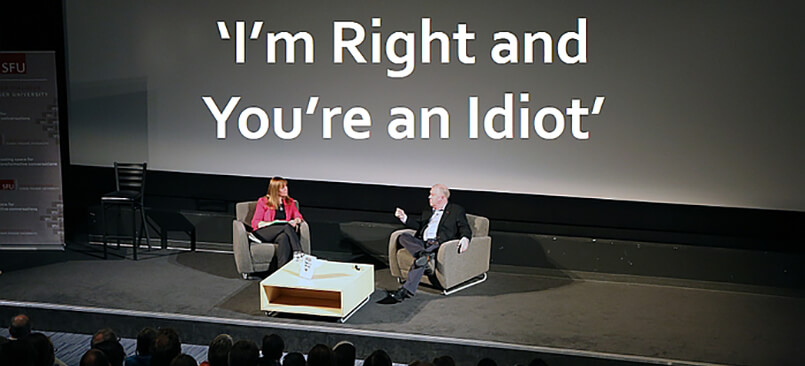
    Image from book launch event courtesy Hoggan & Associates

    My interview with Author James Hoggan: ‘I’m Right and You’re an Idiot: The Toxic State of Public Discourse and How to Clean It Up’
    Published by New Society, May 2016

    James Hoggan has influenced my work for two decades. I find myself quoting his work in many of my public speaking engagements and the lessons he has articulated have shaped MetroQuest and the best practices listed in our guidebook in numerous ways. Naturally, I jumped at the opportunity to sit down with Hoggan to discuss his new book, “I’m Right and You’re an Idiot: The Toxic State of Public Discourse and How to Clean It Up.” After years of research that included interviewing some of the world’s most profound thinkers on democracy, conflict and consensus-building, Hoggan has cleverly articulated not only what’s wrong with public discourse but also what must be done to fix it. Here’s our conversation.

    Dave Biggs: You named your book ‘I’m Right and You’re an Idiot.’ What does that title mean to you?

    James Hoggan: The title I’m Right and You’re an Idiot describes today’s warlike approach to public debate. It’s a style of communication that polarizes public conversations and prevents us from dealing with the serious problems stalking everyone on earth.

    It is an ironic title, chosen because it epitomizes the kind of attack rhetoric we hear so often today. It reflects the opposite of the real message of the book, which was best said by peace activist and Zen Buddhist monk Thich Nhat Hanh who told me to: “Speak the truth not to punish.”

    Dave Biggs: It’s clear that you covered a great deal of ground in researching this book. Tell me about that journey? What motivated you to go to such lengths?

    James Hoggan: I was driven by curiosity about how we might create the space for higher-quality public conversations. What passes for public discourse these days is little more than antagonistic name-calling, where each side accuses the other of bad faith.

    This bitter combativeness has replaced healthy debate, during which passionate opposition and science can shape constructive mind-changing conversations without creating polarized gridlock or deep animosity.

    I am interested in why are we listening to each other shout rather than hearing what the evidence is trying to tell us about problems such as climate change.

    How have we come to a time when facts don’t matter and how can we begin the journey back to where they do?

    No single person has the answers to these complex questions but collectively the experts I interviewed offer incredible wisdom. Many of the thought leaders I spoke to have spent their entire professional lives working to find answers to these tough change resistance questions.

    Dave Biggs: Many of our readers are involved in community engagement for planning projects and, as they can attest, it can get quite heated. You describe public discourse as increasingly “toxic” and “polarized.” What do those terms mean to you? Is the situation getting worse? What’s driving it?

    James Hoggan: Today’s public square is a toxic mix of ad hominem attacks, tribalism and unyielding advocacy. It’s a kind of pollution that sabotages public discourse and discredits the passion and outrage at the heart of healthy public debate, because it polarizes people and stops them thinking clearly.

    Fear is what propels toxic discourse and it is happening on both sides of the Atlantic, in North America and Europe. Sadly, facts do not compete well when leaders whip up primal feelings around fear, whether it’s about immigration, jobs or economic woes.

    Rather than confronting the substance of an argument itself, people tend to attack the motives of opponents and stir up hostility towards groups that hold differing opinions.

    This dangerous habit of attacking the character of those who disagree with us, rather than focusing on specific issues, distracts the public from what’s really going on.

    Accusing opponents of corrupt motives is a highly confrontational technique that deflects attention and makes it easy to dismiss well-founded criticism. This aggressive approach to public debate leaves little room for the middle ground and as Debra Tannen wrote, “When extremes define the issues, problems seem insoluble and citizens become alienated from the political process.”

    Dave Biggs: I’ve started a series called “Fiasco Files” to see what can be learned from the wreckage of public engagement disasters. Have you looked at specific case studies where things went off the rails? Does your book point to common mistakes and how to avoid them?

    James Hoggan: One of the best example of a fiasco in Canada was in 2012 when the oil & gas industry and Conservative government campaigned to convince Canadians that British Columbians who opposed pipelines and tankers on the west coast were extremists working for American business interests.

    A tremendous amount of information was provided, by both government and industry, regarding Kinder Morgan’s Trans Mountain Pipeline expansion, Enbridge’s Northern Gateway Pipeline project and TransCanada’s Keystone XL and Energy East.

    Despite armies of PR people and volumes of communication materials, the mismanagement of communication around these proposed oil sands developments became textbook examples of how not to achieve social license.

    When it comes to public opinion, there’s a common belief among proponents that providing facts is the best way to sell a story. But in the oil sands case, when the companies and government failed to achieve their goals, they resorted to a combative, underhanded style of advocacy.

    The Prime Minister’s Office called opponents “foreign funded radicals.” The Minister of the Environment and the Minister of Natural Resources accused environmental charities of criminal activity.

    Senator Don Platt said ‘where would …environmentalists draw the line on who they receive money from. Would they take money from the Al-Qaeda, the Hamas or the Taliban…’

    This highly polarizing strategy backfired badly as opposition to pipelines grew and community groups and First Nations became better organized. It failed because the government and industry started with a mistaken assumption that anyone who disagreed with them was either misinformed, unreasonable or even a wrongdoer.

    Despite assurances from oil and pipeline companies that these projects will create jobs, are safe and will respect the environment, the public continues to see the benefits as small and the risks as unacceptably high.

    It’s not that information doesn’t matter, but a growing body of research on how people develop perceptions of risk shows that facts and statistics alone do not change people’s concerns about what is risky. Emotions play a huge part.

    University of Oregon psychologist Paul Slovic has studied the various social and cultural factors that lead to disputes and disagreements about risk, and says the problem lies in the diverse ways in which “experts” and the public view risk.

    Experts look at risk as a calculation of probability and consequence. The public takes a more personal approach; their perceptions are around personal control, voluntariness, children and future generations, trust, equity, benefits and consequences.

    Slovic says the mistake experts (and the companies and governments they represent) make is viewing themselves as objective and the public as subjective.

    They perceive the public as being too emotional and having irrational fear. The public’s attitude is then dismissed as laypeople getting the facts wrong and not understanding the evidence.

    “Laypeople sometimes lack certain information about hazards,” Slovic says. “However their basic conceptualization of risk is much richer than that of experts and reflects legitimate concerns that are typically omitted from expert risk assessments.”

    This is where a company’s decision to “educate” the public to adopt its point of view can really backfire. People aren’t sitting around waiting to be told what to think. In fact, few of us like being told what to think.

    Communicators need to be sensitive to this broader concept of risk. Facts aren’t just facts. They aren’t as objective as we assume they are. Facts and risk are subjective for both experts and the public. They are a blend of values, biases and ideology.

    The hypodermic needle theory of communication, where we believe we can simply inject information to cure people of their misunderstandings, doesn’t work. Neither does demonizing opponents or polarizing people.

    Dave Biggs: I’m always on the lookout for emerging best practices in community engagement. Government agencies are hungry for strategies to improve the dialogue in face to face events as well as online. What lessons can you share to help them broaden the dialogue to a wider demographic and collect meaningful and constructive public input to inform their decision making?

    James Hoggan: We often don’t even get the basics right. Learning to engage in emotional dialogue is a good place to start.

    Curtailing the growth of unyielding one-sidedness begins with the assumption that people who disagree with us have good intentions. They aren’t idiots or evil.

    It is important to recognize that in a time when mistrust and polarization have soared to all-time highs, conversations aimed at injecting information into people in order to cure them of their misunderstanding will fail.

    The power of emotion is a critical consideration. No matter how good you think your argument is, regardless of how provable your facts, if the public feels its liberty, right to fair treatment or livelihood is threatened, you’re losing the battle to dread.

    Opposition is often based on feelings of dread that citizens have about the impact a project could have on their way of life, a mistrust of the companies behind it and skepticism around government regulators charged with oversight.

    Fear can grow despite a steady stream of facts and expensive PR campaigns from proponents claiming their projects are built to minimize risk.

    Opponents often don’t accept the proponents’ facts, but are instead driven by what Paul Slovic calls the “dread factor” — the prime predictor of a strong reaction to risk.

    According to Slovic, risk resides in us mostly as a “gut feeling” rather than the outcome of analytical calculations. The most powerful of these feelings is dread and it is linked with a sense of having no control in a situation, inequality (where others get the benefit, while they get saddled with the risk) and how catastrophic a risk is seen to be.

    His research shows that reliance on feelings as our guide to risk causes us, when we see risk as high, to also believe the benefit is low. The opposite is true if we come to believe the benefit is high, we tend to see risk as low.

    Misunderstanding the “dread factor” and the possibly legitimate concerns that fuel it, intensifies the problem of unyielding one-sidedness that we see in so many public disputes.

    It is also difficult to be seen as authentic in an argument if you don’t understand what Slovic calls the “whisper of emotion.” This is the emotional meaning; the good or bad feelings and gut instinct that can help people make decisions. Sometimes these feelings are misguided, but they are usually a sophisticated compass that directs us through life efficiently and accurately.

    We need to be more conscious of emotional dialogue because this is where most risk communication fails. And we need to recognize it needs to be a two-way process where both sides have something worthwhile to contribute.

    If you hold your views lightly and remember you could be wrong, people are more likely to trust you and be more receptive. It’s about communicating trust, by having an open mind, open heart and an open will.

    This post was published in Planetizen here.

  • [WEBINAR] A Recipe for Award-Winning Online Community Engagement with Plan Hillsborough

    [WEBINAR] A Recipe for Award-Winning Online Community Engagement with Plan Hillsborough

    This highly visual 45-minute webinar presents research findings and proven best practices, practical tips and award-winning case studies to guide Florida agencies towards the successful application of online community engagement for planning projects. Viewers will gain an understanding about how to leverage digital engagement to achieve unprecedented results using cost-effective tools. This session showcases a wide range of outstanding planning projects throughout Florida including Lee County, Venice, Satellite Beach, Broward, Jacksonville and the award-winning Seven50 project. Our special guests from the Hillsborough Planning Commission in Tampa, FL will be online talking about Imagine 2040, one of the most innovative and successful planning projects we’ve ever seen. They will discuss the innovative ways they combined online and targeted face to face community engagement to involve over 5,000 community members in the creation of a plan for the region. They will also share advice for agencies seeking to improve the breadth and effectiveness of their community engagement efforts and talk about the positive difference that broad community support is making in their implementation process.

    Watch Recording

    View Slides

    Participant Comments

    Thanks so much for the great comments and kudos. Here’s some of our favorites:
    “What a great session. Thank you so much Dave and Lynn.”
    “One of the best presentations on Public engagement I have seen. Well done and congratulations Hillsborough for a great job and setting a great example for us to follow!”
    “Great graphics and concepts. The presentation was insightful and delightful!”
    “Great suggestions for thinking outside the box when it comes to public engagement.”
    “Wonderful online presentation. Got a lot of out the speakers.”

    AICP CM Credits

    Bonus Case Study: NashvilleNext

    Q&A

    Here are the questions that were raised by participants following the presentations with answers provided by the presenters.

    Q: What was the budget?
    A: [from Lynn] $260,000 including all consultant work and public engagement costs. Many public engagement costs were provided or achieved at drastically reduced costs due to strong public-private partnerships.

    Q: Did Tampa have dedicated staff for the effort? How many?
    A: [from Lynn] The Plan Hillsborough staff of about 40 at the time serves various roles as staff and planners for the Hillsborough County City-County Planning Commission, the Hillsborough Metropolitan Planning Organization, and the Hillsborough River Interlocal Planning Board and Technical Advisory Council. Planners on staff participated as planners in preparation of the Imagine 2040 Comprehensive Plans for Tampa, Temple Terrace, Plant City, and Hillsborough County, and the Imagine 2040 Transportation Plan. The planners were joined by various staff to conduct the public engagement for things like community groups and big events.

    Q: Is the consolidated output of these meetings available to your market?
    A: [from Lynn] The Imagine Hillsborough 2040 public outreach process guided the update of the 2040 Long Range Transportation Plan and the jurisdictional Comprehensive Plans. Two phases of public engagement included: an online interactive survey, taken either via computer or using kiosks placed in various public locations; and were available at community meetings where audiences could take a paper version of the survey. Part 1, took place between August and November of 2013, with more than 3,500 people responding to the survey, choosing between three growth strategies: Suburban Dream showing what would happen if growth continued outward; Bustling Metro, focusing growth in our cities and towns and investing in transit; and New Corporate Centers, focusing growth along major highways. For Part 1 results, visit this site. Also view the Executive Summary of Part 1 (used at public meetings for Part 2) as well as the full Survey Results Report.

    Part 2 of the Imagine 2040 outreach started after the 4th of July weekend and ended on Labor Day weekend, resulting in over 2,400 responses. It consisted of an exercise/survey gauging how to fund proposed transit improvements over the approximate 26-year timeframe. For Part 2 results, visit our project site. The majority of the respondents resided in Tampa representing 38% of all responses. Northwest Hillsborough County had the second highest response rate with 24%, followed by South County with 17% and Central County with 13%. Here are the Part 2 Results.

    Q: How much did the engagement feedback shape the plan?
    A: [from Lynn] A lot – see documentation in the reports on the web page.

    Q: Did it lead to different results than if it had it not be undertaken?
    A: [from Lynn] The results of Imagine 2040 parts 1 and 2 and how they helped create a Vision to guide the Imagine 2040 Transportation Plan and the Comprehensive Plans for the Cities of Tampa, Temple Terrace, Plant City and Hillsborough County can be viewed at here and here.

    Q: Has this been used for any FDOT projects?
    A: [from Dave] I don’t recall contracting directly with FDOT in the past but MetroQuest has been used either directly or indirectly (through consultants) by most DOT’s in the US. Given the wide range of planning projects where MetroQuest was used in Florida I’m sure that some of them were FDOT projects. Feel free to contact us so we can help you find appropriate references or case studies.

    Q: What is the AICP CM event number?
    A: [from Dave] The AICP CM number is 9102565. Here is the direct link:
    https://planning.org/events/course/9102565/

    Q: One of the general MetroQuest projects slides included one project in Lee County Florida. What project was that?
    A: [from Dave] That could have been from one of two projects in Lee County. This first one was one involving growth priorities and scenarios and then another for the 2040 Transportation Plan. Please note that the first one is based on a previous version of MetroQuest so some features have been added or changed and since then.

    Q: Federal funding requires engagement in many efforts. Does it need to be for the “big” picture projects only?
    A: [from Dave] While the “big” picture projects seem to get the most attention, online engagement is useful for a wide variety of scales and types of projects beyond these big picture ones. I briefly showed the Parks Plan that Hillsborough is currently working on which is very different from the grand Imagine 2040 effort. In addition, one of the MetroQuest projects that I did not have time to discuss was the University Drive Corridor plan in Miami which focuses on alternative alignments of a small section of the corridor. This morning I reviewed this site that is using MetroQuest to collect input on an Aquatic Center so there are certainly a wide range of planning projects beyond the “big” picture ones where online engagement tools can be helpful.

    Thanks again for your interest and participation in this webinar.

  • [CONFERENCE] Public Involvement for Transportation Planning at TxDOT

    [CONFERENCE] Public Involvement for Transportation Planning at TxDOT

    On June 15-17, the 2016 Transportation Planning Conference hosted by TxDOT brought together transportation planning professionals from throughout Texas to discuss best practices and review leading case studies in the field of transportation planning. The well-attended Public Involvement panel session was recorded and we are pleased to share it below. Enjoy!

    Public Involvement Panel Session Video

    Recorded live at the Omni Houston Hotel, June 17th, 2016, 8:30 – 10:00 am

    00:00 – 06:24   Moderator introduction – Jefferson Grimes, Public Involvement Section Director, Transportation Planning and Programming Division, TxDOT

    Bonus Case Study: NashvilleNext

    Since many of the conference participants asked for more information about the Nashville case study discussed briefly, I thought you might enjoy a short video of the Nashville team talking about their public involvement efforts.

  • [WEBINAR] A Recipe for Award-Winning Online Community Engagement with the City of Abbotsford

    [WEBINAR] A Recipe for Award-Winning Online Community Engagement with the City of Abbotsford

    This highly visual 45-minute webinar presents research findings and proven best practices, practical tips and award-winning case studies to guide agencies towards the successful application of online community engagement for planning projects. Viewers will walk away with an understanding about how to leverage digital engagement to achieve unprecedented results using cost-effective tools. This session also features our special guests from the City of Abbotsford, BC talking about Abbotsforward, one of the most innovative and successful Official Community Planning projects we’ve ever seen. They join us online to talk about the innovative ways they combined online and targeted face to face community engagement to involve over 8,000 community members in the creation of a plan for Abbotsford, BC. They share advice for agencies seeking to improve the breadth and effectiveness of their community engagement efforts and talk about the positive difference that broad community support is making in their implementation process.

    Watch Recording

    View Slides

    Participant Comments

    Thanks so much for the great comments and kudos. Here’s some of our favorites:
    “Really well organized and digestible.”
    “Excellent presentation. Concise discussion of lessons learned with real, transferable information.”
    “The best presentation on outreach I’ve ever attended (and I’ve done outreach since 1993)”
    “Wow! The webinar itself was a great example of effective engagement.”
    “Great webinar. Really good info, efficient, relevant to my work.”
    “The presentation was really well put together. I really enjoy when a presenter is able to get to the key takeaway first then dive into the specifics of that takeaway. Well done.”
    “Great suggestions for thinking outside the box when it comes to public engagement.”
    “Very good online presentation. Got a lot of out the speakers.”
    “This was a very helpful and insightful presentation. It provided good evidence on the effectiveness of online community engagement.”

    AICP CM Credits

    Funny Video Promoting Abbotsfwd

    Bonus Case Study: NashvilleNext

    Q&A

    Here are the questions that were raised by participants following the presentations with answers provided by the presenters.

    Q: Each community seems to create their own design, so does each community buy MetroQuest software and do their own product? How does it work?
    A: [From Dave] I apologize that I was not able to provide more detailed information about MetroQuest due to the nature of the session. We would be happy to provide additional information to those interested in a separate call. The short answer is that MetroQuest is available by annual subscription and clients simply choose from a variety of screen types to suit the needs of each project and then add their own content (words and images). The product is designed with a wide range of standard functionality and has a number of configuration options to meet the needs of a variety of projects at different stages. The community/agency is free to add unique content to create an engagement experience that matches the needs and branding of each initiative.

    Q: How can this information be translated into sustainable RURAL growth?
    A: [From Dave] Online engagement tools such as the ones demonstrated are used on all sorts of projects at all scales including many rural projects. The content is different when applied in a rural area but the functionality is similar. In fact, online community engagement is often a primary engagement channel for rural projects since, due to longer travel distances, getting people to come to meetings can be even more difficult than in urban areas. While internet access has become widespread even in rural areas, one must always be mindful of those without access. In many cases kiosks in general stores or community centres are a useful addition.

    Q: Are the infographics and MetroQuest tool accessible for persons with disabilities?
    A: [From Dave] Accessibility requirements can be met in a variety of ways without going to a 100% text based tool. This blog post outlines how MetroQuest and it’s clients are meeting accessibility standards and working to expand the definition of accessibility. With infographics such as the ones shown for the Atlanta case study, companion text description and image tags can be used to allow the information to be read by screen readers.

    Q: Who was in charge of the graphic design of the campaign?
    A: [From Reuben] The City hired a consultant early in the process to develop a brand package that included logos, colours, and other graphic elements. Once this was completed, City staff were generally responsible for adapting the graphics to fit a wide range of media uses, except in a few specialized cases.

    Q: What was the role of the City compared to the consultant when it came to engagement?
    A: [From Reuben] Early in the process, we recognized our effort would have the most impact if directed to expanding the engagement component, using consultant resources more for technical analysis and new perspectives. Although they attended some key events and workshops, and provided graphic material, City staff were responsible for approximately 75% of the engagement events.

    Q: How many weeks was the engagement?
    A: [From Reuben] Although the project was about 2 years long, engagement periods were focused and intense during that stretch. We started with 5 weeks in the summer of 2014 (Stage 1), followed by 6 weeks in early 2015 (Stage 2) and another 6 weeks in late 2015 (Stage 3), and finally 5 weeks in early 2016 (Stage 4). These periods of intense advertising and presence in the community resulted in high amounts of focused input, rather than minimal input that is drawn out.

    Q: How long did you plan before you launched the engagement portion?
    A: [From Reuben] See the above answer. With each of the 4 periods of engagement, advanced planning and preparation typically took about 2 to 4 weeks, depending on the diversity and complexity of the engagement activities.

    Q: How much time did it take to develop the overall engagement strategy? Did MetroQuest take the lead or was this a shared iterative process?
    A: [From Reuben] During the RFP process for engaging a consultant to help with the project, the City created a general outline of how we wanted to conduct the engagement, and requested this to be a key component of consultant proposals. Once a consultant was selected (DIALOG Design) we worked collaboratively to draft a final community engagement strategy (DIALOG included MetroQuest as their online engagement software) that focused on engagement activities. In addition, we had an internal corporate City engagement document to coordinate social media and advertising, with baseline targets for each activity. The engagement strategy was also iterative, and we adapted it as we learned what worked and online engagement was only one piece of the puzzle. Our involvement in the online survey was preparing the content by working with DIALOG.

    Q: What was the participation with the community conversations (% of total)?
    A: [From Reuben] We had nearly 8,000 interactions across multiple engagement platforms. This is not a measure of individual people, which would be extremely difficult to track since the engagement methods crossed so many different methods, but rather of how many times people interacted with a booth, survey, workshop, etc. Our city population is 140,000, so 8,000 interactions represent almost 6% of the population.

    Q: How did you complete the process once the plan was finished?
    A: [From Reuben] For engagement, we created a popup park where the draft plan was on display for 3 days and staff attended to answer questions. We also presented the draft plan to Council Committees and other groups. The comments received were used to refine the final plan as a bylaw, and then a final open house and public hearing. Going forward, our plan is to have some format of online or annual report on targets and achievements based on the new plan.

    Q: How will you close the loop with participants to report out how their input was used?
    A: [From Reuben] See the previous answer. Throughout the project, each Stage of work included a summary of the engagement input that was included in the Stage report. All of this material was presented to Council, posted on our project website, and taken to future events as background information.

    Q: What was the engagement budget?
    A: [From Reuben] Approximately $70,000 in direct costs, which included about $10,000 for the branding and promotion strategy, about $40,000 for the engagement activities (includes printing, space rental, honorariums, food, advertising, direct mailing, internet for iPads, Facebook, etc.), and about $20,000 for MetroQuest under subcontract. This does not include staff time.

    Q: What was the budget for the tools and logistics in particular?
    A: [From Reuben] Without providing a spreadsheet, this is difficult to answer but here are some general comments. It ranged from a few hundred dollars to advertise a series of events for a couple weeks in the newspaper, to a few thousand to bring in guest speakers for an evening mix and mingle talk, or create a popup park. However, our dollars were stretched through significant in-kind support from companies wanting to be a part of the project.

    Thanks again for your interest and participation in this webinar.

  • [WEBINAR] A Recipe for Award-Winning Online Community Engagement with Metro Nashville Planning Commission

    [WEBINAR] A Recipe for Award-Winning Online Community Engagement with Metro Nashville Planning Commission

    This highly visual webinar video presents research finding and proven best practices, practical tips and award-winning case studies to guide agencies towards the successful application of online community engagement for planning projects. Viewers will walk away with an understanding about how to leverage digital engagement to achieve unprecedented results using cost effective tools (see participant comments below). This session showcases some of the most effective case studies that have found innovative ways to combine online and targeted face to face community engagement to involve thousands of community members in the planning process. Participants will learn strategies to improve the breadth and effectiveness of community engagement efforts increase the level of community support to facilitate smoother plan implementation.

    Watch Recording

    View Slides

    Participant Comments

    Thanks so much for the great comments and kudos. Here’s some of our favorites:
    “The best presentation on outreach I’ve ever attended (and I’ve done outreach since 1993)”
    “Wow! The webinar itself was a great example of effective engagement.”
    “Great webinar. Really good info, efficient, relevant to my work.”
    “Really well organized and digestible.”
    “The presentation was really well put together. I really enjoy when a presenter is able to get to the key takeaway first then dive into the specifics of that takeaway. Well done.”
    “Great suggestions for thinking outside the box when it comes to public engagement.”
    “Excellent presentation. Concise discussion of lessons learned with real, transferable information.”
    “Very good online presentation. Got a lot of out the speakers.”
    “This was a very helpful and insightful presentation. It provided good evidence on the effectiveness of online community engagement.”

    AICP CM Credits

    Q&A

    Q: These campaigns were designed for larger metro areas. How could a small MPO in a smaller community get some success with a lower budget?
    A: [From Dave] From our perspective, MetroQuest is used by agencies of all sizes including many smaller MPO’s with very limited budgets so we have seen a wide range of scales of engagement efforts. While Nashville had hundreds of meetings and used a variety of online tools, smaller agencies would decrease both of these factors significantly. Typically, smaller agencies reduce costs by only hosting a couple of community meetings thereby reducing staff and consultant time dramatically. As far a digital engagement goes these projects often only use one online engagement tool as opposed to many as Nashville did. Typically, if one tool is used it is an online survey tool that has an attractive cost per participant ratio in the hopes of broadening the participation cost effectively. [From Greg] Trying the same tools, but scaling them back. Knowing your regular participants and regular gaps is key, to then select tools (speakers bureau, street teams, or whatever) that match.

    Q: In both presentations, it looks like the engagement was geared around scenario planning, and sometimes very specific scenarios. Is that the most effective way to gain public engagement? What if your plan doesn’t use scenario planning?
    A: [From Dave] The Atlanta case study did not involve scenarios. We find with MetroQuest, that less than one quarter of the projects involve scenarios. The rest use a variety of other screen types depending on the phase and public input needs of the project. With that said, scenarios are compelling as they provide a rich picture of a possible future and can be a tangible way to gain the attention of residents. [From Greg] I don’t think it’s the most productive, but for Nashville it matched our needs. The critical thing is finding engaging ways to structure the decisions your community needs to weigh in on.

    Q: In both Atlanta and Nashville – besides shaping the vision and end product…how impactful were these efforts in bringing elected officials & leaders on board?
    A: [From Dave] If you are successful in drawing in input from a large and diverse population, you can be confident that elected officials will get on board. That certainly happened in both these cases where over 18,000 people were involved. [From Greg] I don’t think it’s the most productive, but for Nashville it matched our needs. The critical thing is finding engaging ways to structure the decisions your community needs to weigh in on.

    Q: Speaker mentioned that “meeting to go?” did not work as well as it hoped. Any thoughts how it could be better?
    A: [From Greg] I’m not totally sure. It may have been that we had too much going on in that phase, and so we couldn’t focus the public’s attention on it.

    Q: For Nashville, how did you best get people to participate at markets, transit stations, etc. Was there a reward like a raffle, candy, or mugs?
    A: [From Greg] In one round, we had some raffle prizes (coordinated with prizes we recruited to give away to active participants on MindMixer). We also had shirts and tote bags in a different round. And we had stickers throughout – another good way to draw families over.

    Q: Did you find that more people would attend after online outreach or were those done simultaneously?
    A: [From Greg] Generally simultaneously. I think each fed the other.

    Q: What was the total budget for Nashville Next?
    A: [From Greg] About $300,000 in outreach consultant costs, plus 10-12 staff working 60-100% FTE. Several other departments and divisions participated in Resource Team meetings, but did not design, develop, or implement public participation.

    Q: What would the cost for Hispanic input have been had the Spanish language site not been used?
    A: [From Greg] I’m not sure. If you want to follow up with me directly, I can try to run the numbers without that.

    Q: What meaningful public input was gained for Nashville Next that Metro Planning wouldn’t have done otherwise?
    A: [From Greg] The prominence of affordability, largely due to traditionally under-represented groups. Affordability hasn’t ever been far from our understanding of community concerns, but it really came to the forefront in NN.

    Q: How long was the public participation process?
    A: [From Greg] All told, three years. Individual phases lasted two to four months.

    Q: How is the comprehensive plan provided online? Interactive? Static pdf document?
    A: Sadly, several static PDF documents right now. We’re working to get the action plan into the open data portal.

    Q: How is implementation affecting your existing zoning and subdivision regulations?
    A: [From Greg] Primarily through a current effort to add inclusionary zoning. Some minor updates. No comprehensive revision is planned right now.

    Q: Is book a planner like a road show or speakers bureau?
    A: [From Greg] Primarily a speakers bureau.

    Q: What is your take on Twitter Live Chats as a method of consultation?
    A: [From Greg] They’re okay. They weren’t a focus; we participated in one handled through the daily newspaper.

    Q: Albuquerque asks: What were the background reports and studies, and how did you pick the topics?
    A: [From Greg] They’re available here: http://www.nashville.gov/Government/NashvilleNext/Background-Reports.aspx. They were developed partly through our own sense of the community and partly in consultant with our Steering Committee. We went wide with the background reports and then narrowed and consolidated them into seven plan elements.

    Q: Was NextDoor utilized for sourcing participation?
    A: [From Greg] We didn’t have very much of a NextDoor presence when NashvilleNext was underway.

    Q: Did you use existing staff to do the staff level (non-consultant) work, or did you deliberately staff up to accomplish the task? What disciplines were the focus?
    A: [From Greg] Existing staff of planners, landscape architects, and architects.

    Q: What is cost for MetroQuest? Is it a subscription?
    A: [From Dave] I apologize that I was not able to provide more detailed information about MetroQuest due to the nature of the session. This session was not meant to be an introduction to MetroQuest and only included examples to highlight the lessons learned via the case studies. We would be happy to provide additional information to those interested in a separate call. I can let you know that MetroQuest is available by annual subscription and the cost varies based on the size of the organization. The Nashville case study compares the cost per participant of various online and face to face approaches at 38:30 in the video.

    Thanks again for your interest and participation in this webinar.