Category: Transportation

  • [WEBINAR] A Recipe for Award-Winning Online Community Engagement with COTA

    [WEBINAR] A Recipe for Award-Winning Online Community Engagement with COTA

    This highly visual webinar presents research findings, proven best practices, practical tips and award-winning case studies to guide agencies towards the successful application of online community engagement for planning projects. Viewers will walk away with an understanding about how to leverage digital engagement to achieve unprecedented results using cost-effective tools.

    The webinar showcases a wide range of outstanding planning projects throughout Pennsylvania, Ohio, West Virginia and the Northeastern US. Our special guests from the Central Ohio Transit Authority join us to talk about NextGen, one of the most innovative and successful outreach efforts we’ve ever seen. They discuss the innovative ways they combined online and targeted face to face community engagement to involve an unprecedented number and diversity of community members to help define the transit needs for the region. They also share advice for agencies seeking to improve the breadth and effectiveness of their community engagement efforts and talk about the positive difference that broad community support is making as they move forward.

    Watch Recording


    AICP CM Credits

    Here is the direct link to claim your AICP credits from the APA. Note that the date trips people up. This webinar is part of a series so they instructed us to set it up as an “on-demand” session so you’ll notice that the start and end are a year apart.

    COTA’s video from the presentation (the one that didn’t play well)

    Bonus Case Study: NashvilleNext

    Q&A

    Here are the questions that were raised by participants following the presentations with answers provided by the presenters.

    Questions for Dave

    Q: MetroQuest looks like useful software. What is the best way to get more information about it?
    A: [From Dave] I apologize for not being able to provide more in-depth information about MetroQuest due to the nature of this session. The best place to start would be to connect with Derek Warburton at MetroQuest (by email to derek.warburton@metroquest.com, or toll free phone:1 855-215-0186. Derek will be pleased to make sure you get the information you need. In the meantime, here is a quick video to give you a better sense of the software.

    Q: Do you have any bike/ped examples where MetroQuest was used for public involvement?
    A: [From Dave] MetroQuest is frequently used for bike/ped projects. Here are a few examples to play around with:

    Northern Virginia Regional Bikeway and Trail Network Study, VA – https://novabikedemo1.metroquest.com/

    HEPMPO, MD – https://bikehepmpodemo1.metroquest.com/

    Eastside Greenway, OH – https://esgdemo1.metroquest.com/

    Midway Cycle Track, OH – https://midway-demo.metroquest.com/

    Rim of the World, CA Rim Rec & Parks District – https://rimrecatp-demo.metroquest.com/

    Q: Is MetroQuest affordable for smaller communities?
    A: [From Dave] MetroQuest has recently launched an annual subscription which allows for use of MetroQuest on as many projects as you wish. The cost of the subscription scales based on the size of the organization to ensure that it remains affordable for smaller agencies. Here’s how to learn more. https://metroquest.com/contact/

    Q: I was curious as to whether by using the Metroquest software, if you do reach out to a larger demographic, do communities see things coming through that the staff may not have thought of.
    A: [From Dave] This certainly seems to be the case since we hear this comment frequently. The reality is that the types of people who agencies are used to hearing from represent a very narrow cross section of the community. MetroQuest clients report that the feedback that is received online is more positive and constructive than what generally comes out at public meetings. I think this is due to the fact that many who attend public meetings are fired up about the project, often not in a good way.

    Secondly, new information tends to emerge about community preferences since MetroQuest is specifically well-suited to reach a broader demographic that, in the past, has not been represented at all.

    A good example that comes to mind is a recent project about cycling. The voice that was missing in previous bike planning efforts in this community was the large group of people who do not currently bike but would be willing to start if certain changes were made. In the past they were missing because they did not identify as cyclists and were not passionate about the topic. It turned out that this missing demographic was uniquely suited to identify what changes would encourage the largest mode shift towards biking. By making is very easy to participate and getting the benefit of social media sharing this project was able to hear from over 7,000 people and they received over 50,000 inputs from the community including some valuable new insights for the bike plan. [Editorial comment: It’s case studies like these that make it all worthwhile.]

    Questions for Doug and Elliot from COTA

    Q: Did COTA’s public involvement process ask people about using Uber/Lyft type organizations for first mile/last mile services?
    A: [From COTA] COTA did not specifically ask about ridesharing companies in this phase. However, we did receive comments regarding these services. We asked the public what type of non-high capacity service improvements and investments the region should make using fairly broad categories without identifying the actual mode/vehicle. Modes and vehicles will be discussed in the spring of 2017 as part of finishing Phase 2 (out of 3) of the project.

    Q: Did COTA’s public involvement process/planning process ask/consider about the impact of driverless vehicles on their service?
    A: [From COTA] NextGen will consider driveless vehicles as part of the Vision 2050 plan; however, we did not specifically ask about these services during our Phase 2 outreach last year. Of note, the City of Columbus was recently awarded the FTA Smart City Challenge grant, of which driverless vehicles is a significant aspect. We anticipate our Phase 3 outreach will attract a robust conversation about this technology.

    As of now, our consultant team does not believe the impact will be too great as driverless cars will offer the most benefits in less dense areas, due to traditionally longer trip times to work locations and more time spent in congestion.

    This is under the assumption that work trips take place to/from the major employment centers in Columbus, that is Downtown and Ohio State University, and suburban locations.

    Dense, urban areas, will benefit from driverless vehicles, but there will be a question of physical geometry and street capacity, particularly with the desire to narrow thoroughfares and implementation of complete streets policy in the region. Driverless vehicles will improve street capacity, which, I suspect at least, the public will claim the excess capacity for amenities such as more parking, bike lanes and expanded sidewalks. That is increasingly becoming the practice of the City of Columbus and its neighborhoods.

    These assumptions are not set in stone as of yet and will be further fleshed out.

    Q: How long did it take for COTA to get the data in place?
    A: [From COTA] Our demographic and traffic projections came from our MPO, the Mid-Ohio Regional Planning Commission (MORPC). MORPC was updating their long-range Metropolitan Transportation Plan (MTP) at the same time we were launching NextGen, which required employment, population and travel demand data be projected out to 2040. Being an MPO partner, MORPC adjusted their projections for us to include 2025 and 2050.

    Another initiative that MORPC was leading along with ULI, was insight2050, which looked at various growth scenarios for the entire central Ohio region through 2050. MORPC also prepared data for this initiative.

    All in all, we were fortunate that MORPC was able to respond to our requests quite easily, providing us with data within weeks of asking, tied to TAZ’s and ¼ mi. grids.

    Q: How long did the public participation outreach take?
    A: [From COTA] The public meetings occurred over the course of three days (September 28-30). The survey was available for 35 days (September 28 – November 2).

    Thanks again for your interest and participation in this webinar.

  • [INSIGHTS] NCDOT Launches Unique Online Portal for STIP

    [INSIGHTS] NCDOT Launches Unique Online Portal for STIP

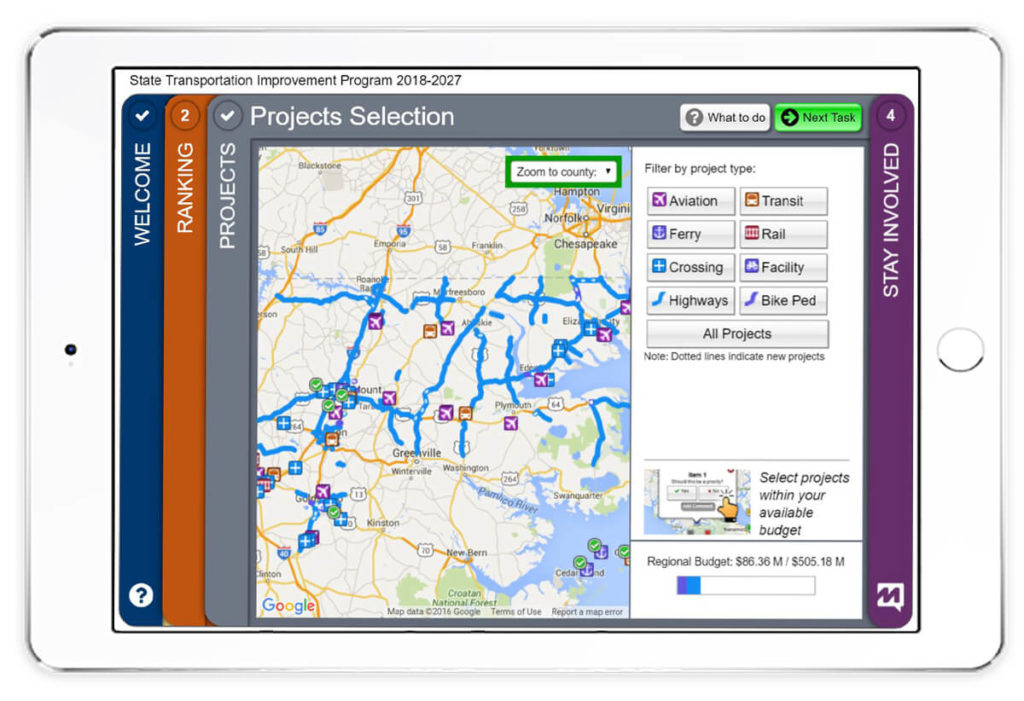
    This unique portal complements the more traditional public meetings in an effort to broaden public input by allowing the public to provide input online in only a few minutes. NCDOT selected MetroQuest in order to provide an interactive experience that would increase the level of public input to guide their planning process.

    “We are very excited to leverage MetroQuest to collect public input to inform our State Transportation Improvement Program. We chose MetroQuest because it represents the state-of-the-art in online public engagement and it’s quickly becoming clear why. We have already collected more public input than ever before and the momentum continues to build.” Jamille Robbins, Public Involvement Group Leader at North Carolina Department of Transportation

    MetroQuest has been used extensively by agencies and planning firms to support a wide range of transportation projects. At the request of NCDOT, MetroQuest developed enhanced functionality to support their unique STIP process.

    “We are thrilled to see the thoughtful and creative way that NCDOT is using MetroQuest to broaden public involvement to help shape their STIP. In the past collecting meaningful input from a broad demographic on these types of projects has been challenging. We anticipate that other DOT’s will be following this process closely since STIP’s are a required federal process in each state.” Dave Biggs, Chief Engagement Officer at MetroQuest

    About MetroQuest
    MetroQuest is the leading supplier of public involvement software for planning projects. With clients throughout the United States and Canada, MetroQuest is focused on helping planning agencies engage thousands of participants and collect informed community input to support their plans.

    About NCDOT
    The N.C. Department of Transportation is one of North Carolina’s largest state government agencies, with nearly 12,000 employees. NCDOT works hard to provide high-quality transportation for travelers throughout North Carolina, including highways, rail, aviation, ferries, bicycle and pedestrian facilities, and public transit.

    The official press release can be found here.

    Would you like to learn more?

    Feel free to email me if you would like additional information. I’ll be happy to help.

  • [CONFERENCE] Public Involvement for Transportation Planning at TxDOT

    [CONFERENCE] Public Involvement for Transportation Planning at TxDOT

    On June 15-17, the 2016 Transportation Planning Conference hosted by TxDOT brought together transportation planning professionals from throughout Texas to discuss best practices and review leading case studies in the field of transportation planning. The well-attended Public Involvement panel session was recorded and we are pleased to share it below. Enjoy!

    Public Involvement Panel Session Video

    Recorded live at the Omni Houston Hotel, June 17th, 2016, 8:30 – 10:00 am

    00:00 – 06:24   Moderator introduction – Jefferson Grimes, Public Involvement Section Director, Transportation Planning and Programming Division, TxDOT

    Bonus Case Study: NashvilleNext

    Since many of the conference participants asked for more information about the Nashville case study discussed briefly, I thought you might enjoy a short video of the Nashville team talking about their public involvement efforts.

  • [WEBINAR] A Recipe for Award-Winning Online Community Engagement with Metro Nashville Planning Commission

    [WEBINAR] A Recipe for Award-Winning Online Community Engagement with Metro Nashville Planning Commission

    This highly visual webinar video presents research finding and proven best practices, practical tips and award-winning case studies to guide agencies towards the successful application of online community engagement for planning projects. Viewers will walk away with an understanding about how to leverage digital engagement to achieve unprecedented results using cost effective tools (see participant comments below). This session showcases some of the most effective case studies that have found innovative ways to combine online and targeted face to face community engagement to involve thousands of community members in the planning process. Participants will learn strategies to improve the breadth and effectiveness of community engagement efforts increase the level of community support to facilitate smoother plan implementation.

    Watch Recording

    View Slides

    Participant Comments

    Thanks so much for the great comments and kudos. Here’s some of our favorites:
    “The best presentation on outreach I’ve ever attended (and I’ve done outreach since 1993)”
    “Wow! The webinar itself was a great example of effective engagement.”
    “Great webinar. Really good info, efficient, relevant to my work.”
    “Really well organized and digestible.”
    “The presentation was really well put together. I really enjoy when a presenter is able to get to the key takeaway first then dive into the specifics of that takeaway. Well done.”
    “Great suggestions for thinking outside the box when it comes to public engagement.”
    “Excellent presentation. Concise discussion of lessons learned with real, transferable information.”
    “Very good online presentation. Got a lot of out the speakers.”
    “This was a very helpful and insightful presentation. It provided good evidence on the effectiveness of online community engagement.”

    AICP CM Credits

    Q&A

    Q: These campaigns were designed for larger metro areas. How could a small MPO in a smaller community get some success with a lower budget?
    A: [From Dave] From our perspective, MetroQuest is used by agencies of all sizes including many smaller MPO’s with very limited budgets so we have seen a wide range of scales of engagement efforts. While Nashville had hundreds of meetings and used a variety of online tools, smaller agencies would decrease both of these factors significantly. Typically, smaller agencies reduce costs by only hosting a couple of community meetings thereby reducing staff and consultant time dramatically. As far a digital engagement goes these projects often only use one online engagement tool as opposed to many as Nashville did. Typically, if one tool is used it is an online survey tool that has an attractive cost per participant ratio in the hopes of broadening the participation cost effectively. [From Greg] Trying the same tools, but scaling them back. Knowing your regular participants and regular gaps is key, to then select tools (speakers bureau, street teams, or whatever) that match.

    Q: In both presentations, it looks like the engagement was geared around scenario planning, and sometimes very specific scenarios. Is that the most effective way to gain public engagement? What if your plan doesn’t use scenario planning?
    A: [From Dave] The Atlanta case study did not involve scenarios. We find with MetroQuest, that less than one quarter of the projects involve scenarios. The rest use a variety of other screen types depending on the phase and public input needs of the project. With that said, scenarios are compelling as they provide a rich picture of a possible future and can be a tangible way to gain the attention of residents. [From Greg] I don’t think it’s the most productive, but for Nashville it matched our needs. The critical thing is finding engaging ways to structure the decisions your community needs to weigh in on.

    Q: In both Atlanta and Nashville – besides shaping the vision and end product…how impactful were these efforts in bringing elected officials & leaders on board?
    A: [From Dave] If you are successful in drawing in input from a large and diverse population, you can be confident that elected officials will get on board. That certainly happened in both these cases where over 18,000 people were involved. [From Greg] I don’t think it’s the most productive, but for Nashville it matched our needs. The critical thing is finding engaging ways to structure the decisions your community needs to weigh in on.

    Q: Speaker mentioned that “meeting to go?” did not work as well as it hoped. Any thoughts how it could be better?
    A: [From Greg] I’m not totally sure. It may have been that we had too much going on in that phase, and so we couldn’t focus the public’s attention on it.

    Q: For Nashville, how did you best get people to participate at markets, transit stations, etc. Was there a reward like a raffle, candy, or mugs?
    A: [From Greg] In one round, we had some raffle prizes (coordinated with prizes we recruited to give away to active participants on MindMixer). We also had shirts and tote bags in a different round. And we had stickers throughout – another good way to draw families over.

    Q: Did you find that more people would attend after online outreach or were those done simultaneously?
    A: [From Greg] Generally simultaneously. I think each fed the other.

    Q: What was the total budget for Nashville Next?
    A: [From Greg] About $300,000 in outreach consultant costs, plus 10-12 staff working 60-100% FTE. Several other departments and divisions participated in Resource Team meetings, but did not design, develop, or implement public participation.

    Q: What would the cost for Hispanic input have been had the Spanish language site not been used?
    A: [From Greg] I’m not sure. If you want to follow up with me directly, I can try to run the numbers without that.

    Q: What meaningful public input was gained for Nashville Next that Metro Planning wouldn’t have done otherwise?
    A: [From Greg] The prominence of affordability, largely due to traditionally under-represented groups. Affordability hasn’t ever been far from our understanding of community concerns, but it really came to the forefront in NN.

    Q: How long was the public participation process?
    A: [From Greg] All told, three years. Individual phases lasted two to four months.

    Q: How is the comprehensive plan provided online? Interactive? Static pdf document?
    A: Sadly, several static PDF documents right now. We’re working to get the action plan into the open data portal.

    Q: How is implementation affecting your existing zoning and subdivision regulations?
    A: [From Greg] Primarily through a current effort to add inclusionary zoning. Some minor updates. No comprehensive revision is planned right now.

    Q: Is book a planner like a road show or speakers bureau?
    A: [From Greg] Primarily a speakers bureau.

    Q: What is your take on Twitter Live Chats as a method of consultation?
    A: [From Greg] They’re okay. They weren’t a focus; we participated in one handled through the daily newspaper.

    Q: Albuquerque asks: What were the background reports and studies, and how did you pick the topics?
    A: [From Greg] They’re available here: http://www.nashville.gov/Government/NashvilleNext/Background-Reports.aspx. They were developed partly through our own sense of the community and partly in consultant with our Steering Committee. We went wide with the background reports and then narrowed and consolidated them into seven plan elements.

    Q: Was NextDoor utilized for sourcing participation?
    A: [From Greg] We didn’t have very much of a NextDoor presence when NashvilleNext was underway.

    Q: Did you use existing staff to do the staff level (non-consultant) work, or did you deliberately staff up to accomplish the task? What disciplines were the focus?
    A: [From Greg] Existing staff of planners, landscape architects, and architects.

    Q: What is cost for MetroQuest? Is it a subscription?
    A: [From Dave] I apologize that I was not able to provide more detailed information about MetroQuest due to the nature of the session. This session was not meant to be an introduction to MetroQuest and only included examples to highlight the lessons learned via the case studies. We would be happy to provide additional information to those interested in a separate call. I can let you know that MetroQuest is available by annual subscription and the cost varies based on the size of the organization. The Nashville case study compares the cost per participant of various online and face to face approaches at 38:30 in the video.

    Thanks again for your interest and participation in this webinar.

  • [WEBINAR] Best Practices for Online Public Engagement for DOTs

    [WEBINAR] Best Practices for Online Public Engagement for DOTs

    This 41-minute video presents a series of case studies, best practices and tips to guide DOT’s towards the successful application of online public engagement for a variety of projects. Award-winning LRTP, STIP, TIP, NEPA, EIS, corridor, highway, transit, TOD and participatory budgeting projects that successfully leveraged innovative digital engagement are presented. From crowdsourcing platforms to interactive surveys to social media, the latest fleet of online engagement tools are making it so easy and fun to participate that they are drawing in thousands of participants and collecting constructive public input to inform and support DOT projects across the country. This session outlines best practices gathered based on hundreds of project case studies.

    Watch Recording

    View Slides

    Q&A

    Below are some of the questions that were asked during the Q&A session at the end of the live webinar.

    Q: Without a registration process, how do we avoid people participating 100 times and skewing the results?
    A: [Responded to in the webinar] Planning processes can be controversial and abuse is always a possibility. With MetroQuest we have tools and techniques to identify and help mitigate ballot stuffing in order to protect the integrity of the results. Any attempts at abuse are easily recognized and nullified.

    Q: Do you think your findings are equally applicable to projects other than ground transportation. e.g., water use planning, watershed management, etc…?
    A: Yes. In our review we also looked at water use plans, storm water management, environmental plans, etc. The lessons equally applied to those projects however they often had the additional challenge of dealing with a subject matter that was not top of mind for the public. I spoke at the American Public Works Association conference last year about Online Engagement for this sector and referenced a MetroQuest project that engaged over 10,000 participants in stormwater management for a public utility. They said they had never seen such high participation in a project like that. I think in that case the entire project team did a great job making the topic accessible and interesting.

    Q: What is the process for setting up MetroQuest for a project?
    A: [Responded to in the webinar] Here is an excerpt from our “Public Involvement Software User Guide”. The MetroQuest team provides much more than software. Think of us as your trusted project partner with over 18 years of experience with digital engagement. We take care of setting up the software to meet the specific needs and goals of your project. We also guide you along the way to ensure the best results. The MetroQuest team works collaboratively with you and your team to determine the 4 or 5 screens that will best meet the needs of your project. We then use your content (pictures, phrases, branding, color schemes, maps, etc) to set up the MetroQuest screens. MetroQuest comes configured for mobile, tablet and desktop platforms so no matter how your participants wish to engage, we’ll make sure that their experience is delightful. Once MetroQuest is launched it’s time for your team to actively promote and monitor participation. We’ll back you up with great advice about how to maximize participation and even target particular demographic groups to ensure broad representation of your community. Download the guide here.

    Q: What tactic works best with communities of color? how do you engage EJ when they are less likely to have internet at home?
    A: [Responded to in the webinar] This is a big topic and I suggest you read our 8 tips to reach targeted communities here.

    Q: How does MQ get beyond the “vote” concept? Setting the expectation that the alternative or concept with the most points “wins”? Decisions are made on a variety of factors, so having an expectation that something will be selected based only on public opinion may backfire on the client.
    A: I totally agree and I realize in my presentation I used the word “vote.” We would not suggest using that word in the public interface for the reasons you cite. I think it’s critical to set expectations for how the public input will be used and not over promise. Great point. Thank you.

    Q: How are sites made ADA accessible?
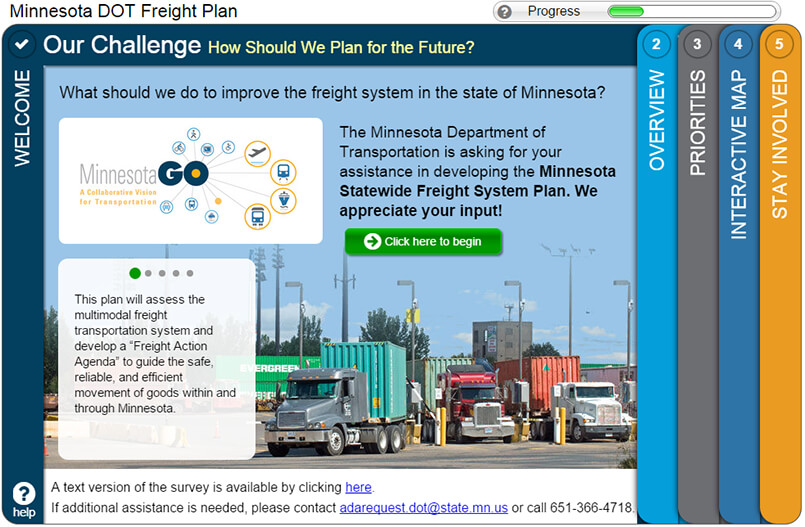
    A: Thanks for reminding me. I meant to point this out when I was showing the Minnesota Freight Plan example. Because of the visual and interactive nature of the tool, some people (such as those with vision impairment) will need an alternative way to participate. This can be easily handled in a variety of ways. In the case of the Minnesota Freight Plan, you’ll see an option to participate in a text only survey as well as contact information for additional assistance.

    Q: Do citizens also have a way to rate the planning process or event itself? Clarity is in the mind of the citizen, not the presenter.
    A: [Responded to in the webinar] Yes we often have often have evaluation questions at the end of the online engagement experience and have used those responses to monitor how we are doing and improve the tool. This kind of honest feedback is extremely useful. Most of the responses are very positive. It’s clear that there is a pent up desire to have an easy and fast way to participate and that online tools are fulfilling that need. The critical responses are helpful as they give us clues as to what we can do to continually improve.

  • [WEBINAR] Best Practices for Online Public Engagement for Transit Agencies

    [WEBINAR] Best Practices for Online Public Engagement for Transit Agencies

    This highly visual webinar presents a series of best practices, tips and case studies to guide transit agencies towards the successful application of online public engagement for a variety of projects. You’ll learn about award-winning LRTP, Mobility Plans, Station Plans, NEPA/EIS, Corridor Studies, Transit Master Plans, TOD and participatory budgeting projects that successfully leveraged innovative digital engagement.

    Watch Recording

    View Slides

    Q&A

    Below are the comments and questions from participants that were received during the Q&A session.

    Q: What if the comments from the community are not financially feasible?
    A: We often include financial constraints into MetroQuest for this very reason. People can come in with very unrealistic expectations and it is very useful to present real constraints into the engagement process to ensure that the participants are learning about these limitations and providing informed input. Take a look at some of the projects here. As one example, this project in Vancouver, Washington is clever. They ask people to choose a level of investment on screen 2 and then require them to raise enough funds to balance the budget on screen 4.

    Q: How can we get maximum involvement with the minimum budget?
    A: In general using some sort of online community engagement is more cost effective on a per participant basis compared with any of the face to face options. For online tools, I’d suggest looking at survey tools over crowdsourcing tools since they attract more participants. As far as online survey tools go, if you are focused on maximizing public involvement, MetroQuest currently has no peer, especially for transportation agencies. Since your goal is maximum involvement I would not suggest using a simple multiple choice survey tool. They simply don’t draw in participants in large numbers and likely won’t meet your goals. If you don’t have a great deal of budget and wish to conduct several projects per year you might be best off looking at an annual subscription which will allow you to keep your per project costs low while still taking advantage of results that you get with MetroQuest.

    Q: Will the slides be available?
    A: Yes indeed. They are posted here. I’m glad you found the material interesting.

    Q: How much should one budget for the kinds of projects that were demonstrated?
    A: We have recently started offering “all you can engage” annual subscriptions so many agencies are now using MetroQuest on multiple projects with no additional cost per project. That makes it a little more difficult to cite a specific per project fee. For agencies that use MetroQuest on a single project typically $12,000 is a reasonable budget number to have in mind. The precise fee depends on the scope of your project so it’s best to have a contact us for a quick chat about what you’d like to accomplish.

    Q: What other software options are out there that are similar to MetroQuest
    A: There are lots of tools but they are all very different than MetroQuest. We have found that it’s best to define the goals and needs of the project and then seek out a software solution to meet those needs. There are no other tools that we are aware of that are as well-suited to transit planning as MetroQuest (e.g. that have the visual and interactive features that planners look for, educate participants about choices and tradeoffs, are designed to be fast and fun to use, etc). There are however several other online survey software options available such as SurveyMonkey. These tools offer basic survey functionality such as multiple choice questions so it’s unfair to compare them with MetroQuest that is specifically designed with the needs and goals of transportation agencies in mind. We have found that on average MetroQuest engages 7.5 times more participants compared with a simple multiple choice survey due primarily to its popularity among participants. I hope it is helpful.

    Q: How can the needs of visually-disabled be accommodated?
    A: There are several great ways to accommodate people with visual-impairment without compromising the appeal of the tool for other participants. This is a very important topic and MetroQuest is leading the charge to expand the accessibility of online tools. I have recently written a blog post on this topic for Planetizen magazine. Check back on our blog for a link to it. It should be released shortly.

    Q: What role does door to door play?
    A: Door to door is generally a last resort of most engagement plans primarily because it is so labor intensive. It can be a useful strategy for very localized projects such as station area plans but even for these plans, broader community involvement is often useful since people interested in station design could live and work in a much broader area.

    Q: Do we work with rural clients?
    A: Yes, indeed. Many rural areas have difficulties with face to face engagement due to the spread out nature of the population. With the increase in online shopping and social media, online participation among rural residents has been rising rapidly.

    Thanks again for your interest and participation in this webinar.