The Michigan Department of Transportation (MDOT) has reinvented how it approaches public involvement and the payoff has exceeded even their wildest expectations.
While transportation matters to residents of all ages, few attend public meetings. Transportation agencies across the country are plagued by declining participation across all planning projects. They’re also struggling with involving a broad demographic.
Public involvement for long range transportation plans (LRTPs) can be particularly challenging. Most people are concerned more about immediate and localized issues. They generally don’t think in terms of long-range policy directions, constraints, and trade-offs that are the subject of the LRTP process.
In fact, last time around MDOT conducted an extensive public involvement effort including over 20 public meetings throughout the state to support its long range plan. A total of 125 people attended, with higher representation from older demographics. MDOT project manager Brad Sharlow described the public input as “very sparse.”
This time around, Michigan DOT went online with the hopes of broadening its outreach to support its new state long range transportation plan (SLRTP). In their webinar, they explain how they joined forces with WSP to engage 6,300 people, from millennials to boomers, to uncover their evolving transportation priorities for the Michigan Mobility 2045 SLRTP. Shane Peck, Anita Richardson, Brad Sharlow, and Kyle Haller share their engagement techniques and what they learned about public preferences for modal tradeoffs, infrastructure investments, intelligent technologies, and transit.
This webinar recording is like a best practices playbook to help other agencies develop and implement public involvement programs for broad and inclusive outreach for LRTPs.
Watch this complimentary on-demand webinar for modern ways to:
Uncover the transportation priorities of your citizens
Engage across all age-groups, going beyond the usual suspects
Gamify transportation education to capture informed public input
Integrate tech to capture public input at public meetings
Build resident support and buy-in for meaningful change
We are thrilled to welcome the Colorado Department of Transportation (CDOT) as the newest member of the MetroQuest community.
CDOT is responsible for the transportation network in the eighth fastest growing state. With so much change occurring, CDOT takes public involvement seriously and is wasting no time in making use of MetroQuest. The team has already collected informed input from over 1,225+ people in less than a week and anticipate that many more thousands will follow. The agency is seeking public input on how to spend taxpayer dollars to plan for rapid growth by prioritizing transportation investments that will move more people and goods, safely and efficiently.
CDOT started its MetroQuest subscription with a BANG by launching its first public survey for a project called “Your Transportation Plan”
Public input collected with this MetroQuest survey will help inform which investments are made over the next 10 years across all modes of transportation, including trains, planes, automobiles, bikes, pedestrians, freight, and more. CDOT Executive Director Shoshana M. Lew described the project in a press release:
“This process builds on Colorado’s tradition of grassroots engagement to take a fresh look at our transportation investment priorities and ask people across Colorado what matters to their lives and what infrastructure can do to get them there … Thank you for joining us as we think broadly and build a plan that provides connections, choice, and a Colorado for all.”
A clever video, press release, and press conference have kickstarted the promotional campaign. During the press conference, Lt. Governor Dianne Primavera addressed residents,
“This is an incredible opportunity for Coloradoans to join us at the table, and identify specific transportation projects for CDOT to consider that will directly improve your community. With your engagement we can create your transportation plan, ensuring that Colorado has the connections and choice that help our state thrive.”
Let’s take a look at the highly engaging public survey they customized using MetroQuest! You can either explore the screenshots that follow or try the DEMO survey here (note that your responses will not be included in final survey data).
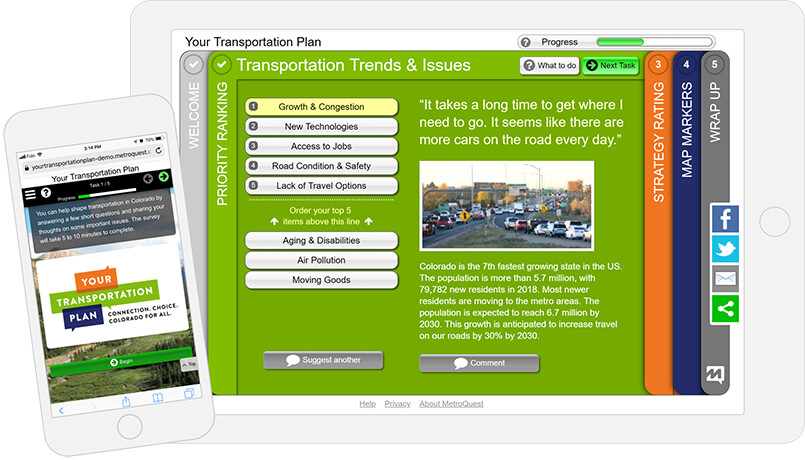
After a short description of the project on the first Screen, CDOT is using the MetroQuest Priority Ranking Screen to educate the public about the state’s top transportation issues, while asking Coloradans which should be prioritized.
“Part of the reason we’re doing this is to have an active conversation with people about the challenges they have and how you can solve them with different types of transportation,” said CDOT Executive Director Shoshana Lew at Friday’s press conference.
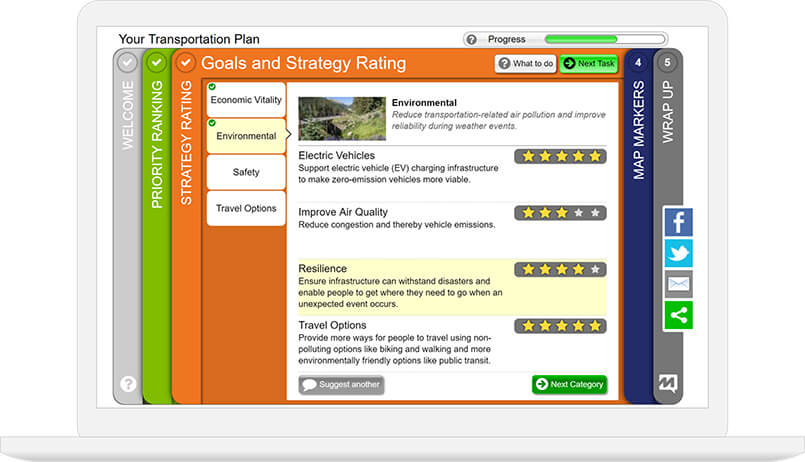
In the next MetroQuest Screen, Coloradans are rating their preferred goals and transportation strategies. When the survey closes in August, CDOT will have a clear understanding of how residents across the state would like to see transportation options evolve. The CDOT team will know whether residents would like to see investments made in infrastructure to support electric vehicles, or to extend travel options for cyclists, pedestrians, transit users, or to fund a host of other transportation priorities.
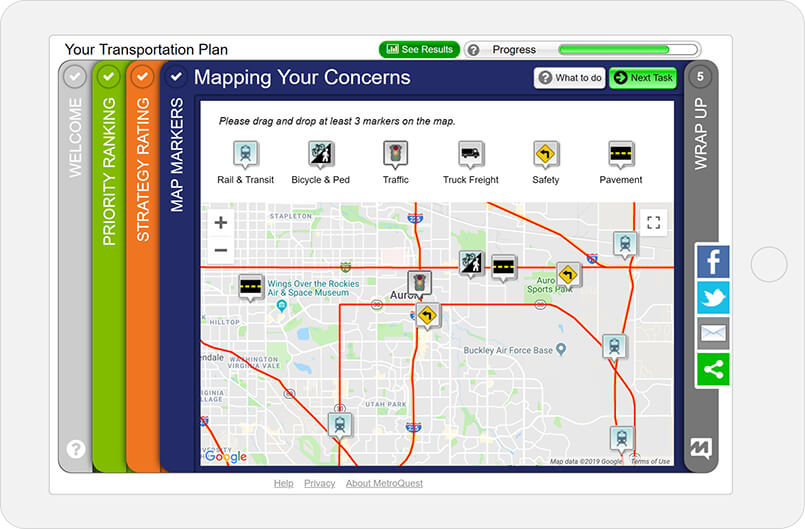
On the last interactive Screen, participants are zooming into a map of Colorado and adding map markers to identify areas of concern. They are informing CDOT of safety issues, poor pavement conditions, missing rail or transit options, and areas that could benefit from bicycle and pedestrian options.
The last MetroQuest Screen is collecting demographic information. This data will empower CDOT to ensure that it has reached a broad audience by age, ethnicity, and geography before the survey closes. We look forward to keeping an eye on the growing engagement numbers until then.
CDOT joins a long list of State Department of Transportation (DOTs) that subscribe to MetroQuest to offer both educational and engaging online public involvement experiences. The list includes Texas, Maryland, Maine (and all its MPO’s), Oklahoma, South Carolina, Kansas, and North Carolina (with all 36 of its MPOs and RPOs).
Our team at MetroQuest extends a warm welcome to the entire team at CDOT! We wish you outstanding public involvement success with this first survey and the many more to come.
Each year at the American Planning Association’s National Planning Conference, when I’m not presenting a session, I can be found in the crowd at any public engagement related session. And each year, I share my thoughts and lessons learned following the conference.
Compared with past years, on the surface, public engagement seemed less prominent at NPC19. A deeper dive reveals that the dialog about public engagement was woven into a sophisticated treatment of equity and inclusion. This trend was first noticeable at NPC18 in New Orleans. This year’s NPC took it to the next level.
There are too many sessions to cover comprehensively, so I will focus on the sessions that inspired me the most. The first session that got me scribbling notes featured Kim Lundgren of Kim Lundgren Associates, Inc. (KLA) in her talk, “Beyond the Usual Suspects: How to Deliver Ongoing, Equitable Engagement.” She described KLA’s approach to reaching beyond the usual suspects using a toolbox approach in recognition that each audience group may require a different tool or engagement technique. This session was a refreshing move away from the one size fits all solutions we’ve seen in past years.
My second inspiration came from the description of the role that the City of Loveland, Colorado’s Youth Advisory Commission (YAC) was playing in the city’s transit planning. The most exciting takeaway for me was the part of the process where YAC conducted peer-to-peer engagement to influence the city’s transportation master plan. I’ll be following the YAC carefully as this demographic is so critical and has been the most challenging to reach for many communities.
I darted out mid-session to catch Darlene Flynn, from the City of Oakland, California, talk about “Strategies Toward Racial Equity in Planning.” I’m glad I did. Her powerful presentation about her work in Seattle and later in Oakland on racial equity in planning and city policy made it clear that it plays a central role in some of the most challenging issues facing cities and regions. She, and her co-presenters, encouraged the audience to look at the legacy of historical policies and planning decisions whose affects still linger across the country. The session dove deep into displacement, gentrification, economic inequality, criminal justice, and health disparities and connected these issues to historical planning policy so clearly that it changed the way I see cities. She made quite a few new fans that day, myself included.
I rushed from there to my own presentation on “Community Engagement Therapy” based on Pecha Kucha talk I gave at the Rail~Volution conference in Denver.
I offered a lighthearted and self-deprecating look at how vulnerable public engagement processes can be to vocal minorities and how new technologies can play a role in creating more balanced and safe ways for meaningful community dialog.
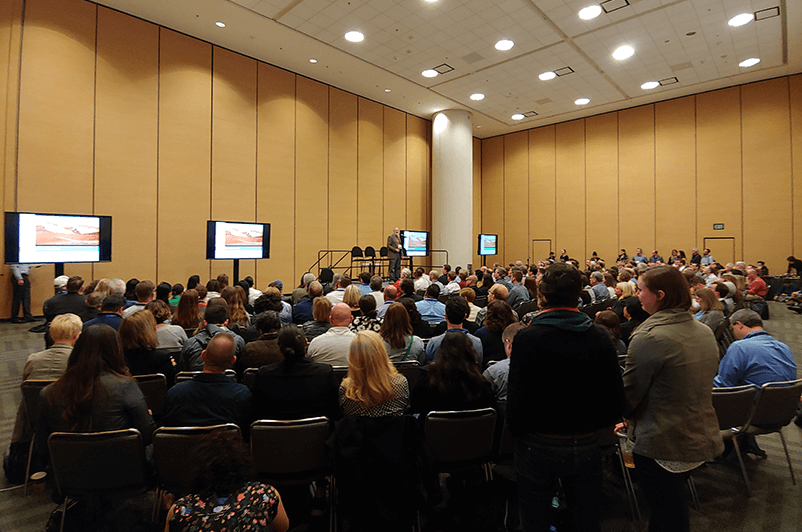
This “Fast, Funny, and Passionate” session was part of a series that the APA has been offering for a few years at the NPC and it is clear that they need larger rooms for these popular sessions. Our room seated 250 and organizers had to close the doors after well over 300 people crowded in!
Next up was an inspiring story about Akron, Ohio who is collaborating with community members to co-create public spaces to develop trust and inspire healing in this mid-size Rust Belt city. Citing increased polarization, segregation, social isolation, and economic inequality, this partnership with the national Reimagining the Civic Commons initiative is reinvigorating a civic pride and engagement in a way that can serve as a model for cities across the country.
Gabrielle Lyon of Lyon Strategies talked about the Chicago Architectural Foundation’s (CAF) Meet Your City initiative to engage with youth. As part of this initiative, CAF hosted a design competition and published a 144-page color graphic novel to help youth understand their role as city stewards and to encourage active participation in the planning process.
The passion and creativity of these planners to deeply understand and address the needs of all demographic groups in the communities where they work is inspiring.
I’ll use this inspiration to look more deeply into online engagement case studies to reveal best practices for reaching traditionally underrepresented populations. I’ve already found three excellent examples, so stay tuned for upcoming articles, case studies, and webinars.
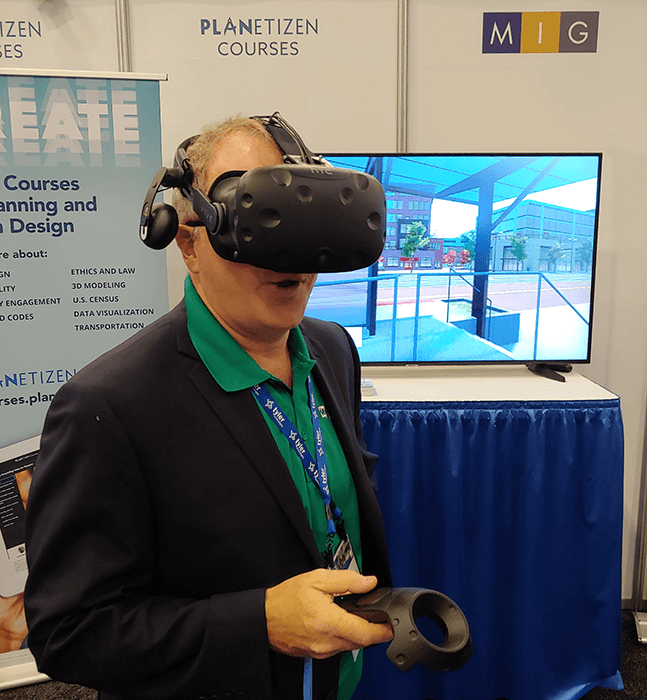
I did manage to sneak in some fun time in the mist of all these amazing sessions. I had a great time playing with the Planetizen/MIG virtual reality setup.
Many thanks to the APA conference team for curating another thoughtful array of presentations and sending me home inspired to continue raising the bar for public engagement. I can’t wait till APA NPC20!
I would like to personally thank the esteemed panel of judges for recognizing the accomplishments of our world-class team. This award represents the collective achievements of all of our employees. They helped make 2018 a truly transformative year! We achieved 5
We’re so excited to welcome our friends at the Oklahoma Department of Transportation to the MetroQuest community!
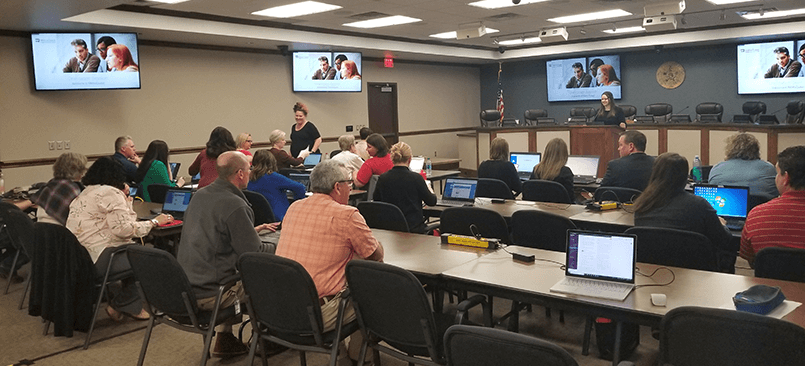
Our CEO, Mike Walsh, and I visited their offices in Oklahoma City last week. I always love being able to put faces to names, and I was thrilled to meet the Oklahoma DOT (ODOT) team in person. Our on-site training (which was recorded for future use) will ensure their users get started on the best path possible towards successful online public involvement!
With over 30 attendees, we were so excited to hear about the broad realm of public outreach projects ODOT is already planning!
We worked directly with the Oklahoma DOT team, as well as various consultants and ODOT partners. Training this breadth of users means that ODOT employees can hand over the reins on various projects to their consultants and be able to focus their time on even more topics. We loved getting to connect with so many groups, each with a different focus and plans for MetroQuest surveys! From highway plans to community projects, we have examples for every project scale and type to help inspire their next online survey.
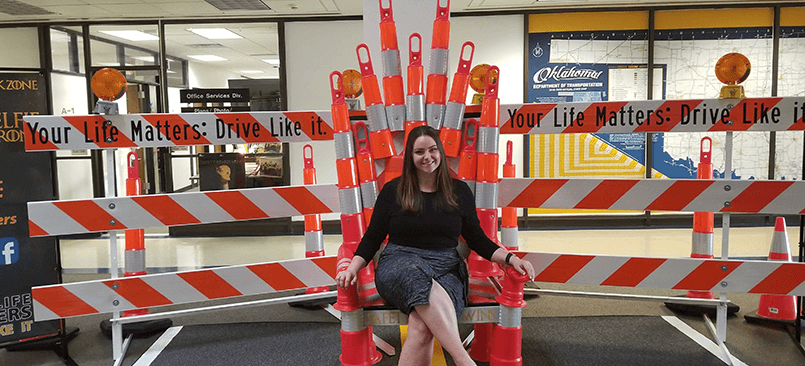
We visited in April, which is Work Zone Safety month! ODOT is focused on keeping all highway workers safe, and this was obvious from the moment we stepped in the door. There are tips on how to drive more safely posted on traffic cones in the lobby and even a huge throne of safety cones available for photos and posing! The focus on keeping highway workers safe and uninjured is clear, and we’re looking forward to helping Oklahoma DOT involve the public on this topic to learn how they can further improve safety methods.
I’m not going to lie, sitting on the throne of cones was definitely a highlight of my trip!
We always love being able to connect with customers in person. Thank you Oklahoma DOT for being such amazing hosts!
Let’s celebrate the outstanding achievements of women in planning and public engagement. The theme for this year’s International Women’s Day is #BalanceforBetter. We wanted to take a moment and highlight some fantastic stories of women who are achieving balanced engagement, moving accessibility and mobility forward, and planning more equitable, vibrant cities for us all.
Beth Alden shares her journey to executive leadership, Liane Miller gives us 5 tips that helped her engage 52% women for the Austin Strategic Mobility Plan, and Jennifer Fix talks about a FEMOPOLIS taking us overseas to visit cities for women, by women. Get inspired by their exceptional stories!
Learn how Chicago’s award-winning MPO is engaging at all scales by collaborating with 284 communities. CMAP Deputy Executive Director of Planning Stephane Phifer, Associate Outreach Planner Katanya Raby, and Senior Planner Lindsay Bayley take us inside their local approach to online engagement for OnTo2050.
Liane Miller tells us how she engaged 5,100+ residents online to help inform and shape the Austin Strategic Mobility Plan, the first locally-focused comprehensive transportation plan. Watch this on-demand webinar to learn how America’s #1 boom town is planning inclusively for the city’s transportation future!
Social media works for sharing information, but let’s get real. Social media can’t collect quantifiable public input for your transportation plan. Find out how Joann Mitchell and Heather Edic with Kinney Engineering surveyed 5,000+ residents online, collecting 80,000+ data points to inform their Glenn Highway project!
Discover how Michelle engaged 8,350+ residents! “We’ve really had robust engagement online. As far as outcomes, being able to do scenario planning and connect the dots between people’s values and the types of land uses they thought were important was tremendous for our region.”
Watch this 3-minute clip on the outstanding success Lorna achieved by going beyond public meetings to reach thousands online. “We’re able to go to decision makers and show them ‘we got this much input, and these were the findings.’ This gives them more confidence to tell us that they’re ready to move forward.”
Congratulations to all of the planners and public participation professionals who achieved outstanding public engagement this year! With MetroQuest surveys, you collected millions of data points to inform better transportation and urban plans to create better places for us to live, work, and play.
As we approach the holidays, we love to celebrate great engagement!
Let’s take a few minutes unwrap some of this year’s outstanding success stories with our friends Lorna, Ken, Michelle, and Jeffrey …
Watch this 3-minute clip to share in the outstanding success our friends Lorna and Ken have achieved this year, going beyond public meetings to reach thousands of residents for their clients. “MetroQuest allows us to very efficiently and cost-effectively get a lot of input – big numbers! That’s good for us and it’s good for our clients,” Lorna, congratulations to you and your team!
“We’ve really had robust engagement online. MetroQuest has been versatile for us and helped our communities to grow and prosper,” congratulations Michelle! Your team engaged over 8,350 residents and collected more than 91,950 data points. Play Michelle’s interview in this 3-minute video clip.
“The power of MetroQuest is the ability to get the representation of our population. On some of the surveys, we’ve had over 1,300 respondents. Getting that through just open houses is not possible,” congratulations Jeffrey! Your team collected meaningful input from 3,825 residents to inform your Official Plan update. Celebrate in Jeffrey’s success with this 2-minute clip.