The Survey of the Month series is a monthly blog where we highlight the extraordinary work our customers are doing, along with some takeaways that are relevant for anyone interested in making the most out of online engagement using MetroQuest’s survey platform! To see more in the series, visit the blogs here.
This month, we spotlight a survey that broke records for the highest number of participants in a day. The transit options survey from COMPASS in Idaho received over 4,000 participants in just one day and went on to hit record-high participation numbers with over 11,000 participants when the survey closed a month later!
Let’s take a look at their survey and highlight some takeaways for success with your next online public engagement survey.
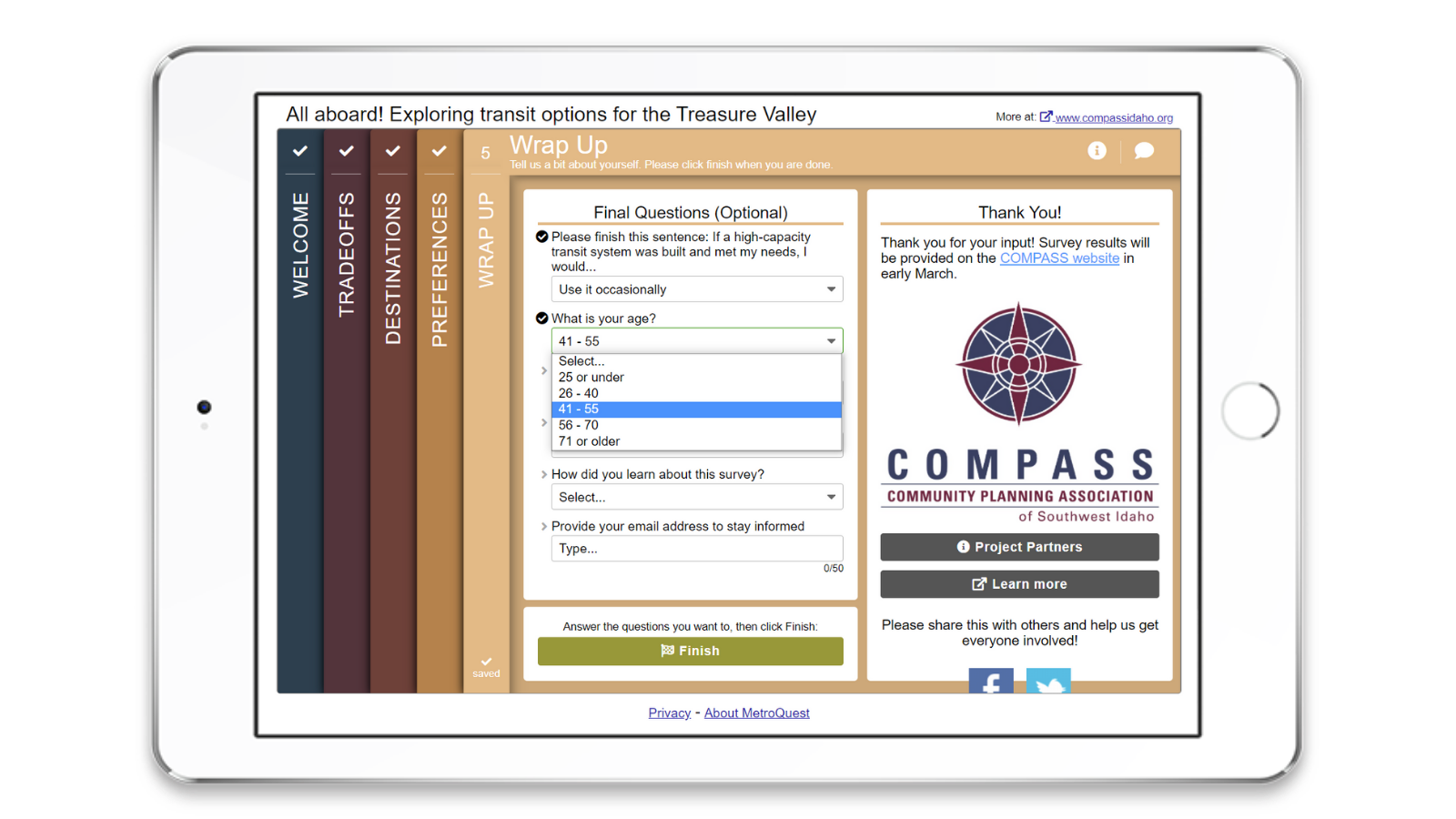
What’s the story? All aboard! Exploring transit options for the Treasure Valley
COMPASS, which stands for the Community Planning Association of Southwest Idaho, created a fantastic survey for the planning of a future high-capacity transit system to meet the demands of a growing region. This new system would be an addition to the current bus system.
While high-capacity transit options for the area have been explored for years, a recent study conducted by COMPASS in 2020 analyzed types of transit and route options. Those results were used to inform the All aboard survey. This survey, which concluded in February of this year, was the third in a series of surveys that aims to shape the region’s long-range transportation plan.
The survey reached incredible participant numbers: 11,706 to be precise, with a much higher number of total data points. Social media was a primary driver for traffic, with almost 50% of respondents stating that social media was how they heard about the survey, followed by news stories with 21.5% of participants. Read the full case study to learn more about the promotional strategy that lead to such great public participation.
The full results from the survey can be found in this report.
For timelines and additional information on the project, visit the project page. For more information, visit COMPASS’s website.
Anatomy of a Transit Survey: Visual Screens for Maximum Fun Factor!
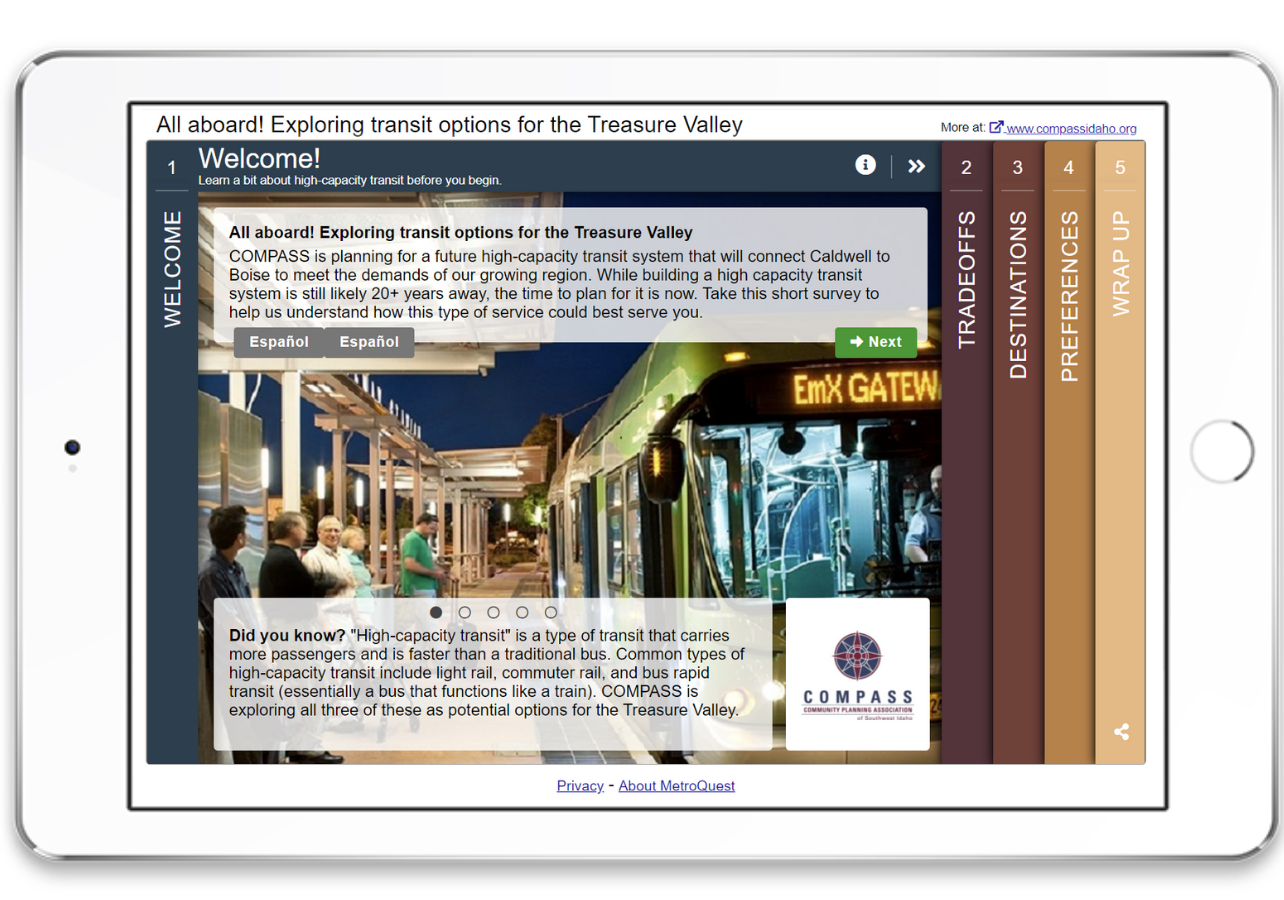
When landing on the Welcome Screen, participants will find information on the project, including the background as well as some additional information on high-capacity transit. Immediately after, the survey starts with a Tradeoffs Screen. This type of Screen gives participants a chance to look at the project in terms of what they would prioritize when given competing choices.
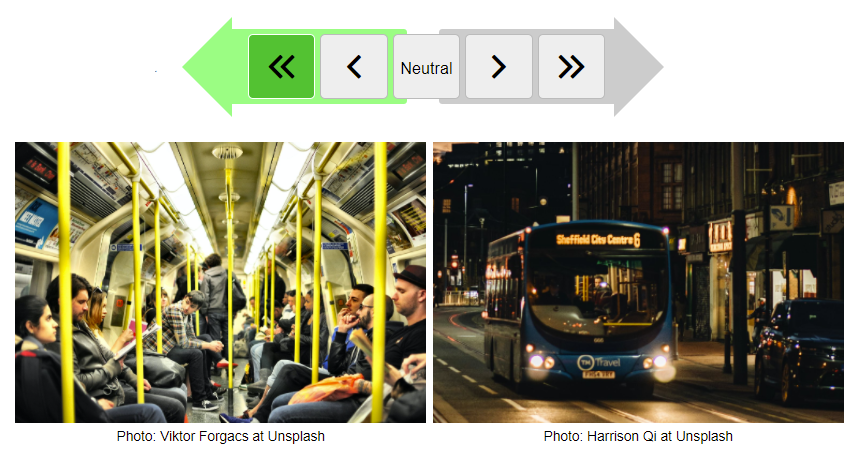
Here, participants were presented with four tradeoffs, namely Convenience, Timing, Separation, and Investment, and asked where they would position themselves. For example, under Convenience, they were asked to indicate their preference regarding faster trips with fewer stops or slower trips with more stops.
The next task was to provide destinations on a Google map on the Map Marker Screen. Participants could choose from available markers, including “home,” “job,” “entertainment,” “errands,” and “other.” The task was for participants to show on the map where they typically go. This exercise around origin and destination is a great way to understand typical trips and help show the study organizers where capacity is most needed!
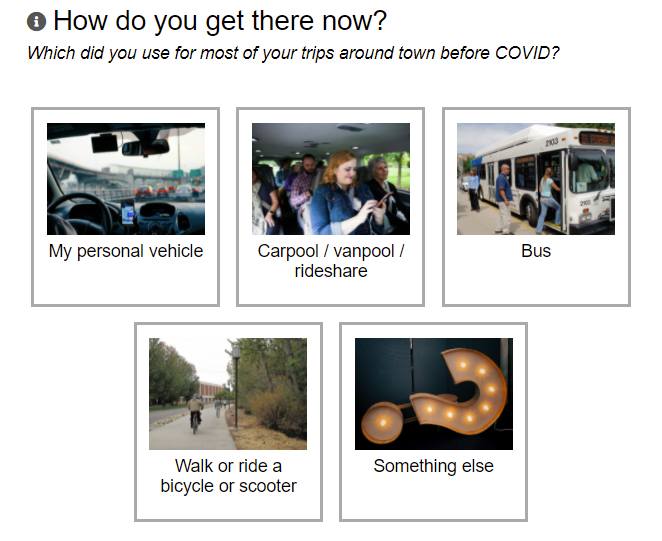
The fourth Screen was an Image Preference Screen where participants were asked to provide input on service preferences. They could choose one image out of a set that best represented their answer in a number of categories, namely “Where do you want to go,” “How do you get there now,” “What’s close enough,” and “What’s most important to you?” Each of the questions had five possible answers, with one being an “Other” or “Not applicable” option. The purpose was for the survey team to understand how high-capacity transit could serve the participants.
If you’d like to try out the survey, take a look at this demo version. This does not collect data and will not impact survey results.
5 Tips from All Aboard: Straightforward and fun survey for a high impact!
The survey stands out as particularly visually appealing and fun. Below are 5 takeaways from their survey:
- On the Welcome Screen where visitors first land, they see a language switch button labelled “Español” so that those who prefer to take the survey in Spanish can do so easily. This element is part of MetroQuest’s overall effort to streamline the process required to create a survey in an additional language. For more information, read our recent update on multilingual surveys to support inclusive public engagement, or reach out to your customer support manager.
- The Welcome Screen also makes use of the rotating slides at the bottom to provide additional information, small factoids about the project, process, and definitions. This is a recommended and particularly useful way to use it! A participant who wants to learn a little more will take the time to read those, and one who wants to spend only a few minutes here can do so as well.
- What stands out from this survey is that it is far from a traditional survey! In fact, apart from a few demographic questions at the end, there are no text-based questions at all! We firmly believe that reason for this survey’s fantastic participation rates is that it does not feel like survey at all, but an interactive, fun experience that still resulted in high numbers of data points and informed public input.
- COMPASS created a very visually appealing experience that, instead of using text for the majority, switches things up with images, and with a map for input. For more tips on this, have a look at this 1-minute video where I discuss why more visuals and less text make for better surveys. The success of this survey helps confirm that participants are much more likely to provide input when it feels like a fun experience, rather than an onerous task with long texts.
- One particularly good example of the above point is the use of the Visual Preference Screen. The questions read like traditional questions – where do you want to go, how do you get there, etc. However, instead of providing a drop down with a list with possible answers, or asking participants to tediously fill in a text answer, this survey provides 5 images for each question that represent each of the answers and create a visually appealing activity that one can complete in just seconds.
For more great tips on how to make the most out of MetroQuest, contact your Customer Experience manager or reach out for more information!
MetroQuest supports community outreach on plans big and small! Check out our recent webinar on designing success for any size project:
The Art & Science of Big Online Engagement for Small Plans
Join us as we delve deep into good survey design and targeted promotional tactics, helping planning teams achieve successful community engagement for any size of project!
Anatomy of a Transit Survey: Visual Screens for Maximum Fun Factor!
When landing on the Welcome Screen, participants will find information on the project, including the background as well as some additional information on high-capacity transit. Immediately after, the survey starts with a Tradeoffs Screen. This type of Screen gives participants a chance to look at the project in terms of what they would prioritize when given competing choices.
Here, participants were presented with four tradeoffs, namely Convenience, Timing, Separation, and Investment, and asked where they would position themselves. For example, under Convenience, they were asked to indicate their preference regarding faster trips with fewer stops or slower trips with more stops.
The next task was to provide destinations on a Google map on the Map Marker Screen. Participants could choose from available markers, including “home,” “job,” “entertainment,” “errands,” and “other.” The task was for participants to show on the map where they typically go. This exercise around origin and destination is a great way to understand typical trips and help show the study organizers where capacity is most needed!
The fourth Screen was an Image Preference Screen where participants were asked to provide input on service preferences. They could choose one image out of a set that best represented their answer in a number of categories, namely “Where do you want to go,” “How do you get there now,” “What’s close enough,” and “What’s most important to you?” Each of the questions had five possible answers, with one being an “Other” or “Not applicable” option. The purpose was for the survey team to understand how high-capacity transit could serve the participants.
If you’d like to try out the survey, take a look at this demo version. This does not collect data and will not impact survey results.
5 Tips from All Aboard: Straightforward and fun survey for a high impact!
The survey stands out as particularly visually appealing and fun. Below are 5 takeaways from their survey:
- On the Welcome Screen where visitors first land, they see a language switch button labelled “Español” so that those who prefer to take the survey in Spanish can do so easily. This element is part of MetroQuest’s overall effort to streamline the process required to create a survey in an additional language. For more information, read our recent update on multilingual surveys to support inclusive public engagement, or reach out to your customer support manager.
- The Welcome Screen also makes use of the rotating slides at the bottom to provide additional information, small factoids about the project, process, and definitions. This is a recommended and particularly useful way to use it! A participant who wants to learn a little more will take the time to read those, and one who wants to spend only a few minutes here can do so as well.
- What stands out from this survey is that it is far from a traditional survey! In fact, apart from a few demographic questions at the end, there are no text-based questions at all! We firmly believe that reason for this survey’s fantastic participation rates is that it does not feel like survey at all, but an interactive, fun experience that still resulted in high numbers of data points and informed public input.
- COMPASS created a very visually appealing experience that, instead of using text for the majority, switches things up with images, and with a map for input. For more tips on this, have a look at this 1-minute video where I discuss why more visuals and less text make for better surveys. The success of this survey helps confirm that participants are much more likely to provide input when it feels like a fun experience, rather than an onerous task with long texts.
- One particularly good example of the above point is the use of the Visual Preference Screen. The questions read like traditional questions – where do you want to go, how do you get there, etc. However, instead of providing a drop down with a list with possible answers, or asking participants to tediously fill in a text answer, this survey provides 5 images for each question that represent each of the answers and create a visually appealing activity that one can complete in just seconds.
For more great tips on how to make the most out of MetroQuest, contact your Customer Experience manager or reach out for more information!
MetroQuest supports community outreach on plans big and small! Check out our recent webinar on designing success for any size project:
The Art & Science of Big Online Engagement for Small Plans
Join us as we delve deep into good survey design and targeted promotional tactics, helping planning teams achieve successful community engagement for any size of project!



![[SURVEY OF THE MONTH] Planning for a High-Capacity Transit System in Southwest Idaho](https://metroquest.com/wp-content/uploads/SURVEY-OF-THE-MONTH-Planning-for-a-High-Capacity-Transit-System-in-Southwest-Idaho.png)