Category: [INSIGHTS]

  • [INSIGHTS] The 3 Most Common Community Engagement Mistakes

    [INSIGHTS] The 3 Most Common Community Engagement Mistakes

    Planners, like any other professionals, live in a kind of bubble. Those charged with dealing with the public run the risk of expecting too much from residents as they design community engagement activities. Here are some of the most common mistakes.

    It’s great to focus on the positive and celebrate the best case studies, but sometimes it’s useful to learn from our mistakes.

    For the purposes of this post, we only considered projects that did not meet their own stated projects goals by a significant margin. This typically translated to one of the following: too few participants, too narrow a demographic participating, or widespread discounting of the validity of the input gathered by the community engagement process.

    After evaluating many case studies and interviewing the agencies involved, patterns started to emerge about lessons learned. It quickly became clear that the subtitle of this article could be “Great Expectations.” Here are three of the most common mistakes that hampered outreach processes.

    1. Expecting too much time

    There seems to be a strong tendency to over-estimate the level of time that people are willing to spend participating in community engagement activities. Dedicated and enthusiastic planning professionals sometimes forget that most people don’t get as excited about planning topics as we do. Others are well aware of short attention spans and talk about “scope creep,” with community engagement exercises starting out lean and slowing building to something unwieldy before it finally goes out the door.

    Keeping it short is not easy, and it’s a trade-off. With less time per person, you’ll be limited about how much detail you can get into. On the other hand, if it’s too long you’ll be limiting participation to only those who are most motivated—oftentimes motivated by negative feelings about the project. The breaking point seems to be about five minutes. Whether it’s at a public event or online, asking visitors or passers-by for five minutes of their time seems to be a sweet spot that allows you to collect a fair amount of input from the largest number of participants. If your “call to action” captures their attention, most people will be willing to give you five minutes. Asking for less time does not seem to make a significant difference while asking for more time results in a sharp decline in participation rates. In our fast paced world, ten minutes can seem like an eternity, especially when you aren’t particularly passionate about the issue.

    2. Expecting too much empathy

    Agencies conducting public participation for their planning projects have mandates, regulations, and specific objectives that they are striving to meet. Unfortunately, the public do not care about them like you do. Many of the projects we looked at focused too directly on agency objectives and missed many of the public’s top of mind issues. The omission of key public priorities or undue focus on agency priorities can either infuriate people or simply drive them away.

    It can be challenging but community engagement can simultaneously resonate with the agency goals and the public’s priorities if you know what they are. Understanding and defining both the community’s priorities and the agencies early on the in process seems to be a critical success factor. While agency priorities are often well-established, community priorities are more elusive. Planners knowledge of community priorities can be heavily based on interactions with the small subset of people who typically show up at council meetings and public workshops. This, we can agree, is hardly a representative sample. Furthermore, the language that people use to describe the issues is also critical when designing your invitations to participate and content for your surveys or other community engagement activities. Some of the best case studies started with an open-ended survey, allowing people to identify issues and priorities early on before alternatives and options had been defined. These early inputs can help to shape the content for subsequent surveys or activities to ensure that the outreach resonates with the community. Many agency goals can then be connected to community priorities but some gaps are to be expected. These gaps can often be accommodated creatively as long as there is enough lead time work with both sets of priorities.

    3. Expecting too much planning knowledge

    The more you learn about a topic, the harder it is to remember what it was like to be a novice. To some extent we are all living in a “planning bubble,” with our own lingo, acronyms, and a rather sophisticated understanding about cause and effect relationships of our complex built environment. Many of the case studies we examined were criticized for asking questions that the community did not fully understand. The result can be either less people being willing to participate or the community input being challenged as not informed or credible.

    Language is relatively easy to change as long as you have editors that can translate the jargon into something more publicly accessible. This translation task works well in the early phases of community engagement when the input being collected is about priorities and issues. People find it relatively easy and comfortable to talk about what’s important to them or what concerns them about a topic or area.

    Where even some of the most thoughtfully prepared projects had difficulty was at the options or alternatives phase of outreach. Asking people to nominate or choose among a set of possible solutions is far more difficult. The reason is that solutions require people to understand the cause and effect of the actions being considered. This is a big stretch for many people.

    The best case studies provided clear information about both the pros and cons of various options. By providing this kind of unbiased and balanced information about the options, planners can generate genuine community support as well as decision-maker confidence.

    This article was published on Planetizen.

  • [INSIGHTS] Tip of the Iceberg: Seeking Real Accessibility in Community Engagement

    [INSIGHTS] Tip of the Iceberg: Seeking Real Accessibility in Community Engagement

    Ensuring that community engagement opportunities are open to all residents is not only the law, it’s also good for planning. Incorporating a diversity of viewpoints improves plans, facilitates implementation, and frankly leads to better communities that meet the needs of all residents. Unfortunately too often the accessibility discussion doesn’t get out of first gear.

    When it comes to ensuring open and inclusive public engagement, it’s critical to understand the needs of residents as broadly as possible. When examining a range of possible methods that agencies can employ to gather public input, it quickly becomes evident that it’s far more than the visually-impaired that are at risk of being excluded.

    The importance of this topic became evident when registration for the webinar on “Engaging Vulnerable & Disadvantaged People in Planning” grew to over twice the maximum capacity in a few days. Here is a snapshot of the most important lessons of the research that led up to that session.

    A Toolkit Approach to Web Accessibility

    It’s true that much of the accessibility guidelines focus on people living with disabilities, so naturally that’s a great place to start. The movement toward online engagement tools has meant that the discussion has become focused on web accessibility standards. Online accessibly introduces a critical fork in the road. Best practices in online engagement lead us toward highly visual and interactive elements that can be awkward to deal with using screen readers and other assistive technology. Engaging the public using visual preference surveys, allowing people to place comments on an interactive map, or offering fun and interactive interfaces like drag and drop coin allocation screens are some of the many elements that make online engagement software tools popular and effective. These tools are visually appealing and fast for users. They also allow planners to better inform planning projects by quickly collecting a vast amount of public input.

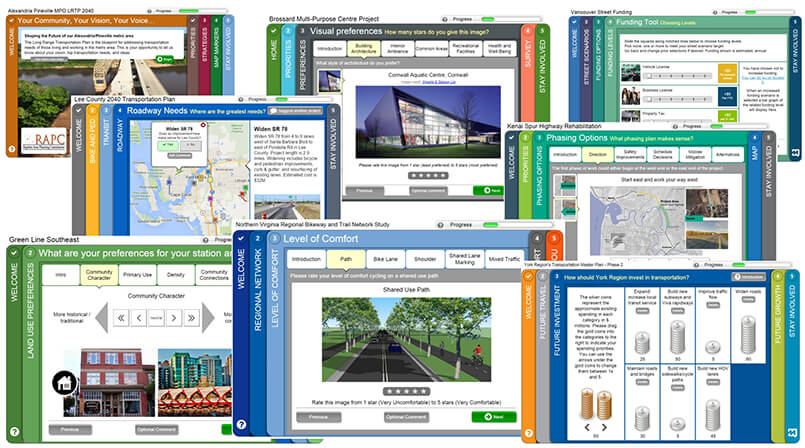
    Collection of MetroQuest screen types.
    Visual and interactive online tools like MetroQuest are a growing part of the community engagement toolkit.

    These same elements present a challenging test when it comes to the web accessibility criteria. While it’s easy to ensure that fonts are large enough for those with less than perfect vision and colors are not used in a way that put people with color blindness at a disadvantage, providing a workaround for people using screen readers to place comments on a map is a bigger challenge. It’s true that even visually rich and interactive online engagement tools can technically meet the requirements by, for example, including text descriptions of images and other screen reader accessible options. It’s also naïve to think that these options are equivalent to the experience provided to those without special needs. Furthermore, depending on the needs of both the project and community members, they may not even be the best alternatives for those with visual disabilities.

    From May to July 2015 we conducted a review of case studies of planning projects using online engagement as a significant source of community input. The review compared the results of the online engagement processes to look for patterns and identify best practices. So what did we learn about these kinds of interactive elements? Should interactive elements be avoided? Based on the case studies we examined, certainly not. In fact, many of the most successful projects attribute much of their success to these visual and interactive features. The leading planning and engagement experts recognize that not every tool in their toolkit will necessarily meet the most stringent online accessibility standards. That said, they know, and have demonstrated, that to optimize overall engagement results, they need a strategy that provides options for all people to participate. And that may include a mix of technologies and approaches, even if some of the visually rich online tools don’t meet certain web standards for accessibility. Here an analogy may help. The entrance to our office building has both a ramp and stairs. To accommodate the needs of people on wheels, the architects didn’t remove the stairs. They added a ramp. No one approach is going to be best for everyone. It’s about a variety of options to meet a diversity of needs.

    Ashley Ver Burg from HDR in Minnesota deals with accessibility issues head on as she seeks to create the most effective digital engagement strategies for her clients. In a telephone interview we conducted in February 2016 she put it this way:

    “When we pull together a digital engagement strategy, we start with accessibility. We strive for design that doesn’t impede accessibility and accessibility that doesn’t impede design. Visual elements are essential to making information easier to understand. This is the foundation of accessibility. The reality is that we often need to use multiple tools to reach different audiences.”

    Naturally, people with visual difficulties have every right to participate, and practical options for them must be part of every engagement plan. Indeed, planning agencies can benefit greatly from the insights provided by people with special needs. In reviewing leading case studies, the best practices that emerge look beyond the minimum requirement spelled out in legislation, toward a goal of providing a range of options that allow people to select the one that best meets their needs. For some people, providing a parallel screen reader accessible site is an attractive option for online access. For those with visual difficulties who choose not to use screen readers or those who would appreciate a more personal experience, providing an opportunity for people to speak to someone by phone or attend a session in their community may be better options. A wide range of choices will serve your community better and will open up the opportunity to participate to a broader audience.

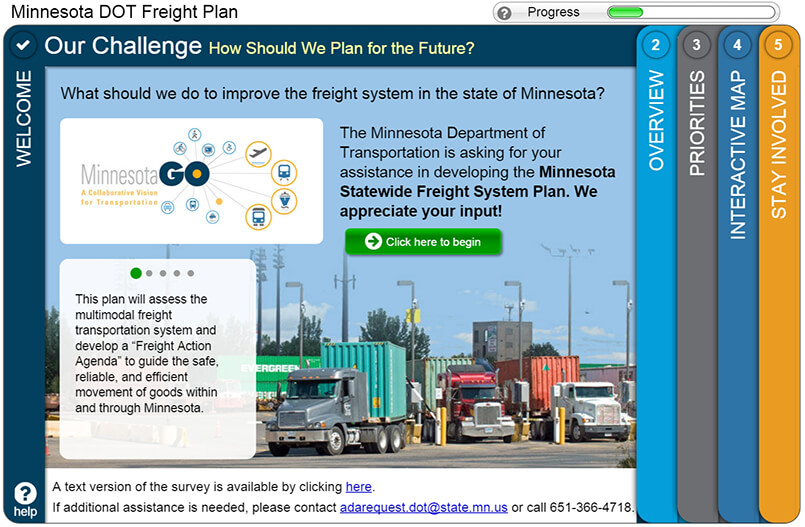
    Minn DOT MetroQuest online public involvement survey
    MinnDOT provides variety of options front and center to accommodate various needs.

    Let’s Broaden the Dialog about Accessibility

    Thinking more broadly about accessibility leads us to consider a wider range of factors that could hamper people’s ability to participate. Looking beyond the ADA guidelines, the environmental justice regulations in the United States call for the “meaningful involvement of all people regardless of race, color, national origin, or income.” While environmental justice applies specifically to environmental laws, regulations, and policies, Title VI applies more broadly to Civil Rights and addresses similar demographic groups.

    Groups that have been traditionally underrepresented in public participation activities for planning projects include youth, people with less formal education, residents who are new to the community and may not have social networks to learn about initiatives, and, perhaps most significantly in terms of numbers, people whose busy schedules or responsibilities limit their ability to get involved.

    Each of these groups present unique but in most cases, manageable challenges. In some cases, online engagement can be an important part of the solution. It can provide an opportunity to engage people with busy schedules quickly and conveniently and when done well, can benefit from the viral nature of social media. Online engagement can be offered in multiple languages and by leveraging visuals and minimizing text it can accommodate people of various national origins and reading comfort levels.

    In other cases, a mix of other community engagement tactics is needed such as:

    • Pop-up engagement events allowing planners to target specific communities,
    • Add-on events allowing planners to engage a specific group as a part another group’s event,
    • Touch-screen kiosks in community centers for participants to “stumble on,”
    • Mobile-friendly engagement options for smartphone and SMS users, and, yes,
    • Public workshops and open houses for people who prefer a face to face opportunity to speak with planners and neighbors about the issues.
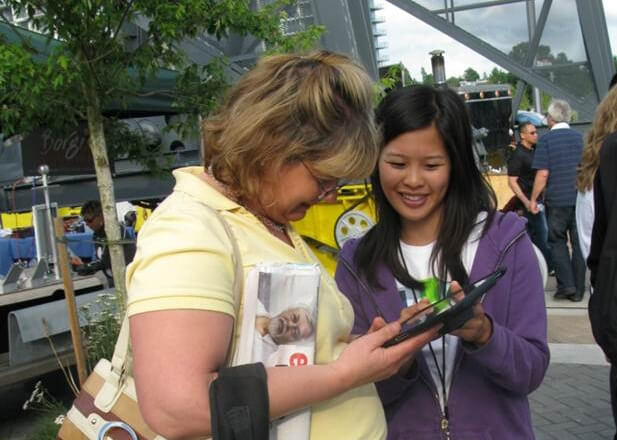
    Women completing public engagement online survey.
    Pop-up engagement with iPads for one-on-one assistance.

    The best projects we examined used a wide variety of engagement and promotional strategies to reach a broad audience. Many planners and engagement experts also commented that while it’s best to plan a multi-pronged engagement strategy at the outset of a project, it’s also very difficult to know precisely who will respond to each option. By collecting demographic information from participants, planners can monitor the reach of their community engagement and adjust tactics accordingly. Leaving room for creativity and fine tuning midway into the engagement period also appears to be emerging as a best practice. Ashley Ver Burg confirmed these findings:

    “We need to consider all audiences. That’s why we are now routinely using demographic data of project participants to inform and update public involvement strategies. Not every meeting, event, workplace, social media platform, or email list will reach the same audience. It’s important to develop a strategy—and continuously update that strategy—based on data.”

    To borrow an old line, “different strokes for different folks.” Based on our dialog with planners and engagement experts, the time might be right to widen the definition of accessibility based on a more inclusive and nuanced understanding of the varied needs of our community members.

    This article was published in Planetizen here. 

  • [INSIGHTS] VIA Metropolitan Transit Uses MetroQuest for Long Range Comprehensive Transportation Plan

    [INSIGHTS] VIA Metropolitan Transit Uses MetroQuest for Long Range Comprehensive Transportation Plan

    VIA Metropolitan Transit is using MetroQuest in support of “Vision 2040,” a planning process to update the agency’s Long Range Comprehensive Transportation Plan for the greater San Antonio region. Using MetroQuest for their engagement process will let the community have their say in the future of public transportation in their area.

    “Vision 2040 is a community-driven process with many opportunities for members of the public to provide us with input and suggestions,” said VIA President/CEO Jeff Arndt. “This online survey is a great way for people to get involved in planning the future, and we are promoting it with a public outreach effort that includes social media, online content, and many community events.”

    When Vision 2040 is completed in the fall of 2016, it will serve as a guide for public transportation for the region and assist decision makers and transportation professionals in planning for the region’s growing population over the next 25 years. Vision 2040 will identify public transportation options that can enhance mobility and the overall quality of life for current and future residents of the region.

    Read more about the project here.

  • [INSIGHTS] APA Smart Cities and Sustainability Task Force

    [INSIGHTS] APA Smart Cities and Sustainability Task Force

    The Smart Cities and Sustainability Task Force continues the focus on sustainability by addressing recent advances in technology and innovation to cultivate cities which are smarter, more resilient, and sustainable. The Task Force, which is a collaborative initiative between the Sustainable Communities, Technology, and Transportation Planning Divisions of the American Planning Association (APA), seeks to research and report on how technology advances are changing the field of planning and our communities, identify best practices, and demonstrate how planners can lead on these important changes.

    The Task Force Goals are to:

    1. Anticipate and prepare for trends and emerging issues and communicate their implications.
    2. Generate the big ideas to advance our communities.
    3. Educate the public and community leaders through documentation of best practices and increase their use by planners, citizens and elected officials.

    After working with MetroQuest on a project in Erie Pennsylvania, Co-Chair Robert Kerns invited MetroQuest President Mike Walsh to join the task force. As an expert in the field of digital engagement, Mike has been working with the team to create online surveys and ideation tools. In addition, Mike participated in the Task Force presentation at the APA National Conference in Seattle and contributed to the recently released Task Force Report.

  • [INSIGHTS] The Evolution of the Scenario

    [INSIGHTS] The Evolution of the Scenario

    Scenarios aren’t new but they certainly have evolved. While the concept of scenario planning can be traced back to the military, planners have been using scenarios for decades. In a nutshell, scenario planning involves creating a variety of possible alternative futures and using them to inform dialog about choices and then ideally, decision making. It’s a kind of “what-if?” exercise.

    Having been involved in scenario planning academically and professionally for 25 years, I’ve seen more than my fair share of scenarios. It strikes me that they have changed in really interesting ways – and many of these changes have made them more useful for public engagement. For simplicity I’ve divided the history into three eras.

    The Mainframe Era (1988 – 1997)

    When I first started working with scenarios, most were extremely complicated and sought to simulate the real world as closely as possible. They took days to compute, weeks to decipher and there was virtually no chance that the public could absorb them quickly. Despite efforts to synthesize the main messages in each scenario, they were still far to complex and multi-faceted to engage all but the most dedicated participant. We used a mainframe computer that required its own air-conditioned room and produced a stack of printouts several feet high. In one project, we worked for 2 years creating a single scenario and wrote a book about it called, “Life in 2030.” Ideally this scenario would have been compared with a few other alternatives but frankly we were exhausted after creating just one. And we weren’t the only ones. The Global Scenarios Group, for example, was also creating elaborate scenarios of the future of the world. Who can forget, “Fortress World?”

    The GIS Era (1998 – 2007)

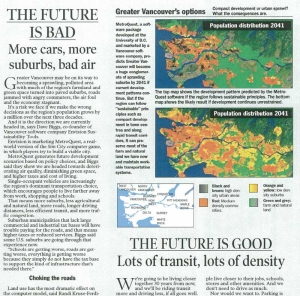
    As personal computers became more readily available and GIS software grew in popularity with planning agencies, scenarios became suddenly more visual, though pixilated. Maps of alternatives along with graphs of indicators became the go-to way of presenting scenarios. Here are a few scenarios we created for a newspaper section for Vancouver, Canada.

    READ THE FULL ARTICLE

    These scenarios are better than those of the early days. They at least showed visually what it might look like and could be explained to the general public, though I’m not sure how many people took the time to read the rather long article. So, in terms of usefulness for public engagement, scenarios had come a long way but they required more effort to understand than the average citizen was willing to put in.

    The iPhone Era (2008 – 2017)

    Something profound started happening in the late 00’s. The focus turned to simplicity and brevity. Life sped up, computing became more ubiquitous, and there was no time for reading. For technology, if instructions we’re needed, forget it. Instant gratification, rounded corners, colors everywhere, simplicity – the iPhone nailed it all. People’s expectations for everything shifted – and for planners wishing to engage the public – they needed to change too. And some did.

    We are starting to see more and more of these kind of scenarios used for public engagement and it’s easy to see why. When dealing with such short attention spans, it’s really our only hope. If the goal is informed input from a broad demographic, we have to pack a lot of learning into a tight timeframe. If a picture is worth a thousand words, looking at this scenario must be like reading 200 tweets in 30 seconds!

    I’m encouraged that the scenario planning industry is making good progress. What does the next era for scenarios look like? I’ve never been more optimistic about the marriage of scenario planning and public engagement.