Category: Public Engagement

  • [WEBINAR] Best Practices for Online Engagement for MPOs

    [WEBINAR] Best Practices for Online Engagement for MPOs

    This 45-minute video presents a series of case studies, best practices and tips to guide MPO’s towards the successful application of online public engagement for a variety of projects. Award-winning LRTP, TIP, NEPA, EIS, corridor, highway, transit, TOD and participatory budgeting projects that successfully leveraged innovative digital engagement were presented. From crowdsourcing platforms to interactive surveys to social media, the latest fleet of online engagement tools are making it so easy and fun to participate that they are drawing in thousands of participants and collecting constructive public input to inform and support MPO projects across the country. This session outlines best practices gathered based on hundreds of project case studies.

    Watch Recording

    View Slides

    Q&A

    Below are some of the questions that were asked during the Q&A session at the end of the presentation.

    Q: How do you reach out to the target public?
    A: We’ve written two blog posts with best practices on promoting participation and reaching targeted populations (e.g. Environmental Justice). I hope they are useful. If there are specific groups you’d like to reach, please let us know and we’ll be happy to advise you on what we’ve seen work best.

    Q: We like the project “voting” in the Lee County example – how do you monitor multiple votes from one stakeholder group?
    A: Yes, I love the Project Selection screen. It’s a great way to collect public input on transportation projects. In each of our surveys we include questions at the end which allow you to determine how many people from each stakeholder group are participating. Using this data you can ensure that no one group is over or under represented. In addition, as I mentioned during the webinar, MetroQuest also has ways of ensuring that individuals are not able to vote numerous times in an attempt to skew the results. Check out some of our most popular screen types.

    Q: For the Lee County MPO, how much staff time was required to set up the interactive website?
    A: The staff time required varies a bit depending on which screen types are selected. In general, we’ll work with you to determine how to make the best use of material that you already have or are planning to develop for other purposes so that generating the content for MetroQuest is not a great deal of additional effort. We’ve found the range to effort to be 1-3 days of staff time spread out over a few weeks. See below for more about the development process.

    Q: Will the slides be available after the presentation?
    A: Yes, see the link above.

    Q: What is the approximate cost to create and maintain an online survey?
    A: MetroQuest is provided for use on a project as a package. Here’s the process and what’s included:

    1. The MetroQuest team collaborates with you (via a web meeting) to determine which of the MetroQuest Screen Types will be the most effective to use on the project.
    2. MetroQuest then provides a template for you to place content (text, images, etc) to populate the screens.
    3. MetroQuest does all the technical heavy lifting and sets up and refines the MetroQuest experience with your feedback.
    4. Once the software meets your approval, MetroQuest performs a suite of technical and user experience testing to ensure the software runs properly on all browsers and smartphones, and is accurately collecting and organizing participant data.
    5. Once MetroQuest is launched it is available for public use for up to 3 months. We’ll offer tips on how your team can promote participation and train you in the use of our MetroQuest Insights dashboard where you can monitor activity and analyze the data.

    The fee for this standard package of software use and related services is $12,000. If you need anything else (additional languages, extended periods of use, etc) we’ll be pleased to discuss your needs if you have a project on your radar.

    Q: Does MetroQuest integrate with electronic keypad voting systems for stakeholder group participation?
    A: Yes, MetroQuest has been used frequently with keypad polling systems in a workshop setting. It’s a great way for everyone to contribute equally (even the shy ones).

    Q: Is Spanish translation automatically included in the MetroQuest survey?
    A: Spanish or any other language support is available as an option. We do not use or recommend tools that rely on automatic translation since they often get things wrong, especially with planning options and concepts. Because there is not a great deal of text on the screens in MetroQuest, the translation task is not too time consuming to do manually and we have found that it pays off to get it right.

    Q: How does MetroQuest integrate with Facebook and Twitter?
    A: MetroQuest is integrated with Facebook, Twitter and other social networks via our sharing widget. People seem to like encouraging their network to participate on social networks so we have incorporated a one click system that allows them to spread the word quickly on the network of their choice. As a client, you’ll have an opportunity to write the default content that goes out so even if people don’t write their own post, what they share will convey your call to action in your own words. This has proven to be a very powerful mechanism to generate participation since people are much more likely to pay attention to someone they know and trust.

    Q: Who do you consider to be your competitors and what do you do better than your competitors?
    A: This is a big question but I’ll do my best to answer it. There are three “competitor” categories.

    1. Business as usual

    Our biggest competition is “business as usual” or not using online engagement at all. While the use of online engagement has been growing quickly, there are still many agencies that are slow to start. I spend some of my time demystifying this new world and allaying fears that it will bring in more opposition. We’ve found repeatedly that the easier we make it to participate, the more support agencies hear from people.

    1. Multiple choice survey tools

    In the online engagement world, there are tools like survey monkey that allow for multiple choice surveys to be presented online. While we don’t think anyone who sees what we do would compare us to a multiple choice survey, they both are technically online survey tools. What do we offer that is superior to online survey tools: a fun and visual interface that people are excited use and share with friends (quantity) and educational exercises that teach people about complex choices before they are asked to weigh in (quality).

    1. Crowdsourcing tools

    On the other end of the spectrum is crowdsourcing tools like Mindmixer that ask people for their ideas and other members of the community weigh in on those ideas. These tools, by their nature, require people to register and encourage people to come back repeatedly to see how their ideas are doing. This activity is appealing to a smaller group of highly motivated citizens (10x lower quantity) and generates input that can be difficult to quantify or ideas that are not practical (lower quality)

    [Mindmixer is no longer available and the organization that created it has focused on another direction. I believe there are other software options still available but their use by agencies is declining.]

    I know you asked me talk about what we do better but I don’t like to sound critical. I believe that there is a role for a variety of tools. I believe that MetroQuest is the best platform for engaging a large audience from a broad demographic and collecting informed and actionable input. This is not by accident – we asked agencies what they wanted to achieve and have focused all our energy towards those objectives.

    Q: What do you recommend for very small MPOs–staffs of one or two–who can barely eke out the time to do the basics? Small MPOs can’t always hire consultants…
    A: I recently gave a presentation at the TRB conference for Small and Medium Sized Communities on this topic and I understand the limitations smaller agencies are facing. Most of our clients in smaller agencies use MetroQuest directly and seldom hire consultants. A number of smaller agencies have turned to online engagement as a way to reach more people with less staff resources compared with public meetings. Of course this only works if you are able to reduce the number of public meetings. We’ve found that the cost of online engagement is often equal to or less than the total cost for planning and hosting a single public workshop. As I said in the webinar, many of the smaller MPO’s are in rural areas that are very spread out and it can be difficult to get people to travel long distances to attend public meetings so online options can be helpful.

  • [CONFERENCE] “Going Viral – 8 Best Practices in Online Engagement” – Highlights from IAP2 2015

    [CONFERENCE] “Going Viral – 8 Best Practices in Online Engagement” – Highlights from IAP2 2015

    We had such a great time at the International Association for Public Participation (IAP2) 2015 conference in Portland this month. It’s always great to present to an audience of public engagement experts. The Q&A was a highlight for me – great questions and dialog! My presentation “Going Viral – 8 Best Practices in Online Engagement” was recorded and this fast-paced 7-minute highlight reel was prepared. Grab a coffee and enjoy!

    Below you’ll find the entire one hour panel presentation in its entirety. This was a session called “Changing the Story: Digital Engagement Transforming Transportation Outreach” and featured myself, then Stephanie Brooks from Michael Baker International and finally Tim Watkins from the San Bernardino Associated Governments.

  • [PRODUCT] Announcing MetroQuest Insights

    [PRODUCT] Announcing MetroQuest Insights

    A New Window into Your Public Input

    The MetroQuest development team has been busy this summer making many improvements to our community engagement software platform. We’ve been listening to the needs of our clients and over the past few months we’ve completely revamped the way our clients get the results of their public engagement.

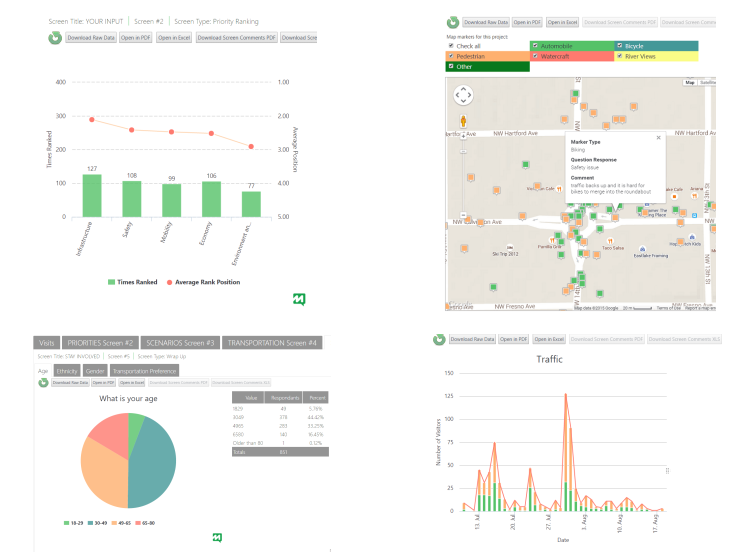
    Introducing MetroQuest Insights, an intuitive dashboard to monitor, evaluate, report and export your public input. MetroQuest Insights allows you to visualize the results through colorful graphs and maps, summarize the findings, break the results down by demographic group and even export the data in specially formatted spreadsheets to allow maximum flexibility.

    With MetroQuest Insights you can:

    Monitor: Stay on top of traffic with an intuitive dashboard

    • Monitor public participation in real-time
    • Breakdown the results by demographic group
    • Compare your web, mobile and kiosk traffic

    Evaluate: Easily explore public input

    • View visitor preferences, ranking and ratings in real-time
    • See graphs, maps, tables and comments tailored for each screen
    • Easily identify data – no more complex variable names

    Report: Get instant visualizations

    • View maps and graphs of results on-screen
    • Customize your visualizations to show only the most relevant data
    • Get colorful graphics suitable for cutting and pasting

    Export: Dive into detailed data for final reports

    • Create and download customized tables and graphs
    • Download a complete table of all your results for detailed analysis

    We think you’re going to love MetroQuest Insights. You’ll save time and money and dive deeper into your public input than ever before. MetroQuest Insights is ready for your next project!

  • [TIPS] Leveraging Social Networks to Increase Online Engagement

    [TIPS] Leveraging Social Networks to Increase Online Engagement

    As an online engagement software company, we recognize that social media is one of the most useful tools out there for promoting your project and increasing engagement. Since these platforms are free the only real cost is time. By following best practices and using tools and techniques to increase productivity, social media can lead to huge gains in engagement with relatively little cost to the project.

    We’ve put together some best practices based on hundreds of the most successful MetroQuest projects. We hope you find these tips useful for your next project.

    Be strategic

    Social media success requires consistent effort, so make sure that you have a plan in place before starting. Strategically allocate the necessary resources to ensure success. Think carefully about your brand, your tone and your key messages, and get agency buy-in before beginning.

    Craft compelling content

    Social media is an amplification tool for interesting content. Use it to promote your initiative and share materials throughout your community. The key to social media success isn’t just having a bunch of followers – it’s about real engagement with your community and encouraging them to share your content with their network.

    The goal is to create content that is compelling enough that people will be eager to talk about and share with their friends. In our experience less is more and a picture (or video) is worth a thousand words. It’s best to focus on issues that the public is most concerned about today, even if your plan is looking 25 years ahead. Keeping your message concise and using great images leads to substantially higher levels of engagement. Take Twitter for example – tweets with photos get 35% more retweets on average and now that Twitter video is here, well, you get the idea.

    Focus on quality, not quantity

    While it’s good to take advantage of as many channels as possible to promote your project, be cognizant of how much time and budget you can allocate to all of these different mediums. It’s easy to sign up for every social network under the sun, but if you’re devoting resources to managing accounts on Pinterest and Instagram and Vine and Google+ and …, you could be spreading yourself too thin and missing out on quality engagement opportunities.

    Focus on the areas that really matter and have the highest potential for impact. In our experience, Twitter and Facebook are the best tools for engaging local communities. LinkedIn can also be very useful for targeting professionals and business owners in your community. Be sure to look for Facebook and LinkedIn groups that are relevant to your area or project and post some great content.

    Be consistent

    Try to post at least once per day in order to reach the largest audience possible and stay top of mind in your community. There’s a lot of debate and research surrounding the best time to post content online, but a good rule of thumb is to just think of when you would most likely see and read the type of content that you’re posting.

    For example, posting a link to a survey at 10 pm on a Friday might not get a lot of results. But 8 am? Now we’re talking.

    Create a content calendar

    Schedule posts in advance and fill your weekly calendar with compelling and relevant content.

    Use a social media management tool like Hootsuite to schedule your social media activity, reducing the amount of time you have to spend every day posting on multiple networks. You could reserve some time on a Monday morning to schedule posts for the entire week, leaving you with more time to focus on the big-picture tasks needed to make your project a huge success.

    Hootsuite is free to use with up to 3 social media accounts – another good reason to limit the number of networks that you use.

    Be a good listener and involve yourself in conversations

    Another key advantage of using social media for your project is the ability to “listen.” In our work, a quick search of “MetroQuest” on Twitter gives a live stream of all the people that are talking about MetroQuest. This gives us a unique opportunity to involve ourselves in these conversations and reply to people. This is something we do every day, and it’s very easy to set up a similar process when promoting your next project.

    Again, a tool like Hootsuite can be very useful in that you can create a view in your dashboard that shows you all the posts across social media that include the particular keyword or hashtag that you’re interested in following. This is a very simple way to stay up-to-date on what people are saying about the topics that matter to your project, and opportunities to get involved in the conversation will come up when you do a good job of listening.

    Give it a shot! Search for topics in your local community today and get involved.

    Use advertising to boost reach

    If you have the budget to spare, it’s very easy to integrate some ad spending into your social media posts to reach more of the people that you want to get involved in your project.

    For example – if you’re trying to get input on a proposed light rail project in Arlington, you can promote your Facebook posts to people who live in a 50-mile radius around Arlington. You can also specify by age, interests and other demographic information. These kinds of ads have been proven to be much more effective than traditional methods like print and radio advertising. With an advertising campaign on Facebook, Twitter or LinkedIn you can track how much you’re spending per click – seeing what works and what doesn’t. Used well, a little bit of advertising money can go a long way to getting your message out to the public.

  • [WEBINAR] Best Practices for Engaging Targeted Populations

    [WEBINAR] Best Practices for Engaging Targeted Populations

    Can online engagement help reach the Environmental Justice and traditionally underrepresented populations? The EPA’s Environmental Justice (EJ) requirement calls for the meaningful involvement of people regardless of race, color, national origin, or income. At the same time, technology is changing the way we communicate. In response, the use of online public engagement is rapidly expanding, whether it’s on your laptop at home, kiosks in the community center or the smartphone in your pocket. Does technology help or hinder with EJ community engagement?

    This webinar explored case studies of planning projects with various transportation agencies (MPO’s, TPO’s, DOT’s) that successfully used online technology to increase the reach of their public involvement efforts. Critical success factors, key strategies and best practices were shared and discussed.

    Watch Recording

    View Slides

    Q&A

    Below are some of the questions that were asked during the Q&A session at the end of the presentation.

    Q: For those of us who have never created an online open house/ interactive website, are there other apps or hosting sites that you would recommend that are affordable? Often projects have limited budgets, what practices would you suggest to use for smaller budgets of $25,000-$75,000?
    A: As discussed at the end of the webinar, software options like MetroQuest are very affordable to use on most projects. MetroQuest, in particular, is designed to be easy to use on a project and requires no previous experience as the vendor sets the tool up for you with your content. If your budget is really small, online survey tools like SurveyMonkey can be useful though they lack the visual, educational and interactive elements that are helpful for engaging on complex topics.

    Q: Much of my practice is for rural municipalities with very low population densities, and often connectivity challenges. Do you have any suggestions?
    A: It’s best to provide many options for people including kiosks in community centers or local stores and even paper-based options for people who prefer not to use a device.

    Q: How do you connect with immigrant/refugees who are not literate not even in the home language? Minneapolis is home to thousands of Somali’s who are in the process of learning English but English literacy takes time.
    A: Attending existing community events with resource people who are able to help people through the process and provide any assistance needed to feel comfortable can be extremely useful for those with reading difficulties. In other situations it’s useful to abandon a formal survey for a moment and simply chat with people about issues that they may be facing relating to the project.

    Q: How do you ensure that people can’t skew the results by voting multiple times?
    A: MetroQuest is really focused on reducing the barriers to participation to enable broad engagement. We realize, as most of our clients do, that the vast majority of people are unwilling to sign-up for things before they participate, let alone go further to prove their address etc. Because we have not included a log-on step as a requirement to access MetroQuest, we have a fraud detection system to make sure that participants are not able to skew the results by, for example, voting for their preferred option 100 times.

  • [INSIGHTS] APA Smart Cities and Sustainability Task Force

    [INSIGHTS] APA Smart Cities and Sustainability Task Force

    The Smart Cities and Sustainability Task Force continues the focus on sustainability by addressing recent advances in technology and innovation to cultivate cities which are smarter, more resilient, and sustainable. The Task Force, which is a collaborative initiative between the Sustainable Communities, Technology, and Transportation Planning Divisions of the American Planning Association (APA), seeks to research and report on how technology advances are changing the field of planning and our communities, identify best practices, and demonstrate how planners can lead on these important changes.

    The Task Force Goals are to:

    1. Anticipate and prepare for trends and emerging issues and communicate their implications.
    2. Generate the big ideas to advance our communities.
    3. Educate the public and community leaders through documentation of best practices and increase their use by planners, citizens and elected officials.

    After working with MetroQuest on a project in Erie Pennsylvania, Co-Chair Robert Kerns invited MetroQuest President Mike Walsh to join the task force. As an expert in the field of digital engagement, Mike has been working with the team to create online surveys and ideation tools. In addition, Mike participated in the Task Force presentation at the APA National Conference in Seattle and contributed to the recently released Task Force Report.