Before 2020 comes to a close, the team at MetroQuest would like to take some time to thank YOU for your hard work and support throughout this unprecedented year. Your work in community engagement has become more important, yet more challenging than ever this year. We appreciate your commitment to making the planning world a better place!
Before our team takes some time off for the holidays, we wanted to share some of our favorite things that happened in 2020!
Getting Creative with Virtual Get-Togethers
This year, we were very excited to reconnect with our friends at DOTs from across the United States for our second ever DOT Roundtable! We heard from the MetroQuest team, as well as from Texas DOT, about some of the things they’ve been working on during this unprecedented year and were inspired by their creativity and resilience.
We also heard from several public engagement superstars over the last few months, as we all put our heads together to come up with the strategies that would bring community engagement forward. Take a look at our webinar page for some of the latest. Each one is eligible for AICP CM credit!
I definitely recommend Community Engagement During COVID-19: Planning Ahead for 2021. Public engagement specialists from WSP and North Carolina DOT predict what public outreach looks like moving forward and share leading techniques and tools to guide planning teams to success. It’s a great place to start planning for the new year!
Important Community Engagement Conversations Around Diversity and Equity
Conversations and protests around equity, particularly Black Lives Matter and Indigenous rights, took the spotlight this summer. For planning, the vital topics of diversity and inclusive engagement took on new urgency in light of this! And with updated NEPA regulations coming into effect in September, there was a lot to talk about.
To support efforts in this area, we put together a panel of key members of the Federal Interagency Working Group on Environmental Justice (EJ IWG) and its NEPA Committee. Our speakers showed us some of the promising practices for reaching traditionally underrepresented communities and provided an update on the rapidly evolving practice of meaningful engagement with EJ communities. Thank you to the panel and all our attendees for helping us to take on this important topic!
Exploring New Projects to Inspire Planning Teams
This year, we were able to introduce the ‘Survey of the Month’, a monthly blog series that highlights exceptional online surveys! Our Customer Experience Manager, Norma Hogan, worked together with our subscribers to find and to showcase examples of exceptional community engagement, inspiring planning teams with tips to achieve incredible results online.
Although work culture has changed a lot (some say that work-from-home is here to stay), we at MetroQuest were able to stay in touch over the year by taking advantage of some of the same virtual meetings options that planners have been using during the pandemic… and getting a little creative.
The MetroQuest cookbook was a labor of love from our social committee, and we’re thankful and excited to see what the team will ‘cook up’ moving forward!
Happy Holidays!
Our team has had the privilege of working with countless thought leaders, industry experts and community engagement superstars this year. We hope that our conversations and resources from 2020 have inspired you and look forward to many new and exciting opportunities in the New Year.
Thank you for making this challenging year a great one!
Without the right tools and techniques, however, planners often end up collecting uninformed input, especially at public meetings. It’s common to receive feedback from only the most motivated members in their community and to feel unable to educate the public about complex planning topics and choices. This year has also limited in-person outreach options, adding new challenges to the public engagement landscape.
The good news is that using online surveys with simple design features can help you overcome these challenges and meet your public engagement goals. Today, let’s explore six survey design tips that help planners inform and engage thousands online.
Tip #1: Keep it short.
Design surveys that take participants only a few minutes to complete! Each MetroQuest survey contains five screens. Why is five the magic number? Decades of experience tells us that participation drops off drastically if an online survey is longer than 5 to 10 minutes.
Once you start to push the 5-to-10-minute experience boundary, you tend to get lower participation and less accurate data as participants are likely to experience survey fatigue. While it may be tempting to cram a lot of information into a long list of questions, people’s attentions spans are short.
Tip #2: Be as visual as possible.
Reading is, plainly out, boring and consumes a lot of a participant’s time. Incorporate visuals into your online survey that can convey the same meaning, enhancing the online experience and enticing more individuals to participate. To learn more, read our blog about the benefits of incorporating images.
Tip #3: Make it fun and compelling.
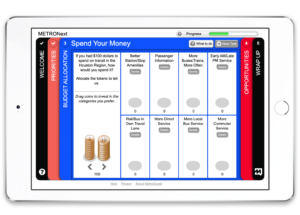
Avoid standard survey questions that are tedious and time consuming; instead, gamify the experience so that participants have a more enjoyable time providing feedback for your planning project. For example, MetroQuest’s budget allocation game is a great way to solicit feedback about where to allocate resources in a way that makes it fun for the participant!
The more enjoyable the survey experience is, the more participants will be to complete it and share it with others, helping you gather input from people who you might not have been able to reach otherwise.
Tip #4: Gather both qualitative and quantitative data.
Ask questions that can be answered with a ranking or rating to quickly gather qualitative data, but also allow participants to provide comments and optional, written feedback where appropriate to receive qualitative data as well. This gives you the ability to compare your results and obtain data-driven insights that are easy to understand.
Tip #5: Educate participants.
Oftentimes, the planning topic at hand is complex, making education a critical component of the survey. Inform participants about the project, choices and tradeoffs before soliciting feedback and collecting data. Instead of a lengthy explanation, embed short descriptions throughout.
For example, you can start by providing participants with some background information about the project to help provide insight into the intent behind the study. Throughout the survey, build on that context to illustrate the choices and tradeoffs that that are part of the planning process.
Tip #6: Make it compatible on a wide range of devices.
Online surveys are a very convenient approach for soliciting public input as they are accessible at any time. In addition, more and more people across demographics have access to the internet! To increase participation and accessibility, make the survey available on as many channels as possible. A great mobile experience is increasingly important for online surveys, as up to 75% of participants will use their mobile phones. You can also put the survey on library computers, set up mobile kiosks and many other types of devices, to allow the greatest range of participation.
The Art & Science of Effective Online Surveys for Planning
What makes an effective online survey for public engagement? Join expert Dave Biggs as he drills down into the elements of a great survey from content to promotion to data!
Survey of the Month is a blog series highlighting particularly great examples of work our customers have done with MetroQuest. This month, we’re excited to share a survey on a topic that MetroQuest has been involved in since the early days: Long Range Transportation Planning (LRTP, known as Transportation Master Plan or TMP in Canada). Many agencies have used our surveys for LRTPs to great success! As always, we will be sharing some insights of this particularly well-designed survey and highlight simple take-aways to help you with your next public engagement project!
One of our long-standing customers, Michael Baker International (MBI), created a fantastic LRTP survey in conjunction with, and for, The Northeastern Pennsylvania Alliance (NEPA) for the Metropolitan Planning Organization (MPO) of the region. Let’s take a look at the project!
What’s the story? Creating a Better Regional Transportation System in Northern Pennsylvania
Four counties (Carbon, Monroe, Pike, and Schuylkill) in Pennsylvania comprise the NEPA MPO and this is their second LRTP plan since receiving the designation in 2010. LRTPs are an important planning tool, especially when federal funding is as unpredictable as it is currently. They are an opportunity for the MPO and its partners to understand trends and drivers that impact the transportation programs and help decide where future, typically limited, funds should be spent.
NEPA MPO’s LRTP identifies the major transportation projects, programs, and policies that are to be prioritized in the next twenty-five years. It further establishes the vision and goals that will guide public decisions affecting transportation facilities, infrastructure, and services in the entire MPO region.
Anatomy of an MTP Survey: How NEPA MPO Identified Transportation Priorities and Improvements
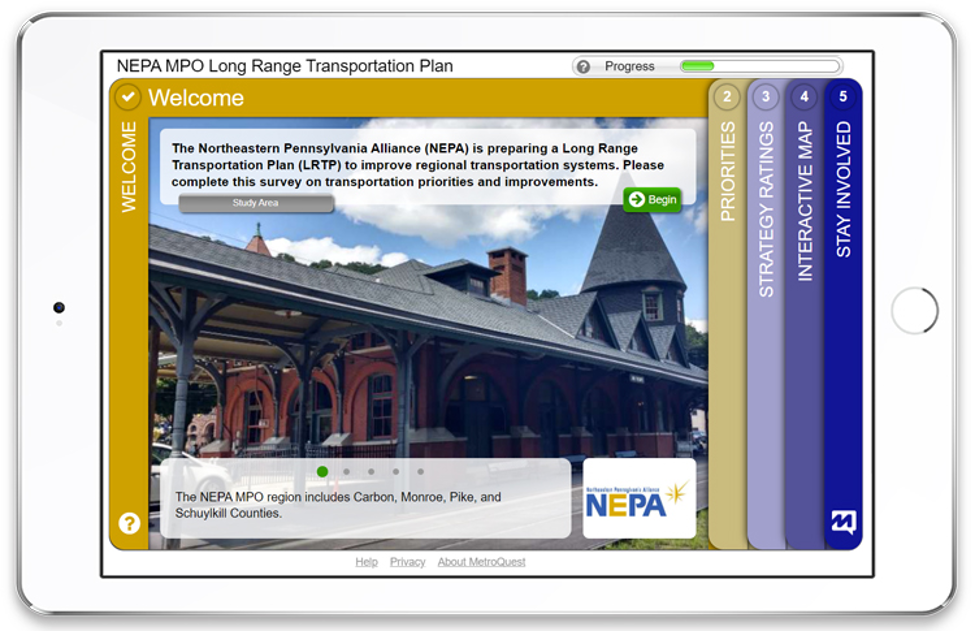
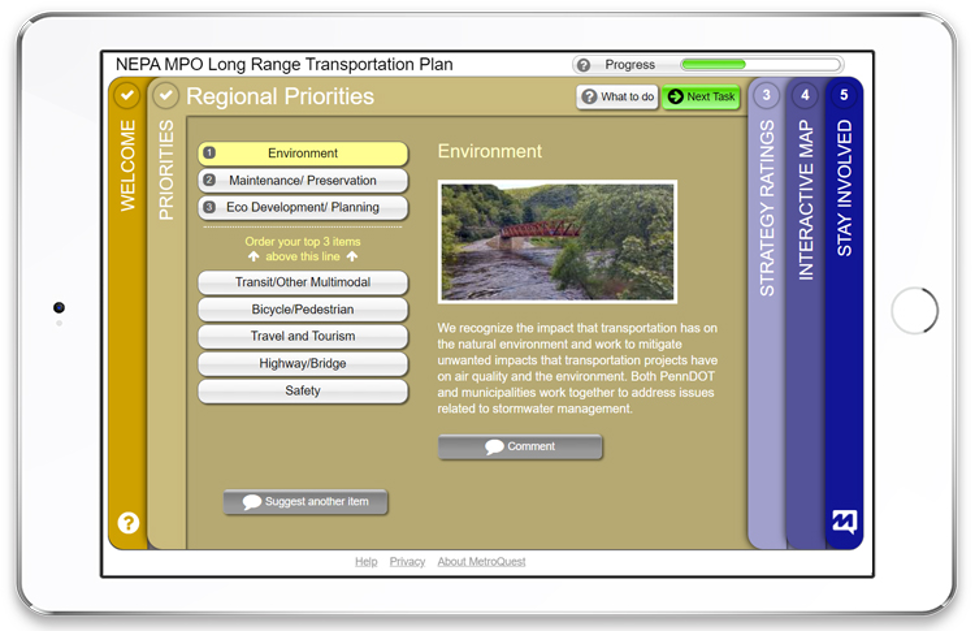
The MetroQuest survey starts with the Welcome Screen which includes facts about the transportation network. This provides context for the participant so that they have some understanding of the situation, and why they are being asked to provide input. The survey’s first interactive screen is a Priority Ranking Screen where participants are asked to rank 3-5 transportation issues that they would like to see addressed, using a list of possible answers, namely Environment, Bicycle/Pedestrian, Eco Development/Planning, Safety, Transit/Other Multimodal, Highway/Bridge, Maintenance/Preservation, as well as Travel and Tourism. These are all priorities that were previously identified by the team.
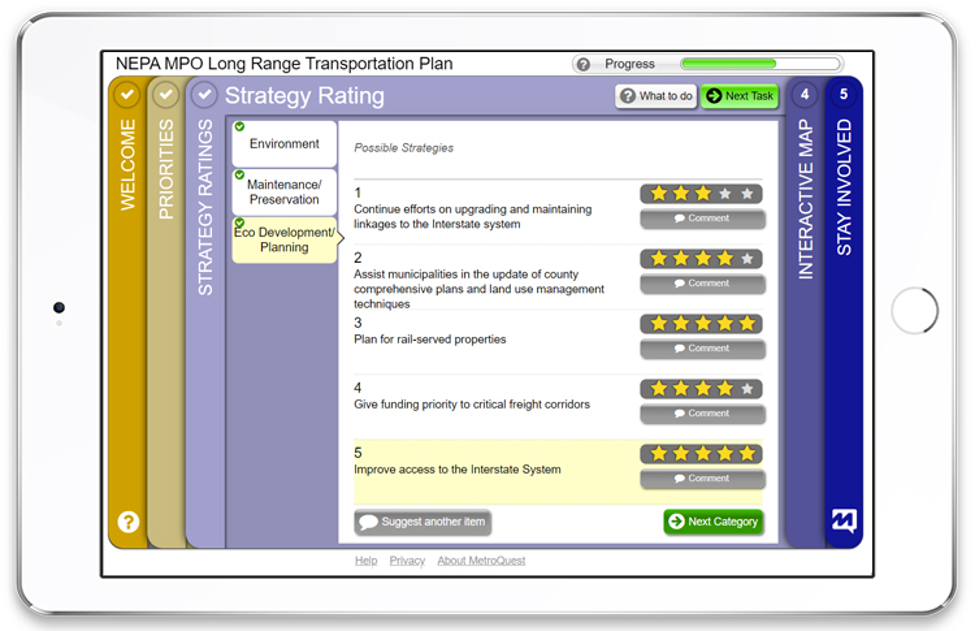
Subsequently, on the Strategy Rating Screen, participants revisit the top transportation issues that they identified as priorities on the initial screen and are presented with a number of corresponding, possible strategies. Their task is to rank each strategy on a 5-point scale and provide input on each item as a potential solution for different issues.
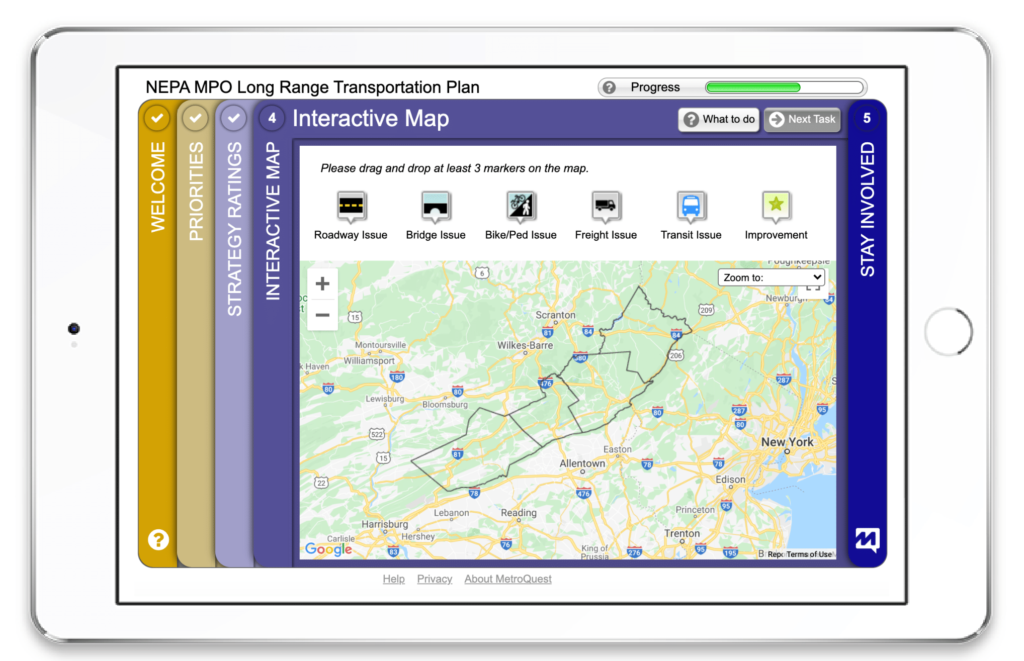
Before providing some demographic information, participants are then asked to identify issues geospatially on a Map Marker Screen. They are asked to drop at least 3 markers onto the map to show where they see transportation-related issues in their day-to-day. This helps the NEPA team to collect information on issues that the research might not have identified. The markers participants can choose from include Roadway Issues, Bridge Issues, Bike/Ped Issues, Freight Issue, Transit Issue and Improvement.
You are welcome to try the MetroQuest survey. This is a demo version that will not affect the survey results.
5 Tips from NEPA MPO LRTP: Making the Most of MetroQuest’s Capabilities
The LRTP survey distills complex material into bite-sized pieces of information by presenting high-level priorities first, then drilling-down into these priorities with strategies, before asking for additional geo-spatial input on a map. The result is an interactive exercise that yielded data from almost 200 participants and helped gain insight on existing conditions as well as give a platform for participants to voice concerns and recommendations. Below are five takeaways from their survey:
The Welcome Screen is intended to provide background information for survey participants without slowing them down too much. The use of the pop up is great for supplementary information. In this case, the team included a map of the study area, which helps those that are unsure about locations to familiarize themselves with the area of the study. Those that know the study area well can go straight into the activities.
MetroQuest allows you to set the Screen colors and tailor them to your project. The survey team here chose the colors from the NEPA logo as well as complimentary colors to make the survey recognizable as an activity from NEPA. Brand recognition is always a good idea!
Connecting the Strategy Screen to the Priority Ranking Screen has a number of benefits; first, the Survey Rating Screen only presents strategies for priorities that participants identified as important in the first activity. This gives the survey a customized feel, making it a more enjoyable experience and keeping the participant interested and engaged. Second, asking participants to weigh in on 40 strategies seems daunting, but providing input on 3-5 strategies for 3-5 priorities is much more doable – again, making it a more delightful experience which means they are more likely to continue taking the survey, leading to more data per participant.
The survey team opted to include a zoom dropdown on the Map Marker Screen, allowing participants to zoom quickly to the location they are most interested in for more accurate input and data. Particularly if you have a large study area, this is a good idea that’s very helpful for participants!
Also on the Map Marker Screen, NEPA chose to include follow up questions for some of their map markers; for example, giving them the chance to elaborate on the type of roadway or bike/pedestrian issue. This allows participants to quickly provide input, making it more likely that they do than if they had to type out their answers, and providing more usable data as a result.
Congratulations to NEPA and Michael Baker International on a great looking survey!
For more great tips on how to make the most out of MetroQuest, contact your Customer Experience manager or reach out for more information!
Want to learn more about how online surveys like MetroQuest support community outreach on your next planning project? Check out our recent webinar:
The Art and Science of Effective Online Surveys for Planning
What makes an effective online survey for public engagement? Join expert Dave Biggs as he drills down into the elements of a great survey from content to promotion to data!
On December 9th, public engagement superstars from WSP and North Carolina DOT join forces with MetroQuest to uncover the most effective community engagement strategies from the last 8 months, providing best practices and leading techniques to guide planning teams to success in the new year!
Vancouver, BC, November 30, 2020 – Events in 2020 have created a perfect storm for public engagement, leading to both new challenges and powerful innovations. In this free December 9th webinar, experts uncover national trends and regional variations around effective community engagement, offering a sneak peek into the most effective strategies and key technologies for successful planning in 2021!
Our ‘new normal’ has pushed public engagement beyond its typical routine, forcing planners across the nation to rise to unique challenges and establish new protocols for community engagement without public meetings. In this webinar, public involvement specialists with a combined 85+ years of community engagement experience explore how planning firms and government agencies have overcome obstacles this year, uncovering the tools and techniques that lead to exceptional public engagement, and recommending effective strategies for 2021.
Host Dave Biggs, Chief Engagement Officer at MetroQuest, leads the discussion. He is joined by Jamille Robbins, Public Involvement Group Leader for North Carolina Department of Transportation (NCDOT), who leads and educates 20+ divisions in public outreach. Joining them is Darrel Cole, Vice President of Communications & Public Involvement Practice at WSP, who leads a team of 45+ nationwide in pivoting to online public outreach. Rounding out the panel is Lisa Hummel, Communications & Public Involvement Specialist at WSP, who brings her expertise in online meetings and experience as a member of the WSP Crisis Communications Rapid Response Team.
Using real-life case studies of successful public engagement projects, including the City of Philadelphia’s Washington Avenue Improvement Project, the North Carolina Capital Area MPO’s Bikeway Study, a Long Range Transportation Plan from Pueblo Area Council of Government and more, the panel of public engagement superstars come together to share valuable insights!
Register to watch as they explore the leading trends from the last 8 months, from the techniques that have helped agencies and firms succeed, to key technologies for your online engagement toolbox and ongoing barriers and obstacles, uncovering what community engagement will look like in 2021 and what you need to succeed moving forward.
This webinar qualifies professional planners for 1.0 AICP Certification Maintenance credit.
About MetroQuest
MetroQuest is North America’s #1 online survey platform for public engagement in transportation and urban planning. Government agencies and planning firms of all sizes trust MetroQuest to engage thousands of people with delightful surveys that obtain informed input and actionable results to get plans approved. 1000s of public engagement practitioners attend MetroQuest’s webinars each month, gaining AICP CM Credit and driving forward the conversation around community involvement.
The Planning Partnership Launched 7 MetroQuest Surveys in 2020
The Planning Partnership Ltd. (TPP), a consulting firm located in downtown Toronto, launched 7 MetroQuest surveys this year for a wide range of projects for both their public and private sector clients. The firm knows the recipe for crafting engaging online surveys to drive high levels of public participation, facilitating a collaborative approach to planning and providing decision-makers with comprehensive input to develop effective solutions for their clients.
Congratulations to TPP for launching so many effective online surveys over the last few months! Your efforts and success are a testament to the fact that great community engagement is possible with the right tools and expertise, even during a global pandemic with mandates preventing in-person public meetings.
WSP Canada Helps the City of Ottawa Make Important Transportation Decisions
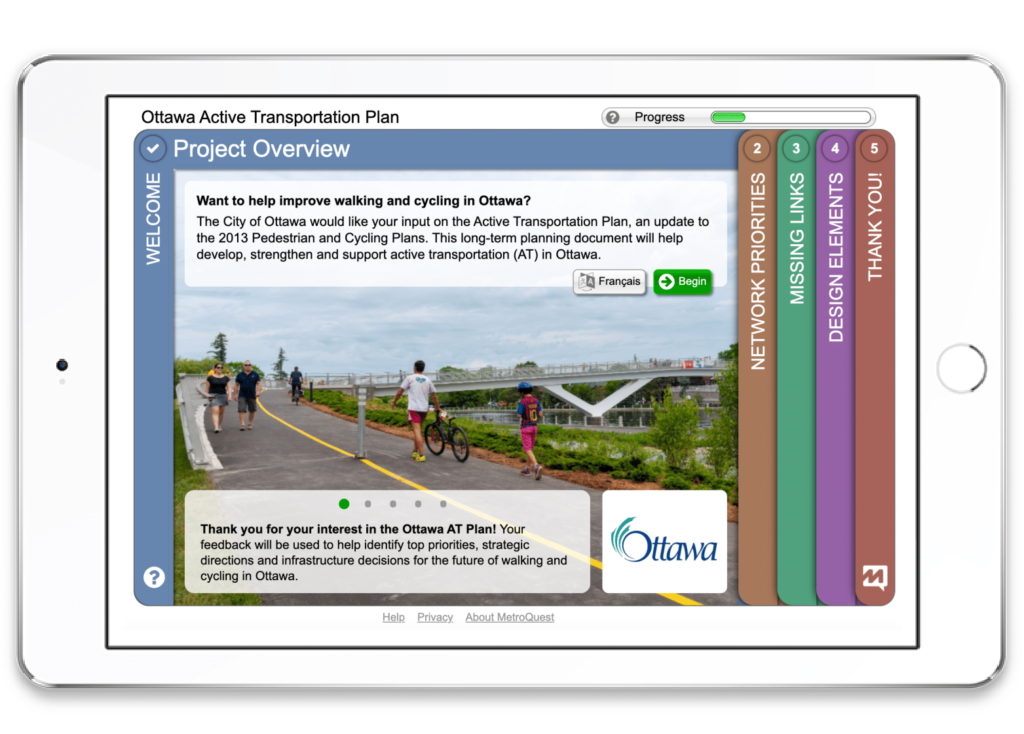
WSP Canada, one of the country’s leading professional services consulting firms, has launched several MetroQuest surveys this year! One project that specifically stood out was their work for the City of Ottawa in helping them update their Active Transportation Plan. With a MetroQuest survey, available in both English and French, the firm engaged over 1,000 participants to help Ottawa set a direction for day-to-day transportation programs and become the most livable mid-sized city in North America.
Planners at WSP Canada did an incredible job crafting the online survey to ensure participants were both well-educated and engaged about important transportation decisions. The firm was able to gather thousands of data points as a result, which helped Ottawa identify the community’s top priorities, strategic directions and infrastructure decisions for the future of walking and cycling in the City. Congratulations to both WSP Canada and the City of Ottawa! We look forward to seeing more of your incredible public engagement accomplishments in 2021.
These are just some of the incredible community engagement projects that Canadian planning firms and government agencies have led this year. If you would like to see more exceptional surveys, please feel free to reach out and let us know! We’d be happy to provide you with examples to help you get inspired for your upcoming projects. You can also explore some additional sample surveys here.
In the meantime, and on behalf of everyone at MetroQuest, I want to say congratulations to ALL Canadian planners! We hope these examples inspire you. We wish you great engagement in the upcoming months and look forward to hearing about your public engagement success in 2021.
At MetroQuest, we are consistently blown away by the exceptional community engagement results our clients report, especially this year when facilitating remote community engagement activities has essentially been the only option. We are very proud of the way government agencies and planning firms all over the nation have taken the complications of 2020 in stride!
Today, we want to take some time to highlight some of the incredible public initiatives we’ve seen over the last few months, specifically in Canada! With our company roots in the ‘neighbor to the north’, we are elated when new Canadian customers come on board and when we receive public engagement success stories from our fellow ‘Canucks’.
Join us as we explore some of the amazing planning projects our Canadian customers have led this year!
The City of West Kelowna Sets Out Their Desired Destination for the Future
To begin with, The City of West Kelowna recently crafted a number of delightful MetroQuest surveys to support #OURWK, the City’s community vision for 2040! After collecting input from thousands in the community with over 10 online surveys this year (and counting!), the City developed a preliminary vision that truly reflects the public’s vision for the future of West Kelowna.
The draft vision found on the City’s website says it wonderfully: “While we cannot predict every change that will come our way in the next 20 years – setting and sticking to a bold Community Vision gives us a powerful lens for making thoughtful decisions.” Congratulations to the City of West Kelowna for all your hard work. Your engagement efforts are inspiring, and we wish your community the best as you begin working together to make your vision for the future a reality!
LURA Consulting Engaged Over 7,400 Participants for Yonge TOmorrow
LURA Consulting, a Canadian leader in collaborative planning, consistently blows us away with their community engagement results. This year we are particularly thrilled to hear about their incredible success while working with the City of Toronto!
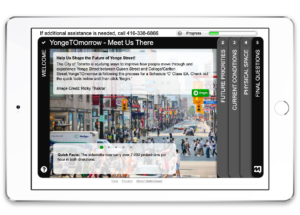
Yonge Street in the heart of downtown Toronto is consistently booming with development, construction and pedestrian traffic. In an effort to find ways to increase space and improve the area, the team at LURA launched three MetroQuest surveys for ‘Yonge TOmorrow’ and engaged over 7,400 participants over the course of the project! The City is now working to bring the public’s recommendations into fruition thanks to the firm’s hard work in successfully engaging the community. You can check out one of the three interactive online surveys from the project below. Congratulations to LURA Consulting – keep up the incredible engagement!
The Planning Partnership Launched 7 MetroQuest Surveys in 2020
The Planning Partnership Ltd. (TPP), a consulting firm located in downtown Toronto, launched 7 MetroQuest surveys this year for a wide range of projects for both their public and private sector clients. The firm knows the recipe for crafting engaging online surveys to drive high levels of public participation, facilitating a collaborative approach to planning and providing decision-makers with comprehensive input to develop effective solutions for their clients.
Congratulations to TPP for launching so many effective online surveys over the last few months! Your efforts and success are a testament to the fact that great community engagement is possible with the right tools and expertise, even during a global pandemic with mandates preventing in-person public meetings.
WSP Canada Helps the City of Ottawa Make Important Transportation Decisions
WSP Canada, one of the country’s leading professional services consulting firms, has launched several MetroQuest surveys this year! One project that specifically stood out was their work for the City of Ottawa in helping them update their Active Transportation Plan. With a MetroQuest survey, available in both English and French, the firm engaged over 1,000 participants to help Ottawa set a direction for day-to-day transportation programs and become the most livable mid-sized city in North America.
Planners at WSP Canada did an incredible job crafting the online survey to ensure participants were both well-educated and engaged about important transportation decisions. The firm was able to gather thousands of data points as a result, which helped Ottawa identify the community’s top priorities, strategic directions and infrastructure decisions for the future of walking and cycling in the City. Congratulations to both WSP Canada and the City of Ottawa! We look forward to seeing more of your incredible public engagement accomplishments in 2021.
These are just some of the incredible community engagement projects that Canadian planning firms and government agencies have led this year. If you would like to see more exceptional surveys, please feel free to reach out and let us know! We’d be happy to provide you with examples to help you get inspired for your upcoming projects. You can also explore some additional sample surveys here.
In the meantime, and on behalf of everyone at MetroQuest, I want to say congratulations to ALL Canadian planners! We hope these examples inspire you. We wish you great engagement in the upcoming months and look forward to hearing about your public engagement success in 2021.
Equitable, transparent, meaningful and inclusive are all common words that are used to characterize great public engagement. In a recent webinar, Dave Biggs, MetroQuest’s Chief Engagement Officer, and Melissa Holguin, Arellano Associates’ Senior Project Manager, explored the proven strategies behind diverse community engagement. They uncovered the ROI of equitable outreach, common barriers leading to poor public participation and a 4-step formula to achieve true diversity and equity when engaging the public!
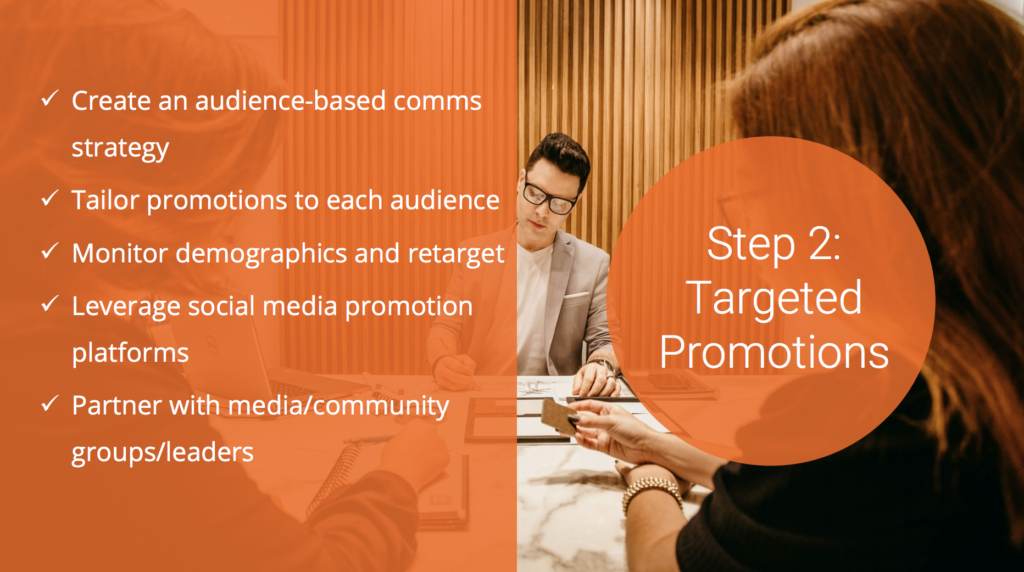
After exploring the initial element, ‘getting the digital right’, and sharing leading techniques to achieve exceptional results with virtual tools, our expert panel explored targeted promotions: the second and a very important component of the 4-step formula.
You can check out the full details from the webinar in the on-demand recording here! In the meantime, let’s take a deeper dive into one of the promotional techniques that was recommended within the discussion of the second step: using an audience-based communications strategy to increase and diversify your reach in the community.
Diverse Communications Strategies to Reach a Diverse Audience
Once you’ve prepared an engagement opportunity, leveraging compelling, targeted promotions is a leading strategy that agencies and firms of all sizes use. Without promotion, your public engagement will only reach ‘the same ten people’. With an effective communications strategy, you can help elevate exposure of your outreach efforts and encourage more individuals to engage and provide feedback on various plans for the future of their community.
Despite spending great lengths of time and money to craft public engagement promotions, however, several planners still report back that they receive input from the same handful of individuals, resulting in public opinion data that doesn’t truly match the diversity of the area. But why?
It is oftentimes the case that when organizations use a one-off communications approach, they fail to reach a wide and diverse audience. This can be because they fail to initially develop strategies that make sense for and meet the needs of different stakeholder groups, or weren’t able to adapt and adjust communication efforts according to interim results. As Holguin expanded on during the discussion, it’s critical that we take on an integrated approach to reaching our communities. Agencies and firms must understand that a diverse group of individuals exists within the community and a one-size-fits-all promotional effort isn’t going to cut it.
So What is an Audience-Based Communications Strategy?
In essence, developing an effective communications strategy must start from a focus on the audience that the strategy intends to reach. Planners must consider the various audiences and adapt both the message and the media outlet to develop communication strategies that make the most sense for each audience. It’s also important to develop opportunities to sustain communication both before, during and after the public engagement process.
An audience-based communications strategy, as the name suggests, is tailoring your promotional efforts to different groups. Where does your audience spend their time, and how can you tailor your promotions to find them where they already are?
Single parents, students, or young professionals, for example, likely won’t be able to attend scheduled meetings, virtual or otherwise, during business or school hours. But many of them will be on social media, or reachable through email—can you use a targeted Facebook ad that leads them to an online survey that can be taken in just five minutes, while they’re on the bus or waiting in line at the store?
This line of thinking can lead to techniques that help you reach distinct stakeholders, encourage a more diverse group of participants to engage in your outreach efforts and reduce barriers that lead to poor participation within various demographic groups.
Understanding your audiences and crafting promotions that help engage each stakeholder group is a critical part of achieving diverse engagement in planning. In the webinar, Holguin and Biggs unpack several strategies: check out the on-demand recording to learn how you can effectively craft promotions that overcome barriers to participation and achieve true diversity and equity in community engagement here!
How to Achieve True Diversity and Equity in Community Engagement
Learn about the best practices and techniques for going beyond the usual suspects to engage even the most difficult to reach audiences and achieve true diversity and equity in your community engagement.


 Our team has had the privilege of working with countless thought leaders, industry experts and community engagement superstars this year. We hope that our conversations and resources from 2020 have inspired you and look forward to many new and exciting opportunities in the New Year.