Category: Transportation

  • MTA New York City Transit Adopts MetroQuest to Enhance Engagement

    MTA New York City Transit Adopts MetroQuest to Enhance Engagement

    The Metropolitan Transportation Authority (MTA) operates New York City Transit, which is the busiest and largest transit system in North America and serves a staggering 8 million trips per day. Planning and maintaining a transit system of this magnitude requires effective community engagement. That’s why MTA has turned to MetroQuest to both broaden the reach of public engagement and collect informed and constructive input to support its planning efforts.

    MTA, like many agencies across the country, was seeking to boost participation rates to collect input from a broad and diverse demographic to inform its plans. Transit riders may be one of the most difficult to reach audiences and low participation rates are common. That’s why MTA turned to MetroQuest to take public engagement online.

    As Ryan Zatlin, Senior Transportation Planner at New York City Transit put it, “The goal with public outreach is always to receive feedback from a high number of participants that are representative of the community. For a variety of reasons, that doesn’t always happen. We’re hoping that MetroQuest’s unique interface and interactive features can help broaden our audience and increase participation from our regular customers.”

    Traditional methods like public workshops tend to attract only a select few participants, primarily those who have the extra time in the evenings. Looking to enhance participation, MTA tried a variety of other online survey platforms, but the results were disappointing.

    As Zatlin states, “Despite marketing efforts, we can often have less than 1,000 participants in a city of 8 million people, which is likely not representative of the demographic makeup of the population.”

    MTA was particularly aware of the narrow demographic that tends to participate in their outreach activities.

    Zatlin stated that MTA, “wanted broader demographic representation and greater participation from average citizens and regular transit users, who, perhaps, are unable to make it to public meetings, or find conventional online surveys time consuming and uninteresting.”

    With the launch of an ambitious series of Bus Network Redesigns for each of the City’s five boroughs, the agency chose MetroQuest to enhance online participation. The agency was seeking a highly interactive tool with plenty of opportunities for public input. They were also keenly aware of the complex choices and tradeoffs facing the agency and were looking for an engagement platform that was up to the task. They became inspired after seeing how LA Metro used a MetroQuest survey to engage over 6,000 participants on budgeting priorities, tradeoffs, and mapping out areas in need of transit improvements. MTA agreed that this type of highly visual and interactive approach was perfect for their needs.

    As Zatlin states, “A bus network redesign is a huge effort that can be difficult to clearly communicate to the public. While there is a time and place for conventional survey tools, we were looking for a platform that would allow us to educate our customers on important concepts, effectively communicate our plans to the public, and receive detailed feedback on the issues that matter most to them. MetroQuest does all this with one simple, intuitive interface.”

    The Bus Network Redesigns started with Bronx (see demo survey), then on to Queens (see demo survey), Brooklyn, Manhattan, and Staten Island. While it’s still early in the outreach process, the plan seems to be working with over 2000 participants already and climbing quickly.
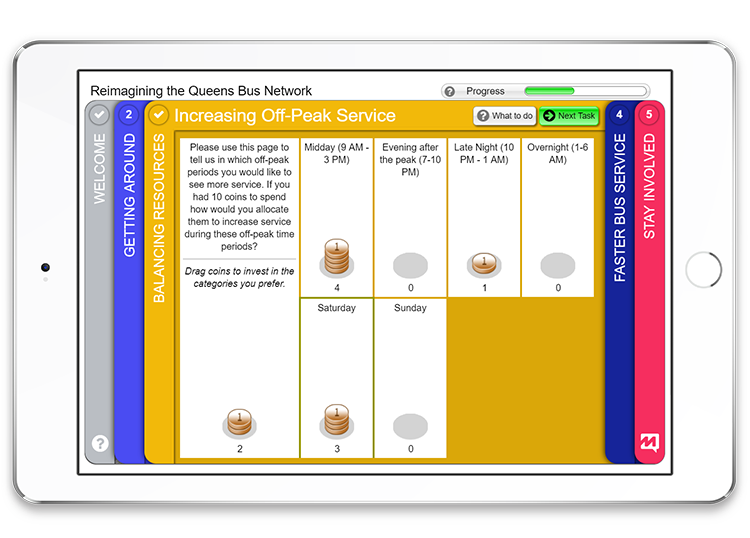
    Each project will involve a series of 3 to 4 surveys coinciding with the phases of the planning process. The first surveys will start at a high-level, focusing on frequency versus coverage, more or less stops, and other key tradeoff questions to educate about constraints and collect input on public preferences. From there, as the planning process moves forward, the survey questions and the interactivity will hone in on increasingly specific planning options.

    Zatlin states, “Given that MetroQuest provides a variety of screens to communicate and collaborate with the public, we hope to use it throughout the different stages of our Bus Network Redesigns, as we move from borough to borough.”

    We are thrilled that MTA has adopted MetroQuest to enhance its online public engagement. Given the match between MetroQuest’s capabilities and the public engagement goals of the agency, we are confident that MetroQuest will quickly become a standard component of MTA’s outreach efforts.
     

  • How to Engage Residents in Sustainable Transportation Planning

    How to Engage Residents in Sustainable Transportation Planning

    With climate change becoming an increasingly important issue, we’ve seen several transportation planners use the dynamic features of MetroQuest to take action! We would like to acknowledge the San Diego Regional Planning Agency (SANDAG), Chicago Metropolitan Agency for Planning (CMAP), Southwestern Pennsylvania Commission (SPC), and the Office of Intermodal Planning and Investment (OIPI) for their sustainability planning initiatives and contributions to making the world a better place.

    San Diego Regional Planning Agency (SANDAG)

    SANDAG used their MetroQuest Site to gain feedback on their environmentally focused 2019-2050 Regional Plan. Each MetroQuest Site contains a Welcome Screen, a Wrap Up Screen, and three additional question screens to suit the needs of the project (selected from 14 available Screen templates). SANDAG selected the Priority Ranking Screen, the Scenario Rating Screen, and the Tradeoffs Screen in their MetroQuest Site allowing them to both educate and collect valuable input from the public!

    The Priority Ranking Screen allowed San Diego residents to rank five of the seven available priorities, such as climate change and public health, and to provide input on which they viewed as the most important issues to address. This allowed SANDAG to gain insight into the perspectives and preferences of the public, and learn what initiatives they should direct more attention to now and in the future.

    The Scenario Rating Screen gave participants the ability to rate the three possible network concepts, and illustrate the extent to which each solution addressed their priorities on the Priority Ranking Screen. Residents were able to compare strategies, see the pros and cons of each, and then weigh in by rating each scenario.  This Screen let participants gain an understanding of each option in just a few minutes before they voiced their opinions. For SANDAG this meant trustworthy and actionable data!

    The Tradeoffs Screen was used to educate residents about critical decisions facing planners and collect feedback on the most preferable transportation options. Due to budget constraints implementing every project is simply not possible, but with their MetroQuest Site, SANDAG can better address the future needs of San Diego residents, all while minimizing harm to the environment.

    Chicago Metropolitan Agency for Planning (CMAP)

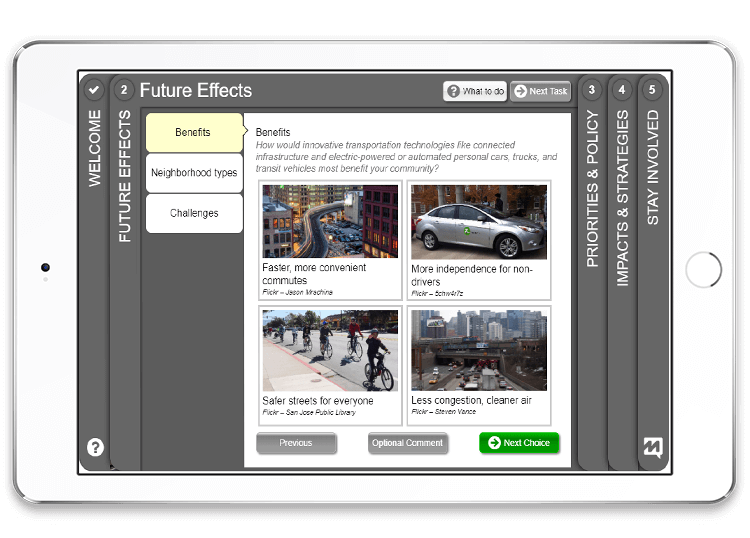
    CMAP project Alternative Futures: Innovative Transportation is another great example of environmentally friendly transportation planning! CMAP chose the Image Rating Screen and two Standard Survey Screens to gather informed input on how new transportation technologies will affect individual citizens.

    The dynamic Visual Preference Screen asked participants three crucial questions: 1. what technological advancements would benefit your community most? 2. where would you live if your commute was more convenient? and 3. what are your concerns with new transportation technologies? The Visual Preference Screen offered valuable insights into the technological advancements necessary and where they should be implemented.

    The two Standard Survey Screens allowed residents to share their preferences regarding future transportation options, and gave CMAP insight into how to ensure equitable access to technology, reduce congestion, and expand parking options. Additionally, the Standard Survey Screens aided CMAP in solving a problem that many of us in transportation planning face – how to keep public transit competitive with new technology.

    Southwestern Pennsylvania Commission (SPC)

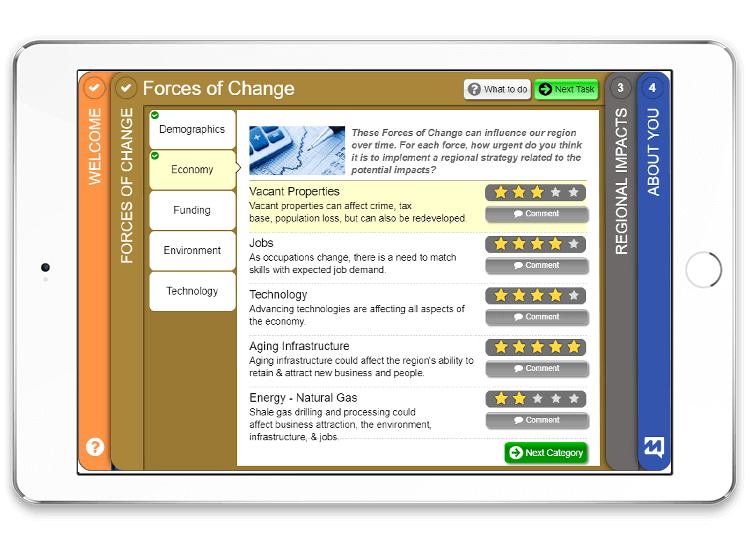
    SPC launched the innovative Forces of Change survey, which embraced change by asking the public’s input on how to best cope with the external forces facing their future. Their MetroQuest Site reviewed several different factors, such as: population changes, new energy, and aging infrastructure. With new technologies being one of the categories, this survey offered valuable data needed to construct a better future, and incorporated a Strategy Rating Screen and a Standard Survey Screen.

    The Strategy Rating Screen asked participants to examine a range of areas that many be impacted by external forces and weigh in on the urgency of each one using a quick star rating. On the Standard Survey Screen participants answered questions on which communities they believed will be most and least impacted by a range of external forces including the environmental and technological change.

    Office of Intermodal Planning and Investment (OIPI)

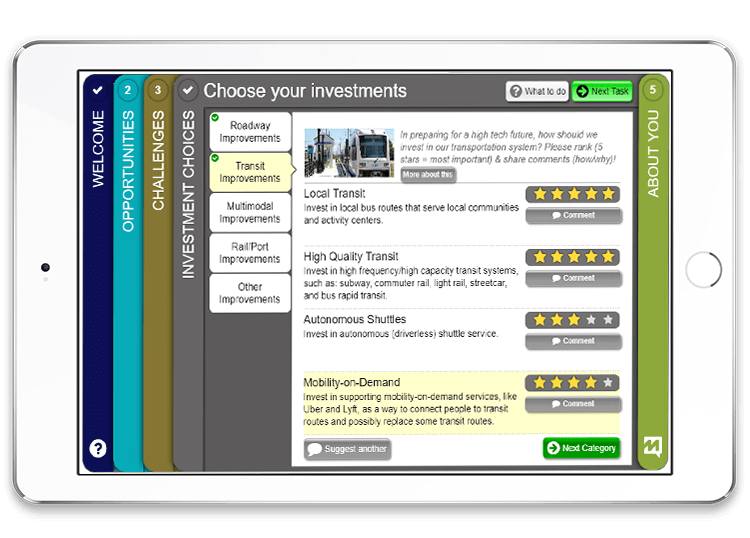
    OIPI used MetroQuest to enhance their knowledge of public preferences as they planned for the green future of transportation in their VTrans2040 survey. Vtrans2040 used two Priority Ranking Screens to ask residents what they believed were the three biggest opportunities and concerns with emerging transportation technologies, such as autonomous vehicles and mobility-on-demand services.

    The Strategy Rating Screen allowed OIPI to gain insight into how Virginia residents thought they should invest in the transportation system. Participants rated potential improvements on a scale of one to five, with “five” being the most important. Additionally, the Strategy Rating Screen gave OIPI a greater understanding of the wishes and needs of residents, which projects to prioritize, and where they should allocate resources.

    Thank you San Diego Regional Planning Agency, Chicago Metropolitan Agency for Planning, Southwestern Pennsylvania Commission, and the Office of Intermodal Planning and Investment for your proactive efforts to fight climate change and implement environmentally friendly transportation plans. We are looking forward to seeing the implementation of these innovative and environmentally friendly solutions. We’re confident that these public engagement efforts will help to support a bright future for your transportation systems.

  • Millennials to Boomers: How MDOT Involved 6,300 for Its LRTP

    Millennials to Boomers: How MDOT Involved 6,300 for Its LRTP

    The Michigan Department of Transportation (MDOT) has reinvented how it approaches public involvement and the payoff has exceeded even their wildest expectations.

    Watch this webinar to hear them tell their story

    While transportation matters to residents of all ages, few attend public meetings. Transportation agencies across the country are plagued by declining participation across all planning projects. They’re also struggling with involving a broad demographic.

    Public involvement for long range transportation plans (LRTPs) can be particularly challenging. Most people are concerned more about immediate and localized issues. They generally don’t think in terms of long-range policy directions, constraints, and trade-offs that are the subject of the LRTP process.

    In fact, last time around MDOT conducted an extensive public involvement effort including over 20 public meetings throughout the state to support its long range plan. A total of 125 people attended, with higher representation from older demographics. MDOT project manager Brad Sharlow described the public input as “very sparse.”

    This time around, Michigan DOT went online with the hopes of broadening its outreach to support its new state long range transportation plan (SLRTP). In their webinar, they explain how they joined forces with WSP to engage 6,300 people, from millennials to boomers, to uncover their evolving transportation priorities for the Michigan Mobility 2045 SLRTP. Shane Peck, Anita Richardson, Brad Sharlow, and Kyle Haller share their engagement techniques and what they learned about public preferences for modal tradeoffs, infrastructure investments, intelligent technologies, and transit.

    This webinar recording is like a best practices playbook to help other agencies develop and implement public involvement programs for broad and inclusive outreach for LRTPs.

    Watch this complimentary on-demand webinar for modern ways to:

    • Uncover the transportation priorities of your citizens
    • Engage across all age-groups, going beyond the usual suspects
    • Gamify transportation education to capture informed public input
    • Integrate tech to capture public input at public meetings
    • Build resident support and buy-in for meaningful change
  • Colorado DOT Launches MetroQuest Survey to Involve the Public in Statewide Transportation Planning

    Colorado DOT Launches MetroQuest Survey to Involve the Public in Statewide Transportation Planning

    We are thrilled to welcome the Colorado Department of Transportation (CDOT) as the newest member of the MetroQuest community.

    CDOT is responsible for the transportation network in the eighth fastest growing state. With so much change occurring, CDOT takes public involvement seriously and is wasting no time in making use of MetroQuest. The team has already collected informed input from over 1,225+ people in less than a week and anticipate that many more thousands will follow. The agency is seeking public input on how to spend taxpayer dollars to plan for rapid growth by prioritizing transportation investments that will move more people and goods, safely and efficiently.

    CDOT started its MetroQuest subscription with a BANG by launching its first public survey for a project called “Your Transportation Plan”

    Watch this 1-minute YouTube video to learn about agency’s new 10-year strategic transportation planning effort:

    Public input collected with this MetroQuest survey will help inform which investments are made over the next 10 years across all modes of transportation, including trains, planes, automobiles, bikes, pedestrians, freight, and more. CDOT Executive Director Shoshana M. Lew described the project in a press release:

    “This process builds on Colorado’s tradition of grassroots engagement to take a fresh look at our transportation investment priorities and ask people across Colorado what matters to their lives and what infrastructure can do to get them there … Thank you for joining us as we think broadly and build a plan that provides connections, choice, and a Colorado for all.”

    A clever video, press release, and press conference have kickstarted the promotional campaign. During the press conference, Lt. Governor Dianne Primavera addressed residents,

    “This is an incredible opportunity for Coloradoans to join us at the table, and identify specific transportation projects for CDOT to consider that will directly improve your community. With your engagement we can create your transportation plan, ensuring that Colorado has the connections and choice that help our state thrive.”

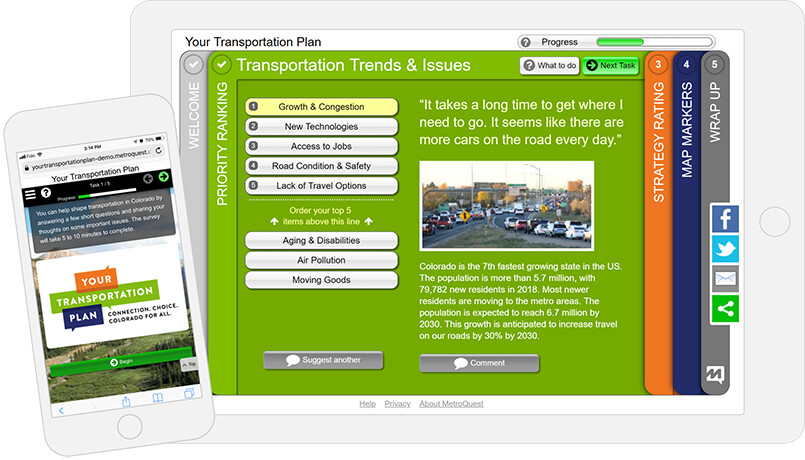
    Let’s take a look at the highly engaging public survey they customized using MetroQuest! You can either explore the screenshots that follow or try the DEMO survey here (note that your responses will not be included in final survey data).

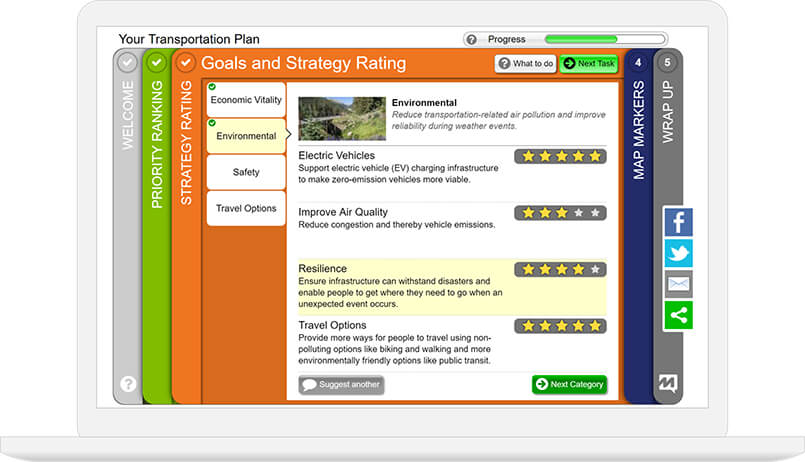
    After a short description of the project on the first Screen, CDOT is using the MetroQuest Priority Ranking Screen to educate the public about the state’s top transportation issues, while asking Coloradans which should be prioritized.


    “Part of the reason we’re doing this is to have an active conversation with people about the challenges they have and how you can solve them with different types of transportation,” said CDOT Executive Director Shoshana Lew at Friday’s press conference.


    In the next MetroQuest Screen, Coloradans are rating their preferred goals and transportation strategies. When the survey closes in August, CDOT will have a clear understanding of how residents across the state would like to see transportation options evolve. The CDOT team will know whether residents would like to see investments made in infrastructure to support electric vehicles, or to extend travel options for cyclists, pedestrians, transit users, or to fund a host of other transportation priorities.

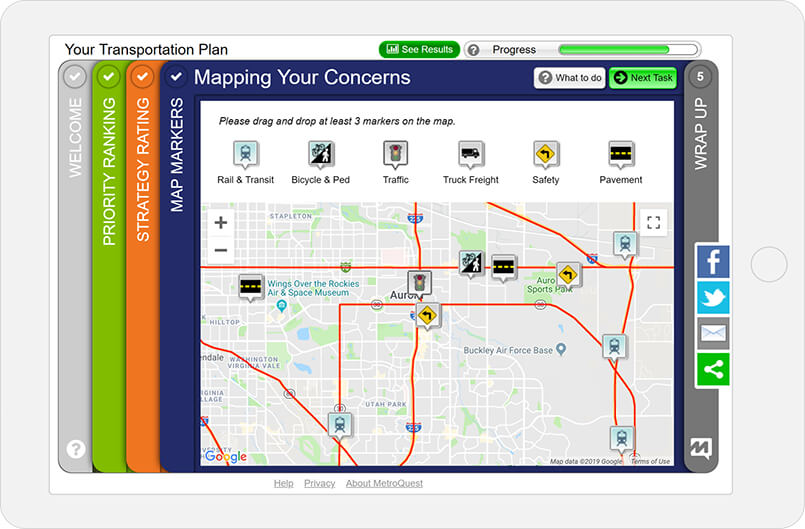
    On the last interactive Screen, participants are zooming into a map of Colorado and adding map markers to identify areas of concern. They are informing CDOT of safety issues, poor pavement conditions, missing rail or transit options, and areas that could benefit from bicycle and pedestrian options.


    The last MetroQuest Screen is collecting demographic information. This data will empower CDOT to ensure that it has reached a broad audience by age, ethnicity, and geography before the survey closes. We look forward to keeping an eye on the growing engagement numbers until then.

    CDOT joins a long list of State Department of Transportation (DOTs) that subscribe to MetroQuest to offer both educational and engaging online public involvement experiences. The list includes Texas, Maryland, Maine (and all its MPO’s), Oklahoma, South Carolina, Kansas, and North Carolina (with all 36 of its MPOs and RPOs).

    Our team at MetroQuest extends a warm welcome to the entire team at CDOT! We wish you outstanding public involvement success with this first survey and the many more to come.

  • The Evolution of Public Engagement at APA NPC19

    The Evolution of Public Engagement at APA NPC19

    Each year at the American Planning Association’s National Planning Conference, when I’m not presenting a session, I can be found in the crowd at any public engagement related session. And each year, I share my thoughts and lessons learned following the conference. 

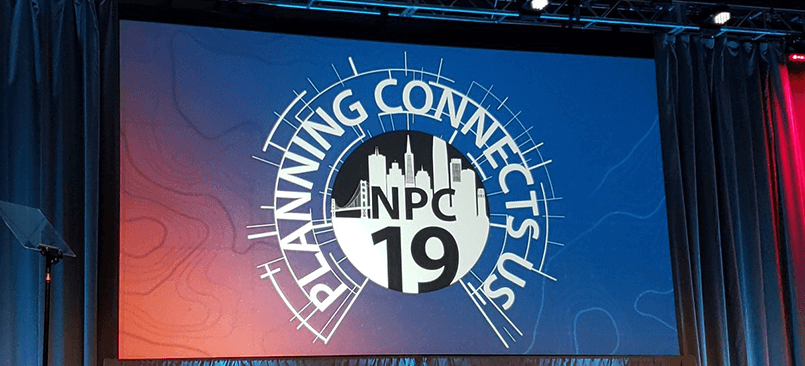
    Compared with past years, on the surface, public engagement seemed less prominent at NPC19. A deeper dive reveals that the dialog about public engagement was woven into a sophisticated treatment of equity and inclusion. This trend was first noticeable at NPC18 in New Orleans. This year’s NPC took it to the next level. 

    There are too many sessions to cover comprehensively, so I will focus on the sessions that inspired me the most. The first session that got me scribbling notes featured Kim Lundgren of Kim Lundgren Associates, Inc. (KLA) in her talk, “Beyond the Usual Suspects: How to Deliver Ongoing, Equitable Engagement.” She described KLA’s approach to reaching beyond the usual suspects using a toolbox approach in recognition that each audience group may require a different tool or engagement technique. This session was a refreshing move away from the one size fits all solutions we’ve seen in past years.  

    My second inspiration came from the description of the role that the City of Loveland, Colorado’s Youth Advisory Commission (YAC) was playing in the city’s transit planning. The most exciting takeaway for me was the part of the process where YAC conducted peer-to-peer engagement to influence the city’s transportation master plan. I’ll be following the YAC carefully as this demographic is so critical and has been the most challenging to reach for many communities.

    I darted out mid-session to catch Darlene Flynn, from the City of Oakland, California, talk about “Strategies Toward Racial Equity in Planning.” I’m glad I did. Her powerful presentation about her work in Seattle and later in Oakland on racial equity in planning and city policy made it clear that it plays a central role in some of the most challenging issues facing cities and regions. She, and her co-presenters, encouraged the audience to look at the legacy of historical policies and planning decisions whose affects still linger across the country. The session dove deep into displacement, gentrification, economic inequality, criminal justice, and health disparities and connected these issues to historical planning policy so clearly that it changed the way I see cities. She made quite a few new fans that day, myself included.  

    I rushed from there to my own presentation on “Community Engagement Therapy” based on Pecha Kucha talk I gave at the Rail~Volution conference in Denver. 

    I offered a lighthearted and self-deprecating look at how vulnerable public engagement processes can be to vocal minorities and how new technologies can play a role in creating more balanced and safe ways for meaningful community dialog. 

    APA NPC19 Session

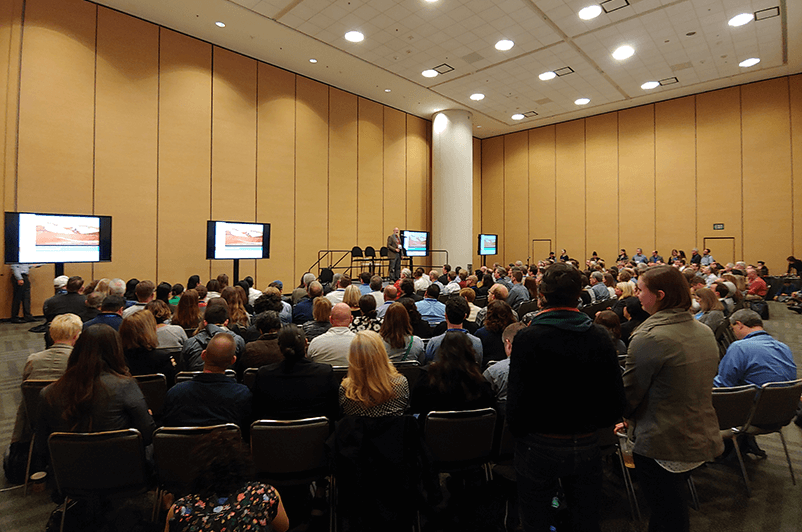
    This “Fast, Funny, and Passionate” session was part of a series that the APA has been offering for a few years at the NPC and it is clear that they need larger rooms for these popular sessions. Our room seated 250 and organizers had to close the doors after well over 300 people crowded in!  

    Next up was an inspiring story about Akron, Ohio who is collaborating with community members to co-create public spaces to develop trust and inspire healing in this mid-size Rust Belt city. Citing increased polarization, segregation, social isolation, and economic inequality, this partnership with the national Reimagining the Civic Commons initiative is reinvigorating a civic pride and engagement in a way that can serve as a model for cities across the country.  

    Gabrielle Lyon of Lyon Strategies talked about the Chicago Architectural Foundation’s (CAF) Meet Your City initiative to engage with youth. As part of this initiative, CAF hosted a design competition and published a 144-page color graphic novel to help youth understand their role as city stewards and to encourage active participation in the planning process.  

    The passion and creativity of these planners to deeply understand and address the needs of all demographic groups in the communities where they work is inspiring. 

    I’ll use this inspiration to look more deeply into online engagement case studies to reveal best practices for reaching traditionally underrepresented populations. I’ve already found three excellent examples, so stay tuned for upcoming articles, case studies, and webinars.  

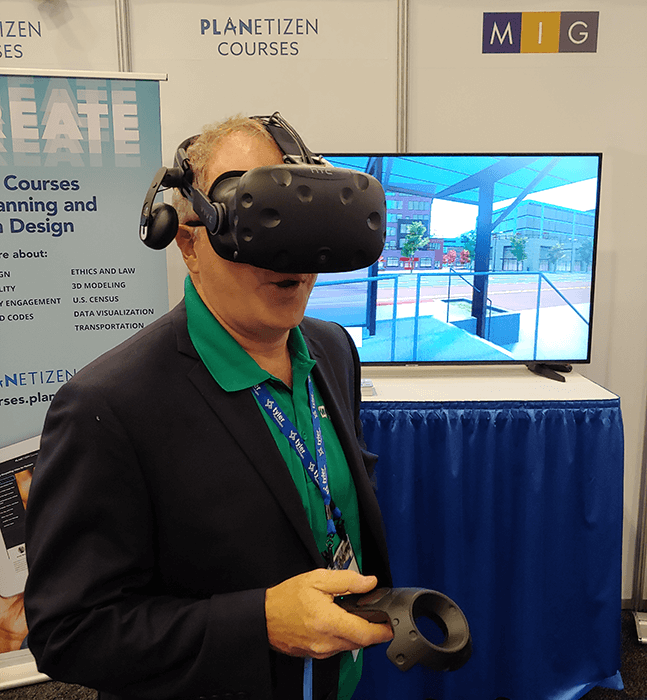
    I did manage to sneak in some fun time in the mist of all these amazing sessions. I had a great time playing with the Planetizen/MIG virtual reality setup.

     VR glasses

    Many thanks to the APA conference team for curating another thoughtful array of presentations and sending me home inspired to continue raising the bar for public engagement. I can’t wait till APA NPC20!

  • [SUCCESS] MetroQuest Success Team Welcomes Oklahoma DOT

    [SUCCESS] MetroQuest Success Team Welcomes Oklahoma DOT

    I would like to personally thank the esteemed panel of judges for recognizing the accomplishments of our world-class team. This award represents the collective achievements of all of our employees. They helped make 2018 a truly transformative year! We achieved 5

    We’re so excited to welcome our friends at the Oklahoma Department of Transportation to the MetroQuest community!

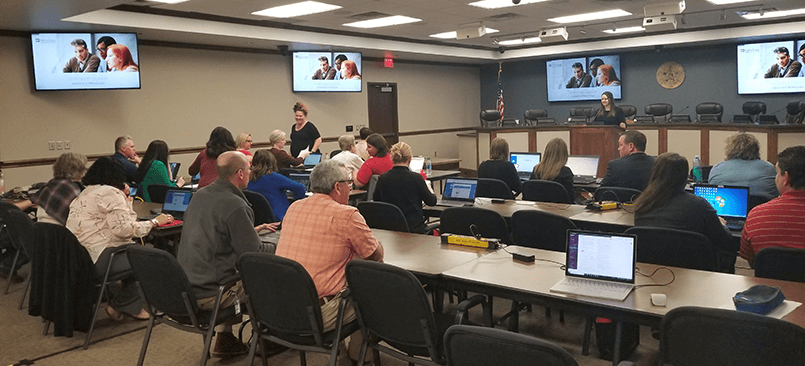
    Our CEO, Mike Walsh, and I visited their offices in Oklahoma City last week. I always love being able to put faces to names, and I was thrilled to meet the Oklahoma DOT (ODOT) team in person. Our on-site training (which was recorded for future use) will ensure their users get started on the best path possible towards successful online public involvement!

    With over 30 attendees, we were so excited to hear about the broad realm of public outreach projects ODOT is already planning!

    ODOT on-site MetroQuest training

    We worked directly with the Oklahoma DOT team, as well as various consultants and ODOT partners. Training this breadth of users means that ODOT employees can hand over the reins on various projects to their consultants and be able to focus their time on even more topics. We loved getting to connect with so many groups, each with a different focus and plans for MetroQuest surveys! From highway plans to community projects, we have examples for every project scale and type to help inspire their next online survey.

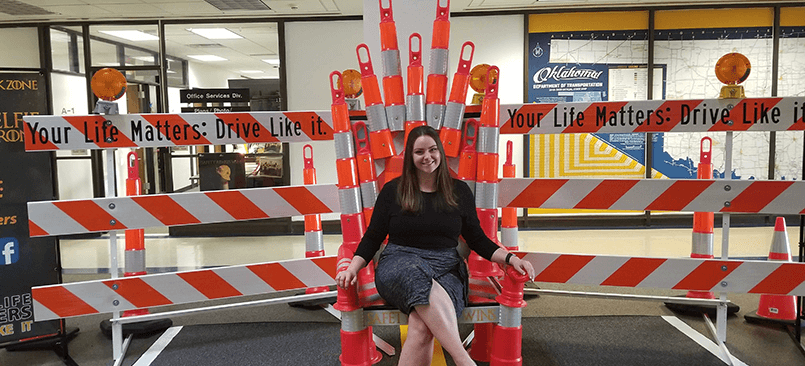
    We visited in April, which is Work Zone Safety month! ODOT is focused on keeping all highway workers safe, and this was obvious from the moment we stepped in the door. There are tips on how to drive more safely posted on traffic cones in the lobby and even a huge throne of safety cones available for photos and posing! The focus on keeping highway workers safe and uninjured is clear, and we’re looking forward to helping Oklahoma DOT involve the public on this topic to learn how they can further improve safety methods.

    I’m not going to lie, sitting on the throne of cones was definitely a highlight of my trip!

    Tara sitting on throne of cones

    We always love being able to connect with customers in person. Thank you Oklahoma DOT for being such amazing hosts!