Category: [TIPS]

  • [TIPS] Leveraging Social Networks to Increase Online Engagement

    [TIPS] Leveraging Social Networks to Increase Online Engagement

    As an online engagement software company, we recognize that social media is one of the most useful tools out there for promoting your project and increasing engagement. Since these platforms are free the only real cost is time. By following best practices and using tools and techniques to increase productivity, social media can lead to huge gains in engagement with relatively little cost to the project.

    We’ve put together some best practices based on hundreds of the most successful MetroQuest projects. We hope you find these tips useful for your next project.

    Be strategic

    Social media success requires consistent effort, so make sure that you have a plan in place before starting. Strategically allocate the necessary resources to ensure success. Think carefully about your brand, your tone and your key messages, and get agency buy-in before beginning.

    Craft compelling content

    Social media is an amplification tool for interesting content. Use it to promote your initiative and share materials throughout your community. The key to social media success isn’t just having a bunch of followers – it’s about real engagement with your community and encouraging them to share your content with their network.

    The goal is to create content that is compelling enough that people will be eager to talk about and share with their friends. In our experience less is more and a picture (or video) is worth a thousand words. It’s best to focus on issues that the public is most concerned about today, even if your plan is looking 25 years ahead. Keeping your message concise and using great images leads to substantially higher levels of engagement. Take Twitter for example – tweets with photos get 35% more retweets on average and now that Twitter video is here, well, you get the idea.

    Focus on quality, not quantity

    While it’s good to take advantage of as many channels as possible to promote your project, be cognizant of how much time and budget you can allocate to all of these different mediums. It’s easy to sign up for every social network under the sun, but if you’re devoting resources to managing accounts on Pinterest and Instagram and Vine and Google+ and …, you could be spreading yourself too thin and missing out on quality engagement opportunities.

    Focus on the areas that really matter and have the highest potential for impact. In our experience, Twitter and Facebook are the best tools for engaging local communities. LinkedIn can also be very useful for targeting professionals and business owners in your community. Be sure to look for Facebook and LinkedIn groups that are relevant to your area or project and post some great content.

    Be consistent

    Try to post at least once per day in order to reach the largest audience possible and stay top of mind in your community. There’s a lot of debate and research surrounding the best time to post content online, but a good rule of thumb is to just think of when you would most likely see and read the type of content that you’re posting.

    For example, posting a link to a survey at 10 pm on a Friday might not get a lot of results. But 8 am? Now we’re talking.

    Create a content calendar

    Schedule posts in advance and fill your weekly calendar with compelling and relevant content.

    Use a social media management tool like Hootsuite to schedule your social media activity, reducing the amount of time you have to spend every day posting on multiple networks. You could reserve some time on a Monday morning to schedule posts for the entire week, leaving you with more time to focus on the big-picture tasks needed to make your project a huge success.

    Hootsuite is free to use with up to 3 social media accounts – another good reason to limit the number of networks that you use.

    Be a good listener and involve yourself in conversations

    Another key advantage of using social media for your project is the ability to “listen.” In our work, a quick search of “MetroQuest” on Twitter gives a live stream of all the people that are talking about MetroQuest. This gives us a unique opportunity to involve ourselves in these conversations and reply to people. This is something we do every day, and it’s very easy to set up a similar process when promoting your next project.

    Again, a tool like Hootsuite can be very useful in that you can create a view in your dashboard that shows you all the posts across social media that include the particular keyword or hashtag that you’re interested in following. This is a very simple way to stay up-to-date on what people are saying about the topics that matter to your project, and opportunities to get involved in the conversation will come up when you do a good job of listening.

    Give it a shot! Search for topics in your local community today and get involved.

    Use advertising to boost reach

    If you have the budget to spare, it’s very easy to integrate some ad spending into your social media posts to reach more of the people that you want to get involved in your project.

    For example – if you’re trying to get input on a proposed light rail project in Arlington, you can promote your Facebook posts to people who live in a 50-mile radius around Arlington. You can also specify by age, interests and other demographic information. These kinds of ads have been proven to be much more effective than traditional methods like print and radio advertising. With an advertising campaign on Facebook, Twitter or LinkedIn you can track how much you’re spending per click – seeing what works and what doesn’t. Used well, a little bit of advertising money can go a long way to getting your message out to the public.

  • [WEBINAR] Going Viral: How Your Project Can Engage Thousands Online

    [WEBINAR] Going Viral: How Your Project Can Engage Thousands Online

    What do the best public engagement projects have in common? Not all projects attract huge numbers of participants online, but it turns out that the ones that do all share some common characteristics. After reviewing hundreds of municipal, MPO, DOT and TPO projects, we have compiled a set of best practices as a guide for your next project.

    This webinar explored case studies of planning projects with various transportation agencies that successfully used online technology to increase the reach of their public involvement efforts. Critical success factors, key strategies and best practices were shared and discussed.

    Watch Recording

    View Slides

    Q&A

    Below are some of the questions that were asked during the Q&A session at the end of the presentation.

    Q: How do online surveys like MetroQuest deal with accessibility on plans – people with disabilities, people in rural areas without internet?
    A: MetroQuest meets most accessibility requirements with its large fonts and clear graphics. Sometimes to accommodate people with vision impairment a parallel survey is offered as an option that presents the material in a text only version that a screen reader can read. In some cases a phone number or other open houses are offered for people who require one on one support. In order to provide as many options as possible, MetroQuest is also able to be offered in a paper-based format and we provide tools to help enter the paper responses into the database so they are all rolled up together.

    With the growth in social networking and online shopping, rural residents are increasingly online and will happily participate in web-based surveys as a convenient option to travelling to a distant event. To add extra support for people in rural areas who do not have connectivity we have found that the kiosk in local stores or community centers work very well. In one project we engaged over 10% of the entire population of a region over a 4-week period using one well-placed kiosk in the main community center.

    Q: How do you feel about Citizens Advisory Committees? Do you still see value in them or do these other methods provide better community input?
    A: CAC’s can serve a different and valuable purpose compared with a broader survey of the general public. CAC’s attract people who are motivated and willing to roll up their sleeves and dig into topics as a deeper level than the general public. This gives you the opportunity to work with them to co-create solutions. We have found that CAC’s are most powerful when combined with the guidance of a broader survey of public opinion. This relates to our concept of Public Engagement 3.0 where we describe phased process of combining broad online engagement with face to face meetings. In the case of CAC’s, they fall into the category of the more detailed face to face engagement even though some CAC’s meet and collaborate online as well.

    Q: How does MetroQuest deal with asking for people’s vision for a long range plan? Do you show trade-offs or is it more about a blank slate? Do you see value on showing the ‘level of effort’ to achieve a particular aspect of a vision?
    A: This is a pretty big question which deserves more than a brief answer but I’ll do my best to begin the dialog. MetroQuest is frequently used for visioning projects. Each one is different so there is no “standard” way of dealing with them. Often visioning is the initial part of a larger process that rolls out in phases. We offer many screen types that have been used to suit the visioning activities of our clients including:

    • our “Vision Screen” which offers open-ended options for any idea participants wish to share,
    • our “Scenario Screen” which presents a series of alternatives tied to trade-offs and outcomes for their feedback, and
    • our “Map Input Screen” which allows people to be very specific about what they wish to see on a map of the area.

    We are cautious to not carry too many preconceptions into those first conversations with clients as each situation is unique. I think in some cases showing “level of effort” is useful if there is a desire to constrain the visions and gather more informed input. In other cases visioning is being used as an engaging way to assess the broader priorities of the community and such constraints are not helpful. Often the best projects go in phases from the “anything’s possible” first phases to more discrete and constrained alternatives during latter phases.

    Q: A lot of dense, creative material. What is a good strategy for a firm with limited resources? Also, some suggestions for getting up to speed on the tools, etc. that have been presented today?
    A: Many thanks. We covered a great deal in 45 minutes and the questions that came in were great! Online engagement is a great option for projects with limited budgets since the ROI is so high relative to more labor intensive face to face engagement. Most projects still have at least one face to face session but many choose to scale back on them as they achieve broader engagement online.

    If you would like to learn more about MetroQuest please get in touch. One of our Engagement Specialists will be happy to help. It is useful to note that MetroQuest does much of the heavy lifting for you so the learning curve is less of an issue compared with other “set it up yourself” software. We will sit down with your team, learn about your needs and then recommend an approach. Once we settle on something that resonates, we give you a check list of content that is needed, typically words and images. Once we get that content from you we will do the work to create the tool for you and get it ready for your review. The process does not require many technical skills on your end so getting up to speed is easy.

    Q: Regarding the examples you showed today: Was the engagement done in multiple phases, or a single outreach campaign?
    A: Three of the five examples we highlighted included two or more phases of public engagement. MetroQuest screens can be easily swapped in and out to adapt to the different needs of each phase of your public engagement process. Many projects take advantage of that capability as the public becomes accustomed to using the software and they can easily see how input from the previous phases is being used in subsequent phases as the project moved towards a final plan.

  • [TIPS] How to Engage the Environmental Justice Community

    [TIPS] How to Engage the Environmental Justice Community

    8 Tips to Help You Reach Targeted Populations

    It’s no secret – the best public involvement is inclusive and increasingly it is being enforced as a requirement of planning efforts. Agencies around the world each have their own way of describing inclusiveness. In the US the EPA’s term is Environmental Justice (EJ) or Title VI. This requires the “fair treatment and meaningful involvement of all people regardless of race, color, national origin, or income with respect to the development, implementation, and enforcement of environmental laws, regulations, and policies.” Because EPA regulations impact transportation and virtually all other public infrastructure planning, these requirements apply to many projects.

    Regardless of what jurisdiction you are in, the calls for broader and more inclusive public engagement are likely mounting. At the same time, technology is changing the way we communicate. In response, the use of online public engagement is rapidly expanding, whether it’s on your laptop at home, kiosks in the community center or the smartphone in your pocket. However, when it comes to engaging the EJ community the question is – does technology help or hinder?

    Based on case studies we’ve evaluated, it can go either way. If implemented well, technology can close the gap and provide much greater access to the EJ community. If handled poorly, public engagement technology will only widen the divide. The most sensitive groups tend to be low income and minority groups for various reasons including access to technology, language barriers and cultural differences.

    The reality is that the EJ community is also often excluded from traditional methods of outreach as well. Many don’t have the time or freedom to attend public workshops or don’t feel comfortable with that form of participation due to language, educational or cultural barriers.

    How can we leverage technology to improve engagement and reach the EJ community? Below are 8 strategies that will help you in your outreach efforts to the EJ community.

    1. Do your research

    When designing your public involvement program, first seek to understand what issues are most important to each of your demographic segments. What are their top priorities? What language do they use to express them?

    Sit down and talk with people face-to-face as early as possible. Go to community centers and try to understand what issues they have concerning your project. This will give you the ability to build the content of your engagement program using the metrics and terminology that will resonate with them the most.

    2. Communicate what’s at stake and how their input will be used

    There will be three questions on people’s minds when they are asked for input:

    • What’s at stake?
    • Why should I contribute ideas?
    • Is there anybody listening?

    Most importantly you’ll need a powerful call-to-action (CTA) that convinces them it’s worth the time and effort to participate. These messages will be used in the collateral and communications to encourage the EJ community to get engaged.

    How do you write a well-crafted CTA? Use the knowledge you’ve gained from doing your research on community priorities. Once you understand which issues are truly important, it will be easy to create a message that resonates.

    If your community is working on a new transportation plan and your research tells you that affordability is a key issue, an effective CTA might be, “Want affordable transportation options? Your input will be used to guide our new city-wide plan.”

    Let them know what’s on the table and craft you communications based around their priorities. Make a promise to them about how their input will be used.

    3. Go to them

    If you’re using a technology solution, make sure it doesn’t entirely depend on your participants coming to your website on their own devices. Be opportunistic – latch on to community events that other groups are planning. Bring kiosks and tablets to community centres, local events and other places where the EJ community members routinely visit. That way even those without access to their own devices can participate.

    For many people who don’t have computers, smartphones are often the only online connection that they have. To include these people, make sure that your digital engagement technology is well-optimized for smartphones.

    4. Support multiple languages

    Naturally if people can’t read your site, it’s a show-stopper. Rather than relying on auto-translation which tends to mangle the meaning of planning concepts, take the time to translate your tool professionally and offer a choice for people on the front page.

    If you’re interested in engaging the Vietnamese community, if your site is available in Vietnamese it will be welcoming to them, even if they also speak English. It sets an inviting and inclusive tone.

    5. Wherever possible, use visuals

    Keep things simple and use images to convey the message. This allows for people with poorer language skills to still get involved and have their voice heard. Visuals also stir emotions very effectively, leading to a more memorable and engaging process.

    6. Integrate educational content

    Provide education and context for questions that are being asked. Many people don’t feel qualified to have an opinion on complex issues like land use or transportation planning. Educating people about the pros and cons of choices helps empower them to weigh in on these issues and contribute meaningfully.

    Be realistic about the questions that you ask. Not everyone knows how to solve planning problems or create solutions.

    “What are your priorities?” We love starting with this question. Everybody knows what’s important to them. It also sets a tone that lets people know that you care about their needs. The added benefit of starting with this question is that you can use their answers to shape what they see next according to their top priorities. This is a great way to keep them engaged.

    7. Leverage community leaders in promotional activities

    When trying to solicit participation, who the message comes from is very important. Keep in mind that the EJ community often feels disenfranchised. In many cases, the Mayor or other city officials may not be the best people to invite the EJ community to participate.

    Instead, it may be useful to ask locally trusted leaders of community groups and political representatives that the EJ community trusts to solicit participation. These can include leaders of local religious, community and non-profit organizations that have earned their trust and are aligned with their values and priorities.

    8. Collect and monitor demographic information in real-time

    Be prepared to adjust your engagement process mid-stream. Don’t plan all events and activities and commit all of your budget in advance. Review your results early on, find out who is missing and fill in the gaps with new strategies and “boots on the ground” efforts.

    While online engagement is increasingly effective, there will always be a role for face to face methods. Go to targeted community events where your missing EJ community members will be. Bring paper-based surveys and iPads and engage away.

    Sometimes creative strategies are needed. For example in one small community, the project team was struggling to get low income and minority families to participate. A unique strategy was hatched. “At Home Engagement Kits” were distributed. The Town offered to reimburse any pizza receipts for groups of 6 participants or more.

    The result? The project engaged over 60% of the population with active participation from the EJ communities that were traditionally missing. What was even more interesting was that the municipality did not have to pay for a single pizza receipt. It seems that the offer was enough to get people started and participating proved to be satisfying enough.

    Conclusion

    If implemented well, online public engagement has a strong role to play in bridging the gap and allowing the EJ community to have their voice heard. By doing so you can reach a demographic that is more representative of your overall community, and have a powerful source of input to support your plans going forward.

    For more information and examples, watch the video below which recaps our recent webinar on best practices for engaging targeted populations.

  • [TIPS] Beyond the Opposition – How to Engage the Moderates

    [TIPS] Beyond the Opposition – How to Engage the Moderates

    I think we can agree that the types of people who show up to public meetings are not very representative of the general population. This observation raises an important question. When we design our public engagement process, who should we be targeting?

    The keenest and most motivated participants are easy. They will show up no matter what. Unfortunately, there’s few of them and they usually hold rigid, extreme, and often negative opinions. The rest of the population are either less motivated, too busy for public meetings, or both.

    For public planning projects, it’s a crying shame because these folks can be the most constructive and supportive voices in the community if only we can find a way to engage them. For this reason, people who are less likely to participate are the most important targets of designing a broad and inclusive engagement program.

    Why do the public seem so angry?

    For any project that impacts the public, there will always be people strongly in favor and strongly opposed. Too often we only end up hearing from the folks who are strongly opposed. The reasoning is simple: anger or fear of a proposed project are excellent motivators. These people will go to great lengths to voice their opposition.

    Happiness or satisfaction, it turns out, are often not enough to encourage someone to get off the couch. People don’t often march in support of something.

    The last group, the vast majority of the population in most cases, are the moderates who are the most open-minded and have not yet formed a strong opinion. These people will base their decision on real information from both sides of the debate. The trouble is that it’s very tricky to engage them.

    Where are the moderates?

    In most communities, what the average person thinks about an issue is a mystery. It’s become politically incorrect to talk about our values publically and since most people don’t participate in civic events, project leaders are often in the dark about their views. All too often that leaves the decisions to be influenced by the folks with extreme and often minority views.

    Why are the moderates less likely to participate? Here is what we’ve heard repeatedly:

    1. They are too busy and don’t have time to attend public meetings,
    2. They don’t have strong feelings about the planning process,
    3. They don’t feel qualified to have an opinion, or
    4. They are supportive of the agency and feel confident in the direction they are taking.

    Since these are the very people who are most likely to provide constructive feedback, it’s critical to find ways to engage them.

    How to reach the average person

    The most effective way to engage these people is to address the obstacles that are keeping them from engaging – thus lowering the barriers as much as possible.

    Online engagement tools can be a very effective way to accomplish this, making it easier to reach out, engage your community and collect informed input. When implemented with care they can provide an easy and fast way for even the least motivated to get involved and provide informed feedback.

    What happened when Tampa tried online engagement?

    During the Imagine 2040 Hillsborough project, our client assumed that the majority of their local community were in favour of the current state of the region: automobile-oriented, low-density urban sprawl with virtually no new development occurring near job centers. This assumption was based on what they were used to hearing from the “public” at traditional workshops and meetings.

    The shock came when they used MetroQuest to educate people about the pros and cons of planning options and then collect their feedback on preferred scenarios online. After receiving over 250,000 votes, comments and other data points from a broad demographic, they were shocked to see that over 80% of participants were actually in favor of a much more densely populated downtown core with extensive public transportation options and support for cyclists.

    The unprecedented public input led to the unanimous adoption of the new regional plan and has expedited its implementation. They have already approved one of Florida’s first bike share programs and transit-oriented development in several key hubs.

    This example did a great job addressing the most important barriers to participation:

    • They made it easy and fast to participate using any device, and even provided kiosks in community centers for those without computers or smartphones,
    • They provided tools in multiple languages to accommodate a diverse population,
    • They educated people about the impacts of alternatives in terms that resonated with their priorities, and
    • They presented alternatives visually to make it easy to understand what’s at stake.

    While each project is different, the patterns discussed here apply to communities across the continent. Don’t underestimate the importance of engaging the moderates in your community. They could hold the key to success for your public engagement process.

    For tips and best practices on how to use online engagement tools effectively, download our new guidebook here.

  • [TIPS] Public Engagement 3.0

    [TIPS] Public Engagement 3.0

    The next generation of community engagement: blending high-tech and high-touch public involvement

    We need to rethink our entire approach to public engagement.

    The 1st generation of public engagement, version 1.0, was dominated by traditional public meetings. Rent the hall, buy the muffins and see who shows up. The issue with these is that you just end up getting the same ten people showing up to your events. The vocal minority dominates the dialogue.

    With the advent of online engagement tools we’ve entered the 2nd generation, version 2.0, where a group of high-tech companies have tried to recreate traditional public meetings digitally. Some people in the industry seem to think that we can completely replace public meetings with these digital tactics. Despite the fact that my company creates online engagement software, I completely disagree. We need to stop fooling ourselves that we can just have online versions of workshops. We are ready for version 3.0.

    I believe that both methods, traditional and digital, have their place – each with unique strengths that make them well suited to different parts of the overall engagement process. I also think a lot of people in our industry aren’t taking advantage of the benefits that could be achieved by integrating the two, and so today I propose a new framework for public engagement. I call it ‘Public Engagement 3.0’, a strategy for blending high-touch and high-tech methods.

    High-touch

    High-touch methods are those that require the physical presence of participants and organizers. High-touch techniques for community engagement are low-tech and include face-to-face meetings, public workshops and various community events. As with any method, there are both benefits and drawbacks to these tactics.

    At a public meeting you can sit down for hours with concerned citizens and have two-way dialogue, getting to know them and their issues and rolling up your sleeves to create solutions that address their concerns.

    The problem with public meetings is that there is a very high barrier to entry and only the most motivated (and usually angry) segment of the community will show up. If these attendees set the priorities for the project moving forward, you’re not really creating solutions based on the priorities of the entire community, just the small subset that was motivated enough to come out and have their voice heard at a public event. They can also be time-consuming and costly to run.

    High-tech

    High-tech is on the other side of spectrum and is very low-touch. It involves zero or very little personal interaction with the community, and uses digital tools to reach out to the community and perform similar function to what would be accomplished at a public meeting.

    As discussed, traditional engagement methods like public meetings have high barriers to entry. Online engagement can have a very low barrier to participation, especially if your online engagement process is fast and easy. The result is that you can easily engage more people of a broader demographic of your community. Using digital tools also lower costs and requires less staff time and logistics.

    The drawback of online community engagement tools is that it’s less personal and you generally have a shorter amount of time to interact with someone – for our surveys, the typical person spends about 5-10 minutes contributing their ideas. This short time commitment is great for ensuring that you hear from a large number of people (as time is a major barrier to entry), but it doesn’t allow for very deep conversations with people. With only a few minutes, there’s a limit on how much information you can gather.

    There are benefits and drawbacks for both traditional and online methods, and in our opinion both are suited to different stages of the overall engagement process.

    How to effectively blend the strengths of both

    The key to my proposed framework is a marriage of the two – using online engagement tools to collect input from a wide audience, and then using that input to guide more constructive public meetings, working with interested community members to come up with solutions, and finally taking those solutions back out online for broad community input.

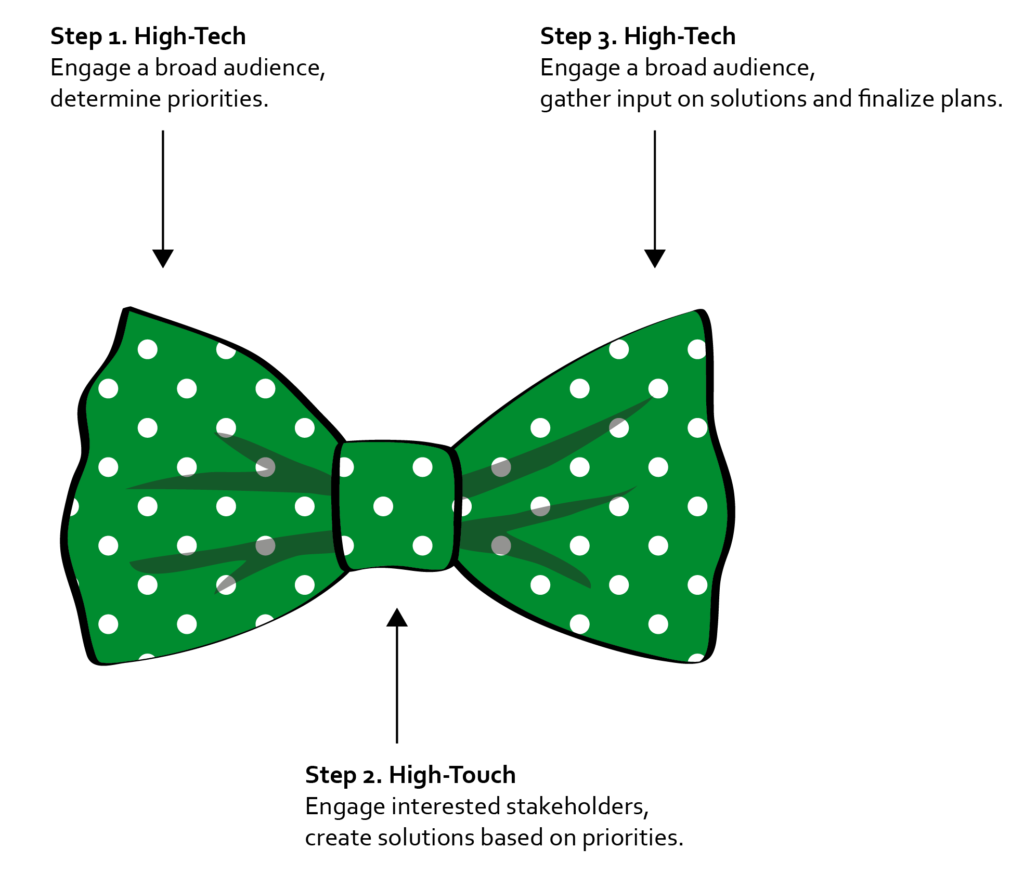
    Picture a bow tie representing the overall engagement process, with the first wide end representing broad engagement using high-tech tools, followed by the narrow middle section representing high-touch methods with a smaller audience of community members, and then finally going back to the broader public using digital tools.

    Step 1. High-tech (Engaging thousands and gaining insight)

    This is the initial phase, where you’ll want to get the broadest input possible in order to set the tone for the project and find out what the most important priorities are for the majority of the community. Using online engagement tools designed to be easy and fast for participants you’ll reach a much larger group of people than you ever could, even with a series of public workshops.

    By engaging a larger audience, you’ll also have an opportunity to entice more people to attend your traditional public workshops, and those who do attend will also be much more informed about the issues after having been educated about the scope of the project online beforehand.

    Step 2. Low-tech (Turning data into possible solutions and alternatives)

    Now that you have all this data from a large and broad demographic of your community, workshops and public meetings will be much more effective and you can work with attendees to craft solutions based on this data.

    I think it’s still beneficial to have a listening session with these motivated community members, but the idea is to complement these sessions with the data in hand and not let the small minority of workshop attendees set the priorities for the entire community.

    A skilled facilitator can empower the attendees to be ambassadors of the broader community voice, and turn the workshop into a solution-creation exercise. By harnessing the time and energy of the participants to roll up their sleeves and create solutions the results can be creative and constructive. This process typically takes a few hours and is the kind of input that can only be gathered face to face. Furthermore, having stakeholders co-create the alternatives can generate significant public support and buy-in.

    Step 3. High-tech (Assessment of alternatives, building community support)

    After your public meetings, go back to high-tech tools again to evaluate these new strategies and alternatives. You’ll now be engaging your broader community with solutions that were guided by their priorities and developed in collaboration with their peers.

    When presenting alternatives of scenarios, it’s important to allow participants to understand the trade-offs associated with each option. For example, in MetroQuest we allow participants to rank their priorities and then see how each scenario or alternative performs on their top priorities before voting. This kind of educational process can generate a great deal of informed input from the community.

    Finally, you can then use this data to create a plan that will have the support of the majority of the community, due to the fact that they were involved in the process every step of the way.

    In my opinion, these are the minimum steps required to ensure a successful engagement process. If your budget and timeframe allow it, you may choose to add additional rounds of public input, iterating back and forth between high-tech and high-touch engagement.

    Conclusion

    The idea of Public Engagement 3.0 is to leverage the best of both worlds. Digital engagement is well-suited to collecting opinions and educating the public at large in a short timeframe, whereas traditional public meetings can be a great forum for looking at data and working with a smaller group of motivated citizens to create solutions. By combining online engagement tools with effective public meetings, you can achieve amazing results.

    Use online engagement to gather informed input that better represents the majority of the people in your community, and then use that data to leverage the highly motivated locals who show up to community workshops – creating high-impact plans with their input and assistance, based on the data of the masses.