Month: March 2016

  • [TIPS] What I Learned When an Angry Mob Destroyed My Public Meeting

    [TIPS] What I Learned When an Angry Mob Destroyed My Public Meeting

    One of my pet peeves is how we fill conference programs and websites with the most successful case studies and we don’t talk about our most potent learning experiences – when things went wrong. Maybe we just need a safe place to talk about these important learning opportunities. When things go wrong in public engagement, they can go spectacularly wrong. The result isn’t just frustration for project leaders. It can spell costly delays, failed or overturned planning efforts, or the loss of public support for politicians and government agencies. Introducing the Fiasco Files – a lighthearted opportunity to look back on those times when things went sideways. We’ll have some fun with it and also draw out some valuable lessons that will help us all avoid them in the future. Names will be withheld in order to avoid any embarrassment to any people or organizations involved and keep the focus on the lessons learned. These stories could happen to anyone.

    Fiasco Files #1: A Vocal Minority Dismantles a Community Meeting

    Being vulnerable and talking about personal disasters can be intimidating so I’ll go first. This is the story about one of the last public meetings I ever facilitated. I was on the public engagement team that was charged with conducting a series of community workshops throughout a metropolitan region to discuss a long range regional vision for land use and transportation. The first few workshops were held in urban areas and went smoothly. We weren’t aware what was brewing as we prepared for our 3rd workshop – this one in the suburbs.

    We learned later that the evening before the workshop a local group of people strongly opposed to the direction that the planning process seemed to be going met privately. They studied a manual on how to disrupt a public meeting and developed a strategy. With the project team blissfully unaware, this group of 40 or so arrived the next morning and positioned two of their members at each of the 20 tables set up around the room. A mere 30-seconds into my introduction it started.

    One by one, members of this group started interjecting, some by raising their hands, others by shouting out. When one would say their piece, a cascade of approval spread around the room as other members of the group chimed in. I still recall the looks on the faces of the non-group members which made up the majority of the audience (though it was hard to tell since they were silent). It was a look of “Gee, I’m the odd duck here.” In speaking with participants afterwards I heard statements like, “I disagreed but everyone seemed so fired up that I kept my head down.” These sentiments spoke to the effectiveness of the intimidation and influence that a vocal minority can wield at a public workshop.

    Despite the finger-pointing, personal attacks and criticisms leveled against me as a representative of the agencies involved, I listened to their input and tried in vain to move forward on our agenda. I was under strict direction from the lead agency that participants should be allowed to have their say for as long as they wish. When we were 45-minutes into the session and still barely past the first stage of our workshop plan I took a moment to confer with the team. “Let them talk” was the directive. Needless to say we were unable to follow our workshop plan and we did not collect any structured input that could be compared with input gathered at other workshops. We left feeling frustrated, humiliated and sympathetic for the majority of the participants who were robbed of their opportunity to express their views by the vocal minority.

    Anyone who has a few community workshops under their belt has experienced a disruptive vocal minority though they are not always as well-organized as they were in this case. With the benefit of hindsight there are several things that we could have done to help the situation. Here are some steps that helped at subsequent workshops:

    1. We got into the habit of making the rules of conduct at the workshop clear and got the audience to agree to them at the beginning of the session.
    2. If people disrespected the agreed-upon rules of conduct steps were taken to restore order – gentle at first and if those didn’t work, increasingly direct. On one occasion a little humor alleviated an outburst.
    3. On other occasions we used the wireless voting keypads to ask the audience whether they wished to continue entertaining interruptions or move on with the agenda. Because of the anonymity of the handset voting, the vocal minority was outnumbered by a wide margin.
    4. In some situations we reduced the opportunities for disruptive plenary outbursts by organizing table discussions.

    I’d like to say that these measures fixed everything. They certainly helped a great deal but there still was moments of chaos and disruption at the remaining workshops and I think the agencies involved came away feeling pretty drained and bruised from the face to face process.

    In this particular case one of the things that helped was the concurrent option for people to participate online. In fact this experience caused us to double down on online community engagement. The disruptors not only showed up at community workshops, they also tried to stack the deck online. In this case, we were thankful that MetroQuest had fraud detection capabilities allowing the fraudulent entries to be easily identified and removed from the results. That combined with the sheer number of online participants (over 11,000 participants online) meant that the sentiments of the general population carried the day. The absence of an open forum online meant that grandstanding opportunities did not exist. Thankfully the intimidation and alienation that occurred in the workshop was not part of the online experience.

    It is important to learn about the views of all stakeholders though there are far more productive ways to gain those insights than a chaotic public meeting. We did learn about the nature of the concerns from our very passionate minority group. That knowledge helped to shape not only the plan but also how those divergent views could be mitigated during the implementation process to avoid a political mess down the road.

    We also came away a little wiser about how to structure a public workshop to avoid this kind of disaster and gained a greater appreciation of the relative safety of online engagement. While there are certainly opportunities for chaos online, well-designed software can help to mitigate these potholes to a great extent.

    This post was published in Planetizen.

  • [INSIGHTS] Tip of the Iceberg: Seeking Real Accessibility in Community Engagement

    [INSIGHTS] Tip of the Iceberg: Seeking Real Accessibility in Community Engagement

    Ensuring that community engagement opportunities are open to all residents is not only the law, it’s also good for planning. Incorporating a diversity of viewpoints improves plans, facilitates implementation, and frankly leads to better communities that meet the needs of all residents. Unfortunately too often the accessibility discussion doesn’t get out of first gear.

    When it comes to ensuring open and inclusive public engagement, it’s critical to understand the needs of residents as broadly as possible. When examining a range of possible methods that agencies can employ to gather public input, it quickly becomes evident that it’s far more than the visually-impaired that are at risk of being excluded.

    The importance of this topic became evident when registration for the webinar on “Engaging Vulnerable & Disadvantaged People in Planning” grew to over twice the maximum capacity in a few days. Here is a snapshot of the most important lessons of the research that led up to that session.

    A Toolkit Approach to Web Accessibility

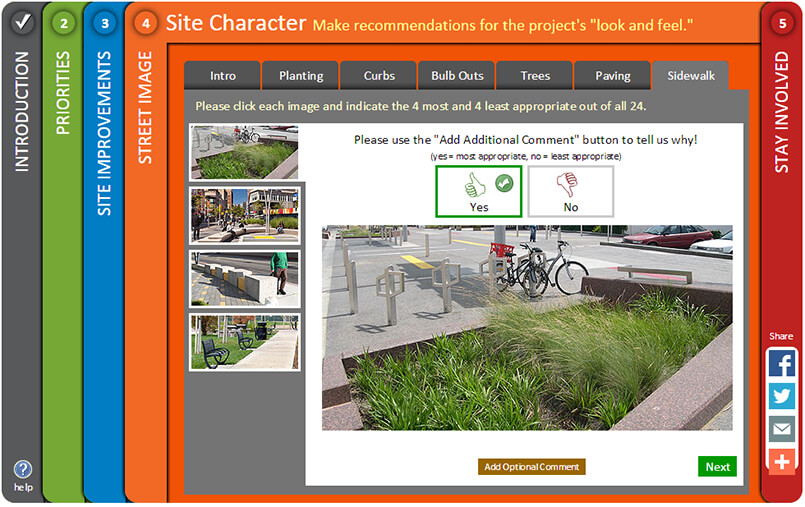
    It’s true that much of the accessibility guidelines focus on people living with disabilities, so naturally that’s a great place to start. The movement toward online engagement tools has meant that the discussion has become focused on web accessibility standards. Online accessibly introduces a critical fork in the road. Best practices in online engagement lead us toward highly visual and interactive elements that can be awkward to deal with using screen readers and other assistive technology. Engaging the public using visual preference surveys, allowing people to place comments on an interactive map, or offering fun and interactive interfaces like drag and drop coin allocation screens are some of the many elements that make online engagement software tools popular and effective. These tools are visually appealing and fast for users. They also allow planners to better inform planning projects by quickly collecting a vast amount of public input.

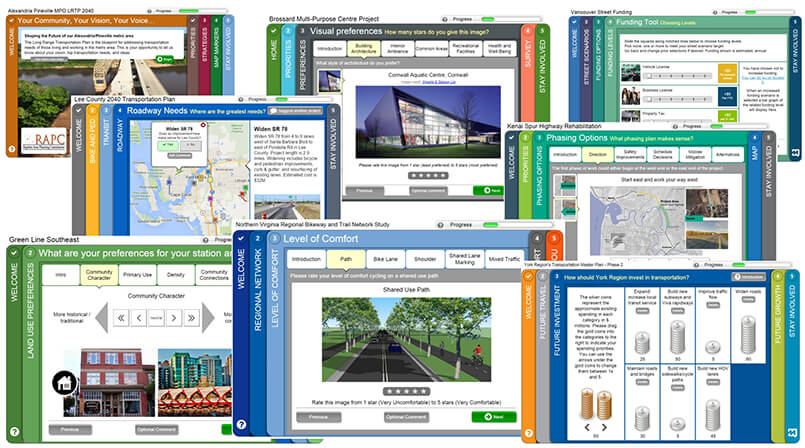
    Collection of MetroQuest screen types.
    Visual and interactive online tools like MetroQuest are a growing part of the community engagement toolkit.

    These same elements present a challenging test when it comes to the web accessibility criteria. While it’s easy to ensure that fonts are large enough for those with less than perfect vision and colors are not used in a way that put people with color blindness at a disadvantage, providing a workaround for people using screen readers to place comments on a map is a bigger challenge. It’s true that even visually rich and interactive online engagement tools can technically meet the requirements by, for example, including text descriptions of images and other screen reader accessible options. It’s also naïve to think that these options are equivalent to the experience provided to those without special needs. Furthermore, depending on the needs of both the project and community members, they may not even be the best alternatives for those with visual disabilities.

    From May to July 2015 we conducted a review of case studies of planning projects using online engagement as a significant source of community input. The review compared the results of the online engagement processes to look for patterns and identify best practices. So what did we learn about these kinds of interactive elements? Should interactive elements be avoided? Based on the case studies we examined, certainly not. In fact, many of the most successful projects attribute much of their success to these visual and interactive features. The leading planning and engagement experts recognize that not every tool in their toolkit will necessarily meet the most stringent online accessibility standards. That said, they know, and have demonstrated, that to optimize overall engagement results, they need a strategy that provides options for all people to participate. And that may include a mix of technologies and approaches, even if some of the visually rich online tools don’t meet certain web standards for accessibility. Here an analogy may help. The entrance to our office building has both a ramp and stairs. To accommodate the needs of people on wheels, the architects didn’t remove the stairs. They added a ramp. No one approach is going to be best for everyone. It’s about a variety of options to meet a diversity of needs.

    Ashley Ver Burg from HDR in Minnesota deals with accessibility issues head on as she seeks to create the most effective digital engagement strategies for her clients. In a telephone interview we conducted in February 2016 she put it this way:

    “When we pull together a digital engagement strategy, we start with accessibility. We strive for design that doesn’t impede accessibility and accessibility that doesn’t impede design. Visual elements are essential to making information easier to understand. This is the foundation of accessibility. The reality is that we often need to use multiple tools to reach different audiences.”

    Naturally, people with visual difficulties have every right to participate, and practical options for them must be part of every engagement plan. Indeed, planning agencies can benefit greatly from the insights provided by people with special needs. In reviewing leading case studies, the best practices that emerge look beyond the minimum requirement spelled out in legislation, toward a goal of providing a range of options that allow people to select the one that best meets their needs. For some people, providing a parallel screen reader accessible site is an attractive option for online access. For those with visual difficulties who choose not to use screen readers or those who would appreciate a more personal experience, providing an opportunity for people to speak to someone by phone or attend a session in their community may be better options. A wide range of choices will serve your community better and will open up the opportunity to participate to a broader audience.

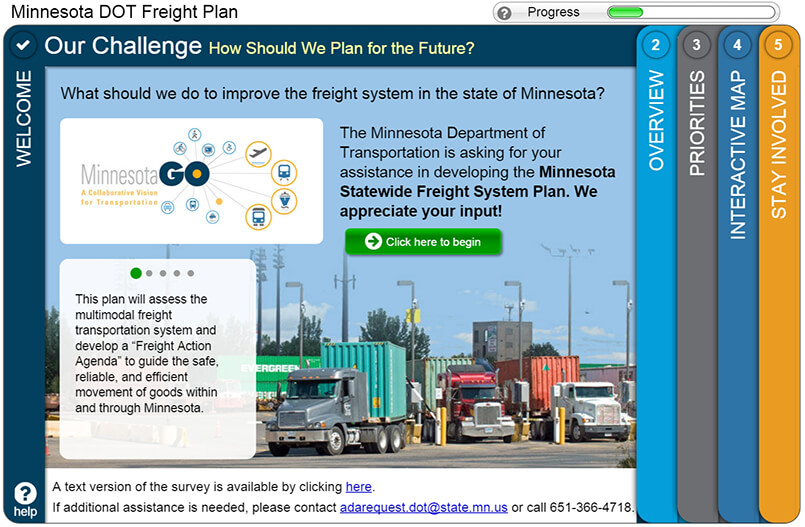
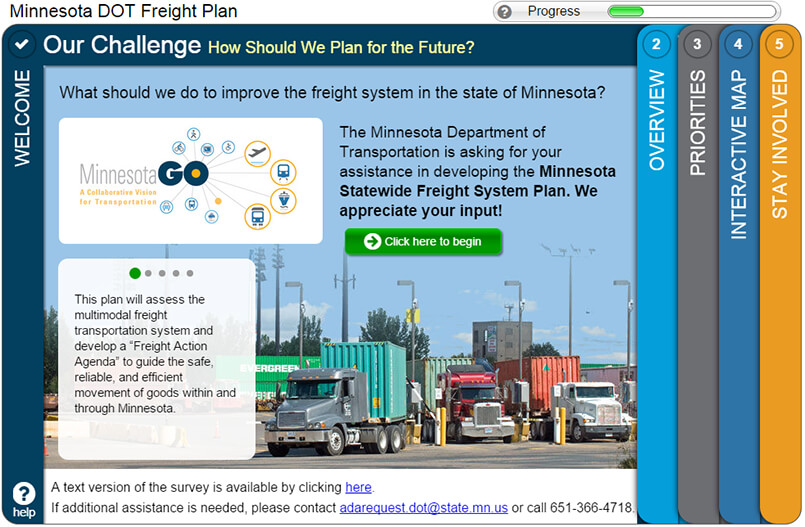
    Minn DOT MetroQuest online public involvement survey
    MinnDOT provides variety of options front and center to accommodate various needs.

    Let’s Broaden the Dialog about Accessibility

    Thinking more broadly about accessibility leads us to consider a wider range of factors that could hamper people’s ability to participate. Looking beyond the ADA guidelines, the environmental justice regulations in the United States call for the “meaningful involvement of all people regardless of race, color, national origin, or income.” While environmental justice applies specifically to environmental laws, regulations, and policies, Title VI applies more broadly to Civil Rights and addresses similar demographic groups.

    Groups that have been traditionally underrepresented in public participation activities for planning projects include youth, people with less formal education, residents who are new to the community and may not have social networks to learn about initiatives, and, perhaps most significantly in terms of numbers, people whose busy schedules or responsibilities limit their ability to get involved.

    Each of these groups present unique but in most cases, manageable challenges. In some cases, online engagement can be an important part of the solution. It can provide an opportunity to engage people with busy schedules quickly and conveniently and when done well, can benefit from the viral nature of social media. Online engagement can be offered in multiple languages and by leveraging visuals and minimizing text it can accommodate people of various national origins and reading comfort levels.

    In other cases, a mix of other community engagement tactics is needed such as:

    • Pop-up engagement events allowing planners to target specific communities,
    • Add-on events allowing planners to engage a specific group as a part another group’s event,
    • Touch-screen kiosks in community centers for participants to “stumble on,”
    • Mobile-friendly engagement options for smartphone and SMS users, and, yes,
    • Public workshops and open houses for people who prefer a face to face opportunity to speak with planners and neighbors about the issues.
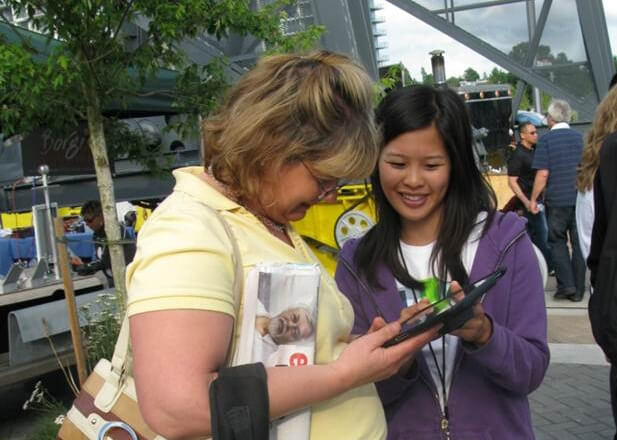
    Women completing public engagement online survey.
    Pop-up engagement with iPads for one-on-one assistance.

    The best projects we examined used a wide variety of engagement and promotional strategies to reach a broad audience. Many planners and engagement experts also commented that while it’s best to plan a multi-pronged engagement strategy at the outset of a project, it’s also very difficult to know precisely who will respond to each option. By collecting demographic information from participants, planners can monitor the reach of their community engagement and adjust tactics accordingly. Leaving room for creativity and fine tuning midway into the engagement period also appears to be emerging as a best practice. Ashley Ver Burg confirmed these findings:

    “We need to consider all audiences. That’s why we are now routinely using demographic data of project participants to inform and update public involvement strategies. Not every meeting, event, workplace, social media platform, or email list will reach the same audience. It’s important to develop a strategy—and continuously update that strategy—based on data.”

    To borrow an old line, “different strokes for different folks.” Based on our dialog with planners and engagement experts, the time might be right to widen the definition of accessibility based on a more inclusive and nuanced understanding of the varied needs of our community members.

    This article was published in Planetizen here. 

  • [WEBINAR] Best Practices for Online Public Engagement for DOTs

    [WEBINAR] Best Practices for Online Public Engagement for DOTs

    This 41-minute video presents a series of case studies, best practices and tips to guide DOT’s towards the successful application of online public engagement for a variety of projects. Award-winning LRTP, STIP, TIP, NEPA, EIS, corridor, highway, transit, TOD and participatory budgeting projects that successfully leveraged innovative digital engagement are presented. From crowdsourcing platforms to interactive surveys to social media, the latest fleet of online engagement tools are making it so easy and fun to participate that they are drawing in thousands of participants and collecting constructive public input to inform and support DOT projects across the country. This session outlines best practices gathered based on hundreds of project case studies.

    Watch Recording

    View Slides

    Q&A

    Below are some of the questions that were asked during the Q&A session at the end of the live webinar.

    Q: Without a registration process, how do we avoid people participating 100 times and skewing the results?
    A: [Responded to in the webinar] Planning processes can be controversial and abuse is always a possibility. With MetroQuest we have tools and techniques to identify and help mitigate ballot stuffing in order to protect the integrity of the results. Any attempts at abuse are easily recognized and nullified.

    Q: Do you think your findings are equally applicable to projects other than ground transportation. e.g., water use planning, watershed management, etc…?
    A: Yes. In our review we also looked at water use plans, storm water management, environmental plans, etc. The lessons equally applied to those projects however they often had the additional challenge of dealing with a subject matter that was not top of mind for the public. I spoke at the American Public Works Association conference last year about Online Engagement for this sector and referenced a MetroQuest project that engaged over 10,000 participants in stormwater management for a public utility. They said they had never seen such high participation in a project like that. I think in that case the entire project team did a great job making the topic accessible and interesting.

    Q: What is the process for setting up MetroQuest for a project?
    A: [Responded to in the webinar] Here is an excerpt from our “Public Involvement Software User Guide”. The MetroQuest team provides much more than software. Think of us as your trusted project partner with over 18 years of experience with digital engagement. We take care of setting up the software to meet the specific needs and goals of your project. We also guide you along the way to ensure the best results. The MetroQuest team works collaboratively with you and your team to determine the 4 or 5 screens that will best meet the needs of your project. We then use your content (pictures, phrases, branding, color schemes, maps, etc) to set up the MetroQuest screens. MetroQuest comes configured for mobile, tablet and desktop platforms so no matter how your participants wish to engage, we’ll make sure that their experience is delightful. Once MetroQuest is launched it’s time for your team to actively promote and monitor participation. We’ll back you up with great advice about how to maximize participation and even target particular demographic groups to ensure broad representation of your community. Download the guide here.

    Q: What tactic works best with communities of color? how do you engage EJ when they are less likely to have internet at home?
    A: [Responded to in the webinar] This is a big topic and I suggest you read our 8 tips to reach targeted communities here.

    Q: How does MQ get beyond the “vote” concept? Setting the expectation that the alternative or concept with the most points “wins”? Decisions are made on a variety of factors, so having an expectation that something will be selected based only on public opinion may backfire on the client.
    A: I totally agree and I realize in my presentation I used the word “vote.” We would not suggest using that word in the public interface for the reasons you cite. I think it’s critical to set expectations for how the public input will be used and not over promise. Great point. Thank you.

    Q: How are sites made ADA accessible?
    A: Thanks for reminding me. I meant to point this out when I was showing the Minnesota Freight Plan example. Because of the visual and interactive nature of the tool, some people (such as those with vision impairment) will need an alternative way to participate. This can be easily handled in a variety of ways. In the case of the Minnesota Freight Plan, you’ll see an option to participate in a text only survey as well as contact information for additional assistance.

    Q: Do citizens also have a way to rate the planning process or event itself? Clarity is in the mind of the citizen, not the presenter.
    A: [Responded to in the webinar] Yes we often have often have evaluation questions at the end of the online engagement experience and have used those responses to monitor how we are doing and improve the tool. This kind of honest feedback is extremely useful. Most of the responses are very positive. It’s clear that there is a pent up desire to have an easy and fast way to participate and that online tools are fulfilling that need. The critical responses are helpful as they give us clues as to what we can do to continually improve.

  • [WEBINAR] Getting the Most Out of Online Engagement

    [WEBINAR] Getting the Most Out of Online Engagement

    This webinar presents an overview of the MetroQuest Public Involvement Software to help both new and existing users get the best results from their online community engagement. The video covers the latest features, screen types, best practices and tips on everything from planning and promoting your site to analyzing and reporting the results. You’ll learn about award-winning case studies that successfully leveraged MetroQuest in innovative ways to engage thousands, collect informed input and build community support for their projects.

    Watch Recording

    View Slides