Category: Transit

  • [WEBINAR] Best Practices for Online Public Engagement for Transit Agencies

    [WEBINAR] Best Practices for Online Public Engagement for Transit Agencies

    This highly visual webinar presents a series of best practices, tips and case studies to guide transit agencies towards the successful application of online public engagement for a variety of projects. You’ll learn about award-winning LRTP, Mobility Plans, Station Plans, NEPA/EIS, Corridor Studies, Transit Master Plans, TOD and participatory budgeting projects that successfully leveraged innovative digital engagement.

    Watch Recording

    View Slides

    Q&A

    Below are the comments and questions from participants that were received during the Q&A session.

    Q: What if the comments from the community are not financially feasible?
    A: We often include financial constraints into MetroQuest for this very reason. People can come in with very unrealistic expectations and it is very useful to present real constraints into the engagement process to ensure that the participants are learning about these limitations and providing informed input. Take a look at some of the projects here. As one example, this project in Vancouver, Washington is clever. They ask people to choose a level of investment on screen 2 and then require them to raise enough funds to balance the budget on screen 4.

    Q: How can we get maximum involvement with the minimum budget?
    A: In general using some sort of online community engagement is more cost effective on a per participant basis compared with any of the face to face options. For online tools, I’d suggest looking at survey tools over crowdsourcing tools since they attract more participants. As far as online survey tools go, if you are focused on maximizing public involvement, MetroQuest currently has no peer, especially for transportation agencies. Since your goal is maximum involvement I would not suggest using a simple multiple choice survey tool. They simply don’t draw in participants in large numbers and likely won’t meet your goals. If you don’t have a great deal of budget and wish to conduct several projects per year you might be best off looking at an annual subscription which will allow you to keep your per project costs low while still taking advantage of results that you get with MetroQuest.

    Q: Will the slides be available?
    A: Yes indeed. They are posted here. I’m glad you found the material interesting.

    Q: How much should one budget for the kinds of projects that were demonstrated?
    A: We have recently started offering “all you can engage” annual subscriptions so many agencies are now using MetroQuest on multiple projects with no additional cost per project. That makes it a little more difficult to cite a specific per project fee. For agencies that use MetroQuest on a single project typically $12,000 is a reasonable budget number to have in mind. The precise fee depends on the scope of your project so it’s best to have a contact us for a quick chat about what you’d like to accomplish.

    Q: What other software options are out there that are similar to MetroQuest
    A: There are lots of tools but they are all very different than MetroQuest. We have found that it’s best to define the goals and needs of the project and then seek out a software solution to meet those needs. There are no other tools that we are aware of that are as well-suited to transit planning as MetroQuest (e.g. that have the visual and interactive features that planners look for, educate participants about choices and tradeoffs, are designed to be fast and fun to use, etc). There are however several other online survey software options available such as SurveyMonkey. These tools offer basic survey functionality such as multiple choice questions so it’s unfair to compare them with MetroQuest that is specifically designed with the needs and goals of transportation agencies in mind. We have found that on average MetroQuest engages 7.5 times more participants compared with a simple multiple choice survey due primarily to its popularity among participants. I hope it is helpful.

    Q: How can the needs of visually-disabled be accommodated?
    A: There are several great ways to accommodate people with visual-impairment without compromising the appeal of the tool for other participants. This is a very important topic and MetroQuest is leading the charge to expand the accessibility of online tools. I have recently written a blog post on this topic for Planetizen magazine. Check back on our blog for a link to it. It should be released shortly.

    Q: What role does door to door play?
    A: Door to door is generally a last resort of most engagement plans primarily because it is so labor intensive. It can be a useful strategy for very localized projects such as station area plans but even for these plans, broader community involvement is often useful since people interested in station design could live and work in a much broader area.

    Q: Do we work with rural clients?
    A: Yes, indeed. Many rural areas have difficulties with face to face engagement due to the spread out nature of the population. With the increase in online shopping and social media, online participation among rural residents has been rising rapidly.

    Thanks again for your interest and participation in this webinar.

  • [CONFERENCE] Boosting Staff Enthusiasm with Stories

    [CONFERENCE] Boosting Staff Enthusiasm with Stories

    It all came together for me at the Rail~Volution conference in Minneapolis. Is your organization like ours with a select few traveling the world collecting and sharing stories about your work while the rest of the staff remain at home relatively isolated?

    I travel and collect stories. I find that they recharge my batteries and reinforce my sense of purpose. What I realized that day in Minneapolis is that the employees back at home are missing that texture and relevance and the cost was greater than I had realized. I know they work with MetroQuest for many of the same reasons I do. I wondered what I could do to help them see the impact of their work. This post is the start of that effort.

    That fall day in Minneapolis, I was in the midst of my traditional fall speaking tour. From conference to conference, I was collecting and sharing stories about the impact that MetroQuest clients are having “out there” in the real world. A few weeks earlier, I was at the American Planning Association conference in Florida and, as usual, there were great stories being shared.

    First off was the Dover, Kohl & Partners’ team accepting the Best Practices award for the Seven50 project. This regional visioning process, which used MetroQuest for its online engagement, was also featured earlier in 2014 at the National APA conference in Atlanta during the session titled, “Online Engagement in Planning.” Among other triumphs, this project had a public outreach that exceeded one million people!

    When I asked the Dover Kohl team to pose for a photo with their award, they generously insisted that I be in the photo with them. They said that our team’s contributions were integral to the success of the project. A proud moment for MetroQuest!


    The next compelling story came from Ray Chiaramonte, Executive Director of the Hillsborough Metropolitan Planning Organization in Tampa, who received the award for Lifetime Achievement. The award came on an auspicious day: it was the last day for public input for his hugely successful swan song project, Imagine 2040, a regional visioningprocess for greater Tampa. It was the conversation that I had with Ray after the award ceremony which touched me most.

    He told me that, with his retirement coming up quickly, he felt both urgency and a kind of fearlessness. With urban sprawl and traffic congestion at critical levels in the Tampa region, he was driven to use Imagine 2040 to create a lasting legacy for positive change. In designing the project, Ray was looking for a way to engage the general public in large numbers in a meaningful way. He talked about his faith in the wisdom of the public.

    Ray said, “I believe that if you give the public good information about the tradeoffs associated with different planning alternatives, they will make smart choices every time. When I saw MetroQuest I knew it was the right tool for us. MetroQuest is easy to use and visually appealing while also providing the information that people needed to make informed choices.

    “With MetroQuest, we engaged over 5,000 residents and collected a wealth of valuable input from a broad demographic. In the end over 80% voted for the most compact and transit-oriented future knowing full well that along with the benefits come trade-offs. That’s a very powerful result!”

    Ray’s award was followed by the announcement that Melissa Zornitta, Assistant Director of Hillsborough MPO, would become the new President of APA Florida. She spoke with passion and pride about Imagine 2040 and walked attendees through their innovative public involvement process and how they leveraged MetroQuest to go beyond the usual suspects in their session called, “A New Track to 2040.”

    Three parts of this story touched me: Ray’s pride for the success of his swan song project, Melissa’s enthusiasm in sharing their success with online engagement, and the new future vision that will guide Tampa for decades to come.

    The rest of the APA Conference in Jacksonville was more of the same. From there I went on to California and collected more stories. To wrap up September, I stopped to do a presentation at the Rail~Volution transit conference in Minneapolis.

    The last session was a great keynote by Hannah Ubl, who is a Generational Expert from BridgeWorks. She talked about strategies for engaging people of different demographics. It was her run down of Millennials and Gen Xers that interested me most as many of our awesome staff fall into these groups. She highlighted how important the purpose of their work is for people in these age groups. They are driven by their values and are most motivated when they see the greater purpose of their efforts being achieved.

    The light went on. They need to hear these stories. They need to see the positive effect that their work is having on cities and towns around North America. I was making the mistake of saving those stories for our marketing. I realize now how important it is for those stories to be brought home.

    It’s stories like this that are the “why” that drives me. I’m thrilled that they are coming in more and more frequently and I pledge to do a better job sharing them with the team at home. To the MetroQuest team: this one’s for you!

  • [INSIGHTS] Public Engagement Pioneer Speaks in Vancouver

    [INSIGHTS] Public Engagement Pioneer Speaks in Vancouver

    It was great fun to reconnect last week with friend, mentor and collaborator Dr. Carolyn Lukensmeyer at Simon Fraser University’s Centre for Dialogue.

    For those who don’t know her, Dr. Lukensmeyer is the Executive Director of the National Institute for Civil Discourse and founder of America Speaks. As one of the foremost citizen engagement practitioners in North America, she has gathered public input on issues ranging from the redevelopment of the World Trade Center after 9/11 to the rebuilding of New Orleans following Hurricane Katrina. Carolyn is a true inspiration and a pioneer in the field of public engagement.

    I was honored to be asked to help facilitate an America Speaks event in September 2008 called “Equal Voice for America’s Families Campaign” that brought together 12,000 participants in one session spread across three cities (Los Angeles, CA, Chicago, IL, and Birmingham, AL) all connected by simulcast. It was a thrill and the lessons I learned preparing for and facilitating that event have stuck with me to this day.

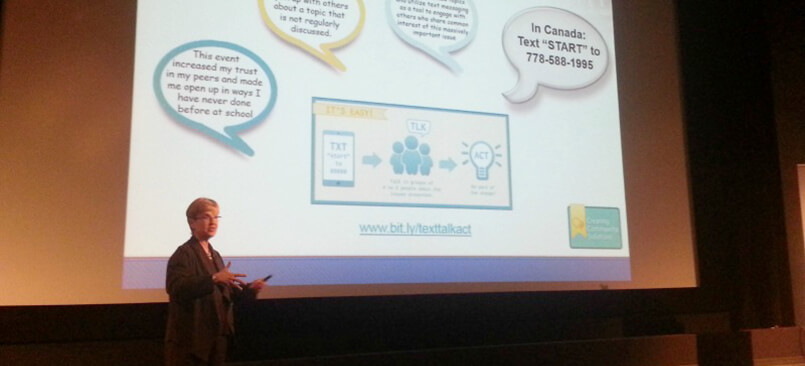
    The day-long workshop at SFU last week brought together a who’s who of public participation on the west coast including leading academics from SFU and UBC, municipal and regional government agency representatives, and public involvement practitioners from a diverse array of sectors. Carolyn gave an inspiring talk that highlighted her work with America Speaks as well as more recent initiatives leveraging texting and other forms of digital engagement.

    Some of the initiatives she spoke about were: Creating Community Solutions as part of the U.S. National Dialogue on Mental Health; the Washington D.C. Citizen Summit on municipal planning and budgeting; and, Listening to the City, the redevelopment of Lower Manhattan after the September 11 terrorist attacks.

    The interactive session was, not surprisingly, a dialog and will produce a document of findings on key questions around how we need to act to develop infrastructure to support deeper and more meaningful democratic processes in decision making in BC. The discussion focused on three topic areas: mental health, transportation and urban design.