Month: October 2018

  • [INSIGHTS] Are You Getting Spooked by Public Engagement?

    [INSIGHTS] Are You Getting Spooked by Public Engagement?

    If you feel like you’re facing increasing tensions in your public engagement processes, you’re not alone. Across the country the climate of public discourse has been shifting dramatically. It’s getting spooky out there.

    Planners and public engagement practitioners working for government agencies increasingly find themselves on the front lines of highly polarized debates.

    Are you feeling scared? The good news is there are proven ways to detoxify public engagement, but first, it’s important to understand why contention is on the rise.

    Public discourse in recent years has shifted dramatically for reasons that include:

    • The biasing and organizational impacts of social media,
    • The growing divide between income groups,
    • The polarizing political tensions, and
    • The dehumanization of the opposition.

    While all these trends can play a significant role (and there are undoubtedly others), perhaps the most dramatic has been the influence of social media on public opinion and the mobilization of opposition. We have reached a point where even the CEO’s of social media firms are admitting responsibility. Mark Zuckerberg, CEO of Facebook, this year announced measures to address his firm’s role in the poisoning of democracy.

    News clipping saying: Facebook admits it might be poisoning democracy

    Imagine if ten years ago … you were told that by 2018 the majority of news and information would be curated specifically for people based on their current views and interests and that conflicting information would be made more difficult to find. Creepy!

    This process of curation – which describes your Facebook news feed, your customized search engine results, and other social media streams – is driven in part by a desire to keep your attention and thus, in crude terms, expose you to more advertising. It’s well-known that people tend to navigate away more frequently if exposed to conflicting information.

    The polarizing effect of this curation is only one part of social media’s influence on public discourse. Social media has also provided us with easy access to tools to mobilize like-minded people to influence almost any cause or project. That’s terrifying.

    Things are heating up in the public arena, and yes, we can certainly see the contributing effects of social media.

    The new eBook – Facing Contention: 21 Tips to Detox Public Engagement – highlights key success factors and 21 proven tips that public engagement and planning professionals are using to mitigate some of these tensions and conduct constructive and positive outreach. It’s time to put the ghosts back in the closet.

  • [WEBINAR] 10 Tips for Successful Online Engagement Every Time

    [WEBINAR] 10 Tips for Successful Online Engagement Every Time

    Transportation agencies of all kinds, from DOTs to MPOs and transit agencies, face many challenges when it comes to public involvement. This new webinar recording showcases three case studies that together create a framework for successful online community engagement that can be easily followed by others.

    You’ll learn about a creative county, an innovative MPO, and a leading transportation planning firm who collaborated to engage 12,000 residents on three transportation projects. Join Amy Elmore from Pasco County, Johnny Wong from Hillsborough MPO, and Jim Meyer from AECOM as they share proven tips for effective online public involvement. Here’s a sneak peek at some of the key tips highlighted in the webinar.

    1. Start online public involvement early.

    The three case studies effectively demonstrate the benefits of beginning your community engagement as early as possible, well before key decisions have been made. They discuss the types of survey questions best suited for early engagement to uncover key community priorities and issues.

    2. Engage the community in phases.

    The presenters demonstrate how early community engagement results were used to inform and support a second phase of online engagement to allow planners to hone in on a specific recommendations based on initial community priorities. Engaging in phases ensures that the final plan will meet community needs.

    3. Ask survey questions to uncover public priorities.

    The webinar dives into the types of survey questions that are most appropriate for collecting the most actionable public input possible to inform a planning project. In particular, the value of priority ranking questions is highlighted as it generates valuable data that can inform policy directions for both the current planning process as well as subsequent initiatives.

    4. Promote via multiple channels to boost public participation.

    The webinar presenters shared a wide range of valuable tips on how to promote online community engagement surveys, including innovative Facebook campaigns and a wide range of other online and traditional channels for maximum reach. These strategies reveal how underrepresented populations can be effectively targeted to ensure broad outreach.

    5. Monitor online community engagement results and retarget.

    Closely related to multi-channel promotions, the case studies demonstrate how early public engagement results can be monitored to identify possible gaps so that subsequent public outreach efforts can focus on filling in any missing segments of the community.

    Watch the on-demand webinar today for five additional tips! Over 800 planners and public participation professionals registered for this popular webinar. If you missed it, you can still explore these exceptional case studies to learn how outstanding community engagement results are possible on every project. This on-demand webinar will help guide agencies to engage thousands of people online and collect real, actionable community input to support their plans.

  • [SUCCESS] MaineDOT Launches MetroQuest Survey for Its 2050 Long Range Transportation Plan

    [SUCCESS] MaineDOT Launches MetroQuest Survey for Its 2050 Long Range Transportation Plan

    We’re excited to celebrate the launch of a new MetroQuest Site! The Maine Department of Transportation (DOT) is inviting residents to provide public input for the State’s Long Range Transportation Plan Update.

    The results from this survey will help shape the future of transportation across Maine through to 2050, with a focus on providing the safest and most reliable transportation system possible.

    Maine, not unlike the rest of the United States, is experiencing several issues affecting transportation. Public input from this survey will provide guidance and insight on the strategies needed to achieve MaineDOT’s transportation goals by supporting a data-driven approach to address the many challenges facing the State over the next 20-30 years.

    Let’s take a look inside their MetroQuest Site!

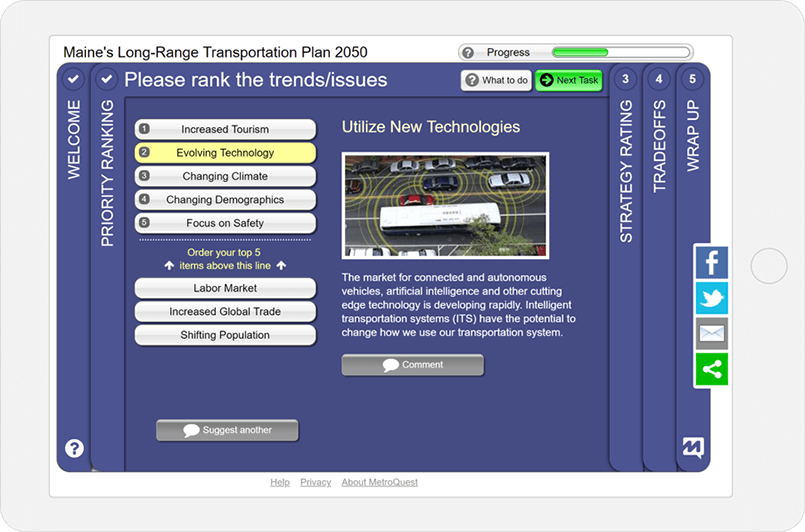
    The online public survey was designed around the 8 key trends that MaineDOT anticipates will impact transportation in upcoming years: the aging population, labor markets, global trade, urbanization, tourism, technology, safety, and climate. Residents of Maine are being asked to comment on these issues and to rank the top 5 most influential trends.

    The issues selected by survey participants here determine what questions each participant is asked on the following MetroQuest Screen, creating an individualized survey experience that’s customized to each participant’s interests and priorities.

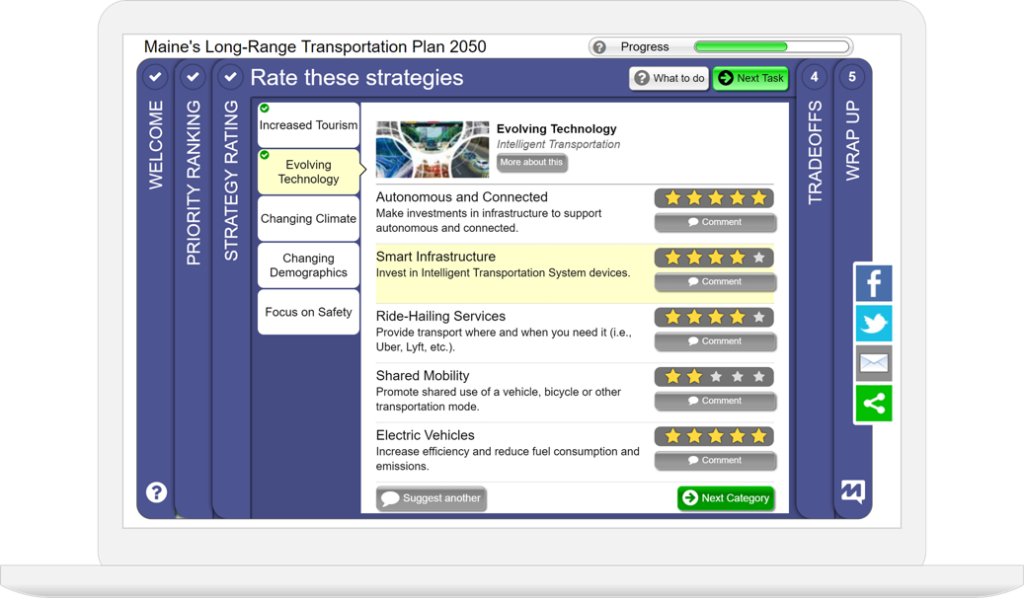
    MaineDOT chose the Strategy Rating Screen to allow residents to rate how effective they feel various strategies could be in dealing with the trends they prioritized. For example, if they ranked “Evolving Technology” as an important trend, they are able to rate 5 different potential ways to make transportation more intelligent, including autonomous vehicles, smart infrastructure, ride-hailing, shared mobility, and electric vehicles.

    The data collected with the Strategy Rating Screen will help MaineDOT make the right transportation investments in areas that the public supports.

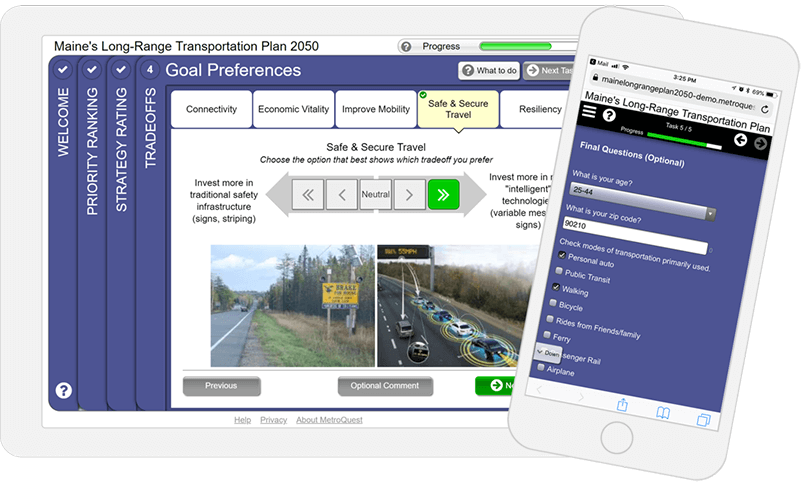
    As all planners know too well, transportation budgets are finite, so it’s important for residents to understand that investments in certain areas will affect fund availability for other projects. MaineDOT chose the Tradeoff Screen next to educate residents about their options. Participants must decide, for example, between improving safety and signage or investing in new intelligent technologies to make travel more safe and secure.

    Participants are providing more informed input on the issues while gaining a better appreciation of the limitations to their decisions … there may not be budget or time for every possible solution.

    Demographic questions are presented at the end (rather than at the start) of the survey experience, when participants are most invested and therefore most likely to provide personal information. With data about the geolocation of residents (via zip codes) and their current transportation behavior, MaineDOT will have the information needed to best address the needs and preferences of different communities.

    MaineDOT anticipates the final plan to be complete late this fall. We’re eager to see how the actionable results from this public involvement effort will help shape their next LRTP!

    Do you want to experience this online survey firsthand? You can explore the sample survey here (note that no data will be submitted by using this demo version): https://mainelongrangeplan2050-demo.metroquest.com/