In the last 18 months, the world has become more virtual than ever, and the workplace is no exception. In fact, it may be the place most notably affected by the online-only trend. Working from home has become the norm and many have adjusted to digital meetings and attending events virtually.
While there are a great number of benefits to virtual conferences, such as networking or gaining insight and inspiration from the comfort of your home and saving time and money, there are also a number of potential stumbling blocks that any virtual activity brings. Many of us have experienced the challenges of home distractions or are experiencing “screen fatigue”.
Given that virtual engagement is MetroQuest’s bread and butter, we are very excited to be teaming up with the APA and NCDD to host our first-ever virtual conference on September 28th: Conference on Virtual Public Engagement for Transportation Planning (#VPET21)! To ensure you receive the maximum benefit from our conference, I have put together a quick guide with 5 tips to help you make the most of #VPET21. Let’s get started…
Things to keep in mind before the virtual conference:
Tip #1: Prepare ahead
Before the event, be sure to familiarize yourself with the platform, review the schedule to prioritize the sessions you are particularly interested in and double check your technology works to ensure you are set up for success!
Take the chance to review the conference website to see if there are sessions or keynotes you definitely don’t want to miss.
During the conference:
Tip #2: Minimize distractions
Find a quiet space where you will be undisturbed, block off your calendar for the day, log off your email or instant messaging and even turn your phone off if possible. Consider this a regular workday – if you need child or pet care, be sure to organize it ahead of time!
Tip #3: Participate actively
Go beyond listening; take notes, ask questions, note down any speakers you want to connect with, and participate in online polls, chats or Q&A sessions to make the most out of the sessions. Most virtual conference planners, just like public engagement practitioners, have levelled-up their virtual-engagement, so there should be plenty to keep you actively engaged!
Tip #4: Take breaks
The conference has scheduled breaks for a reason! Stretch your legs and move between sessions. Stock up on desk snacks, have your favorite beverage handy and perhaps even consider having a meal delivered to you that day!
After the conference:
Tip #5: Network and connect
Connect with other attendees or speakers who you’ve noted down during the conference to deepen your insights. In our experience, speakers are happy to hear from attendees and discuss aspects of their session in more detail, answer questions, or help provide resources.
If you’ve attended with co-workers, it can be a good idea to schedule a meeting or get-together to debrief and share your key takeaways and learnings. Everyone takes away something different, and all of it can help your team achieve virtual community engagement success.
The Planning Partnership Launched 7 MetroQuest Surveys in 2020
The Planning Partnership Ltd. (TPP), a consulting firm located in downtown Toronto, launched 7 MetroQuest surveys this year for a wide range of projects for both their public and private sector clients. The firm knows the recipe for crafting engaging online surveys to drive high levels of public participation, facilitating a collaborative approach to planning and providing decision-makers with comprehensive input to develop effective solutions for their clients.
Congratulations to TPP for launching so many effective online surveys over the last few months! Your efforts and success are a testament to the fact that great community engagement is possible with the right tools and expertise, even during a global pandemic with mandates preventing in-person public meetings.
WSP Canada Helps the City of Ottawa Make Important Transportation Decisions
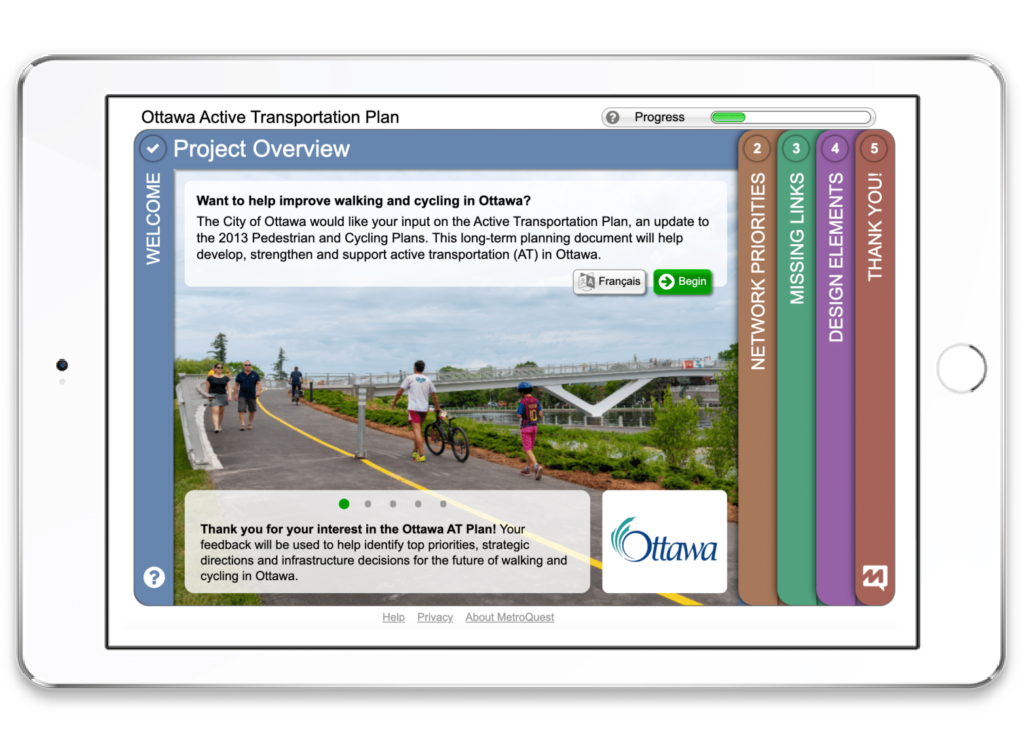
WSP Canada, one of the country’s leading professional services consulting firms, has launched several MetroQuest surveys this year! One project that specifically stood out was their work for the City of Ottawa in helping them update their Active Transportation Plan. With a MetroQuest survey, available in both English and French, the firm engaged over 1,000 participants to help Ottawa set a direction for day-to-day transportation programs and become the most livable mid-sized city in North America.
Planners at WSP Canada did an incredible job crafting the online survey to ensure participants were both well-educated and engaged about important transportation decisions. The firm was able to gather thousands of data points as a result, which helped Ottawa identify the community’s top priorities, strategic directions and infrastructure decisions for the future of walking and cycling in the City. Congratulations to both WSP Canada and the City of Ottawa! We look forward to seeing more of your incredible public engagement accomplishments in 2021.
These are just some of the incredible community engagement projects that Canadian planning firms and government agencies have led this year. If you would like to see more exceptional surveys, please feel free to reach out and let us know! We’d be happy to provide you with examples to help you get inspired for your upcoming projects. You can also explore some additional sample surveys here.
In the meantime, and on behalf of everyone at MetroQuest, I want to say congratulations to ALL Canadian planners! We hope these examples inspire you. We wish you great engagement in the upcoming months and look forward to hearing about your public engagement success in 2021.
At MetroQuest, we are consistently blown away by the exceptional community engagement results our clients report, especially this year when facilitating remote community engagement activities has essentially been the only option. We are very proud of the way government agencies and planning firms all over the nation have taken the complications of 2020 in stride!
Today, we want to take some time to highlight some of the incredible public initiatives we’ve seen over the last few months, specifically in Canada! With our company roots in the ‘neighbor to the north’, we are elated when new Canadian customers come on board and when we receive public engagement success stories from our fellow ‘Canucks’.
Join us as we explore some of the amazing planning projects our Canadian customers have led this year!
The City of West Kelowna Sets Out Their Desired Destination for the Future
To begin with, The City of West Kelowna recently crafted a number of delightful MetroQuest surveys to support #OURWK, the City’s community vision for 2040! After collecting input from thousands in the community with over 10 online surveys this year (and counting!), the City developed a preliminary vision that truly reflects the public’s vision for the future of West Kelowna.
The draft vision found on the City’s website says it wonderfully: “While we cannot predict every change that will come our way in the next 20 years – setting and sticking to a bold Community Vision gives us a powerful lens for making thoughtful decisions.” Congratulations to the City of West Kelowna for all your hard work. Your engagement efforts are inspiring, and we wish your community the best as you begin working together to make your vision for the future a reality!
LURA Consulting Engaged Over 7,400 Participants for Yonge TOmorrow
LURA Consulting, a Canadian leader in collaborative planning, consistently blows us away with their community engagement results. This year we are particularly thrilled to hear about their incredible success while working with the City of Toronto!
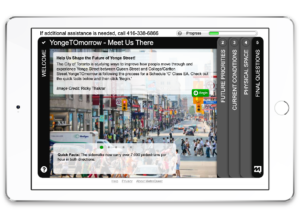
Yonge Street in the heart of downtown Toronto is consistently booming with development, construction and pedestrian traffic. In an effort to find ways to increase space and improve the area, the team at LURA launched three MetroQuest surveys for ‘Yonge TOmorrow’ and engaged over 7,400 participants over the course of the project! The City is now working to bring the public’s recommendations into fruition thanks to the firm’s hard work in successfully engaging the community. You can check out one of the three interactive online surveys from the project below. Congratulations to LURA Consulting – keep up the incredible engagement!
The Planning Partnership Launched 7 MetroQuest Surveys in 2020
The Planning Partnership Ltd. (TPP), a consulting firm located in downtown Toronto, launched 7 MetroQuest surveys this year for a wide range of projects for both their public and private sector clients. The firm knows the recipe for crafting engaging online surveys to drive high levels of public participation, facilitating a collaborative approach to planning and providing decision-makers with comprehensive input to develop effective solutions for their clients.
Congratulations to TPP for launching so many effective online surveys over the last few months! Your efforts and success are a testament to the fact that great community engagement is possible with the right tools and expertise, even during a global pandemic with mandates preventing in-person public meetings.
WSP Canada Helps the City of Ottawa Make Important Transportation Decisions
WSP Canada, one of the country’s leading professional services consulting firms, has launched several MetroQuest surveys this year! One project that specifically stood out was their work for the City of Ottawa in helping them update their Active Transportation Plan. With a MetroQuest survey, available in both English and French, the firm engaged over 1,000 participants to help Ottawa set a direction for day-to-day transportation programs and become the most livable mid-sized city in North America.
Planners at WSP Canada did an incredible job crafting the online survey to ensure participants were both well-educated and engaged about important transportation decisions. The firm was able to gather thousands of data points as a result, which helped Ottawa identify the community’s top priorities, strategic directions and infrastructure decisions for the future of walking and cycling in the City. Congratulations to both WSP Canada and the City of Ottawa! We look forward to seeing more of your incredible public engagement accomplishments in 2021.
These are just some of the incredible community engagement projects that Canadian planning firms and government agencies have led this year. If you would like to see more exceptional surveys, please feel free to reach out and let us know! We’d be happy to provide you with examples to help you get inspired for your upcoming projects. You can also explore some additional sample surveys here.
In the meantime, and on behalf of everyone at MetroQuest, I want to say congratulations to ALL Canadian planners! We hope these examples inspire you. We wish you great engagement in the upcoming months and look forward to hearing about your public engagement success in 2021.
No one planned for this pandemic. With so many urban and transportation planning projects under way for 2020, are plans still moving forward? The nationwide mandate for social distancing resulted in the cancellation of thousands of public meetings. How can agencies meet their public engagement requirements now?
The COVID-19 outbreak has raised a lot of questions. We turned to you for answers.
Using live polls and questions, we learned how you and your peers are adapting to maintain momentum. We also explored case studies, strategies, and best practices with our guest panel speakers: Stephen Stansbery from Kimley-Horn, Shane Sawyer from the Virginia Department of Transportation (VDOT), and Bob Bini from Lancaster County. Stephen, Shane, and Bob shared the techniques and tools they’re using to keep key projects moving forward over the next 18 months. Thank you for all your insights! Let’s spotlight what we learned.
YES! Most urban and transportation planning projects are moving forward, despite COVID-19.
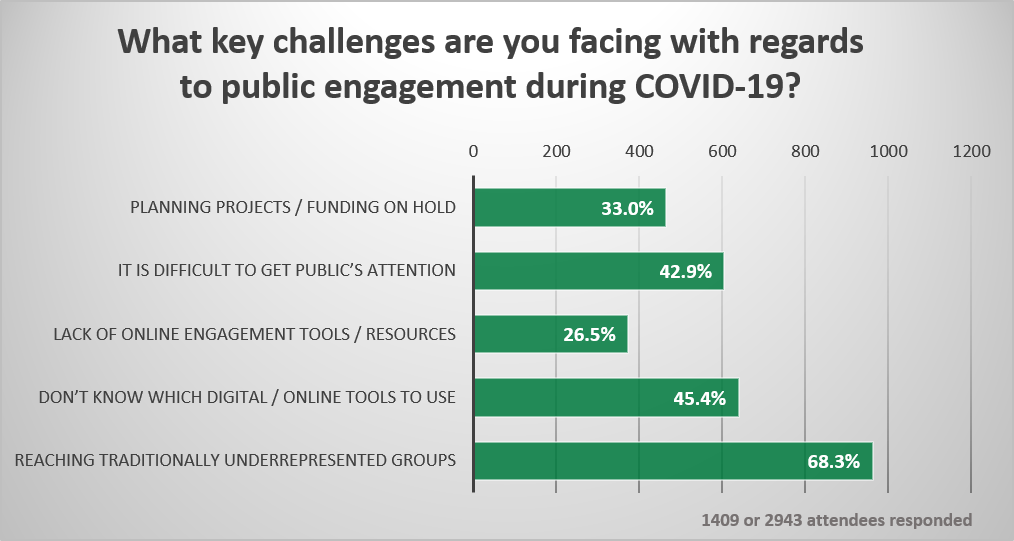
There is some disruption, with 33.0% of 1,409 poll participants noting their planning projects or funding have been put on hold. And yet, the vast majority are charging forward with public engagement.
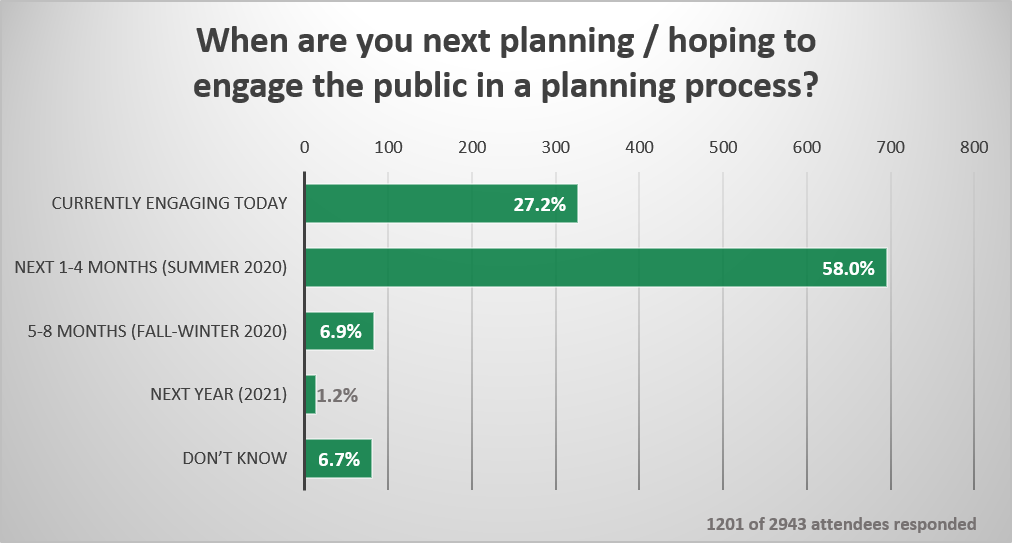
Over 1,200 planners and public participation professionals answered the poll question: “When are you next planning / hoping to engage the public in a planning process?” It was uplifting to learn that 85.2% currently are or plan to engage the public in planning over the next four months, with very few waiting for the fall.
Poll: When to Engage the Public in Planning
Bob Bini as Director for Transportation Planning for Lancaster County, Pennsylvania is among those charging forward with transportations projects aimed at improving safety and reducing congestion. While traffic may not be an issue today, Bob oversees planning activities for the Lancaster County Metropolitan Planning Organization (MPO), including the development of a new Metropolitan Transportation Plan, Connects 2040, and the management of the biennial Transportation Improvement Program. He is responsible for what will soon again be one of the most heavily traveled highway networks in Pennsylvania.
“There are key deadlines with our comprehensive plan,” noted Bob in the webinar. “So, it’s important that we keep these activities moving even through these times and we are managing to do that.”
Bob is true to his word. In his recent Connects 2040 MetroQuest survey, his team engaged 2,837 residents, capturing over 78,250 data points to better inform the Lancaster 2040 Metropolitan Transportation Plan.
With public meetings on hold, what are the most popular tools for online public engagement?
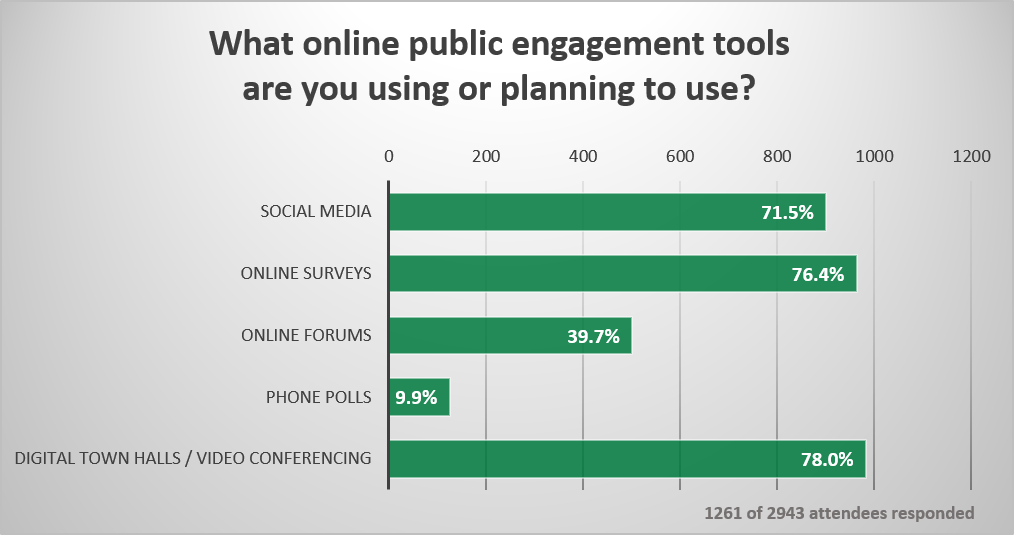
Bob isn’t holding public meetings. Neither are Shane nor Stephen. Like thousands of their peers, they turned to online tools and digital engagement to continue to involve the public in support of their projects. In a live poll, we learned that the three most popular online tools today are: (1) digital town halls held via video conferencing, (2) online surveys, and (3) social media.
Poll: What to Use When Engaging the Public in Planning
All three webinar panel speakers are seeing great success with these online tools. For instance, as Multimodal Programs Manager at the Virginia Department of Transportation, Shane Sawyer is posting meeting-like videos on his project webpages to keep the public informed – you can take a look at his Route 60 Corridor Study webpage here →
To collect public input, Shane has consistently achieved success by combining targeted social media and online surveys. While newspaper ads previously cost his department thousands of dollars followed by meager attendance at public meetings, his team is now able to use just $200 in Facebook advertising to promote its MetroQuest surveys with great results.
“We have been effectively utilizing a range of virtual public involvement techniques for planning studies,” Shane told us, including MetroQuest surveys. “Corridor studies are very limited in geographic scope, usually around two miles or so. Getting 500, 600, even some cases nearly 2,000 folks to fill out a survey has exceeded our expectations! We’ve been very impressed with online engagement.”
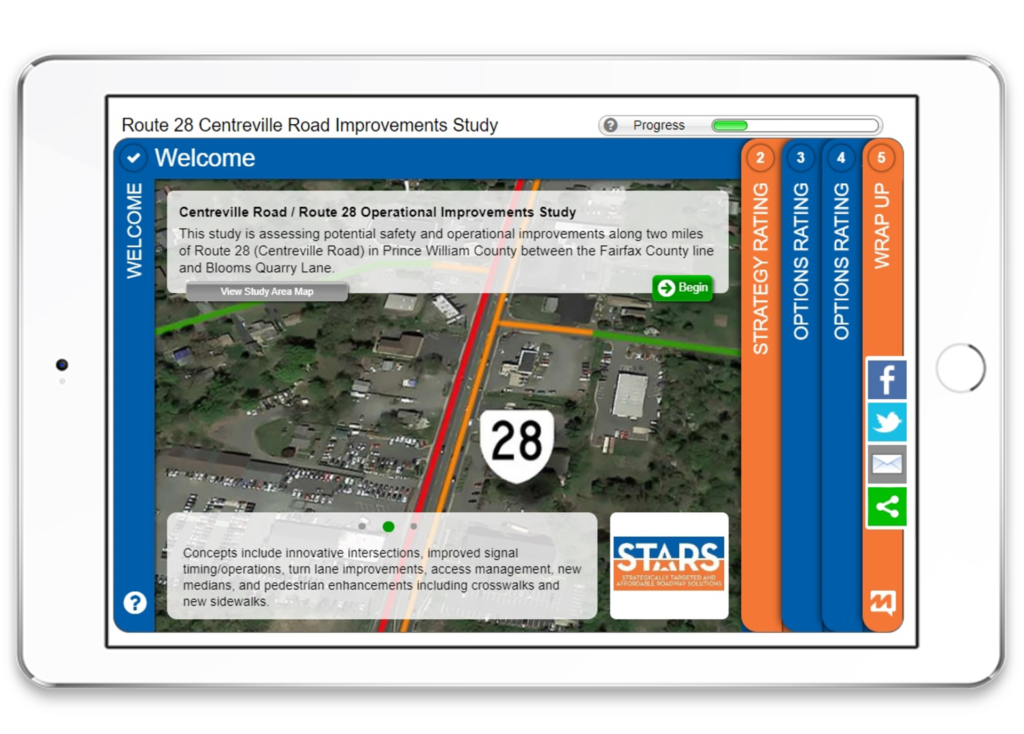
In a recent MetroQuest survey for the Route 28 Centerville Road Improvements Study, VDOT engaged 698 residents, collecting 24,091 data points and 22,513 option ratings to better inform a data-driven plan. You can try his MetroQuest survey here (no data will be collected from this demonstration-only copy).
For planners transitioning to online engagement, Shane also recommended the virtual public involvement resources made available by the Federal Highway Administration.
Building the right toolbox for online public engagement remains a challenge.
Another poll confirmed some key challenges facing 1,409 planners and public participation professionals, with 71.9% noting they either don’t have online engagement tools or don’t know which ones to use for safe, effective public engagement in planning.
Poll: Public Engagement Challenges During COVID-19
Those with a keen eye for data will have noticed in the chart above that “reaching traditionally underrepresented groups” also remains a top public engagement challenge, particularly during COVID-19. Stephen Stansbery, AICP, Vice President at Kimley-Horn & Associates offered great advice during last week’s webinar.
“In the era of geofencing and those sorts of technologies, we have the ability to zero in geographically into the specific cohorts that we want to ensure that we’re elevating,” said Stephen. “And I think one thing that we don’t want to lose sight of is the effectiveness of representative groups, whether a committee, an advisory group, or even a paid online focus group. We’ve been working with clients that have found incredible value in ensuring that we’ve got a specific set of constituencies assembled for the purposes of asking questions related to the relevancy to those traditionally underrepresented and underserved populations.”
Shane from VDOT agreed, recommending social media targeting as a solution. “I think by default you’re going to reach a larger and more diverse demographic. It can be very cost effective, and it can be targeted as well. We often use zip codes to target populations to try to reach folks who are not likely to come out to a public meeting. Social media can be very effective.”
Reimagining Public Engagement for Planning During COVID-19: A Peer-to-Peer Exchange
COVID-19 is changing the way planner and public participation professionals are engaging the public. This webinar highlights how 1,000s of your peers are managing to maintain momentum.
At MetroQuest, we know how important it is to generate robust participation for your planning projects. We know you’d like to go beyond what we fondly refer to as those “same ten people” who show up to most community events.
You’d like a much larger and broader representation of the community’s views. So what works best? Over the past 16 years we’ve focused on engaging the public in planning projects using digital tools, and we’ve seen lots of strategies. We’re also very proud of the fact that MetroQuest was at the center of many of the most successful and award-winning community engagement projects in the planning world.
Here are 8 tips for achieving viral public participation:
Remember that your primary goal in a networked world is to create something that people want to share with friends, family and colleagues. That means making sure that the experience is fun, easy, fast, compelling and relevant.
Make sure that MetroQuest is easy to share, preferably with one click. Link it to Facebook, Twitter and other social networks and let your participants spread the word for you.
Evaluate your community: Who are the thought leaders? What community groups exist? How do they communicate?
Think carefully about the “voice” of your communication to the world. What personality do you want to present to the world? How can you make it more personal and engaging?
Make sure that your site is live before public events so you can demo it and send those participants home with the site address and a request to help spread the word.
Leverage partnerships. If, together, we’ve done a good job creating a fun and meaningful experience, community groups and agency partners will be glad to help spread the word.
“Chance to win” contests work! For the price of one iPad you can boost participation dramatically.
Give your site enough time to spread throughout the community. It can take a little while for a critical mass to build up, and when it does, wow!
Our goal is the help all of our clients achieve the best participation possible! We’re always learning too. What best practices can you add?





![[TIPS] Sharing is a Golden Rule: 8 Tips for Creating Viral Engagement](https://metroquest.com/wp-content/uploads/group-of-people-at-laptop-discussing-public-engagement-strategies.jpg)